Millions of Dollars. Five Generations. And a Broken Heart.
This is the story of an Arizona rancher and a collision of conservative values.
A story is unfolding across Arizona’s open range. No headlines. No press conference.
Just a post from a man whose roots run deeper than most of us will ever know.
On one side: generational ranching, private property rights, food production, and land stewardship.
On the other: tax incentives, economic growth, energy development, and the infrastructure powering AI and data centers.
Both are rooted in the same principles of limited government, free markets, and American independence.
But in places like Arizona, they’re now on a collision course.
And for ranchers like Casey Murph in Northern Arizona, the question is whether those values still protect them… or are being used to replace them.
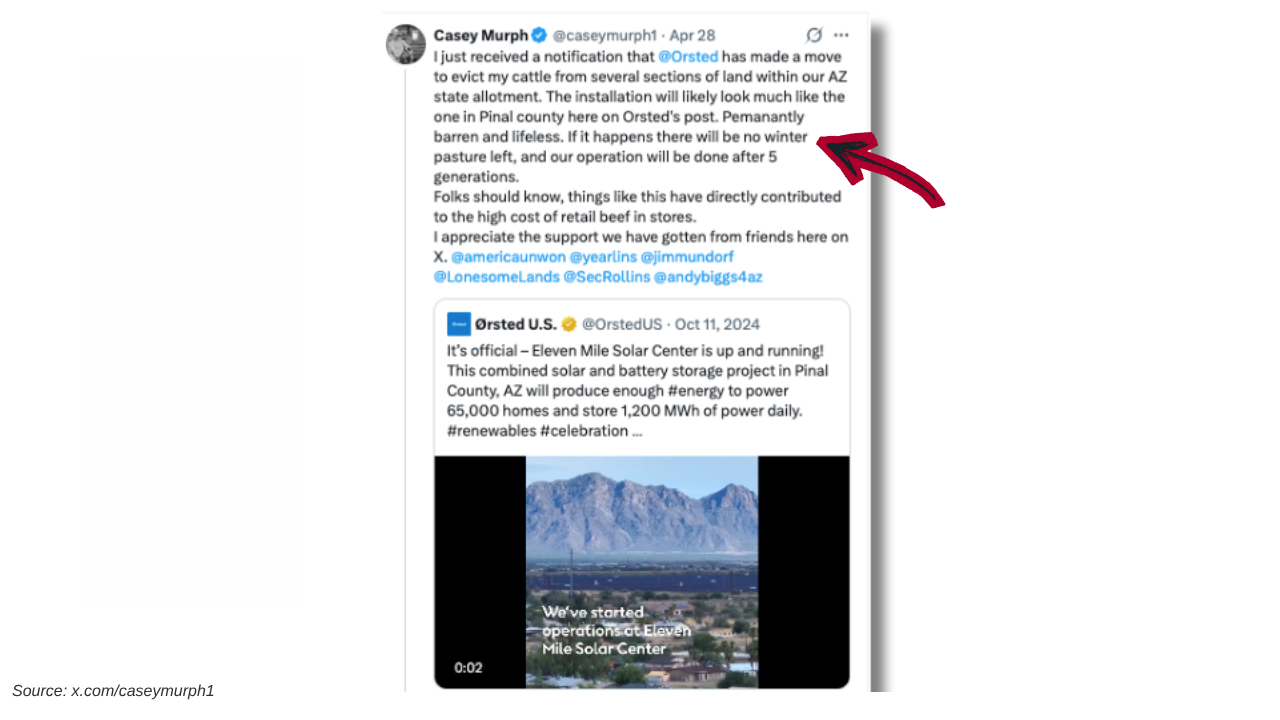
“I just received a notification…”
That’s how it started last week for Casey Murph - a fifth-generation Arizona and New Mexico rancher. A man who describes himself through the land: high desert scrub country, backcountry trails, Grand Canyon mule strings, generations of work written into dust and grass.
The message he shared wasn’t dramatic. It didn’t need to be.
He says a foreign-owned company is moving to cut sections of land from a state grazing allotment. Land his family and others have depended on for decades. Land that, once changed, won’t come back.
ENTER YANASA: “HOW IS THIS LEGAL?”
Murph’s post didn’t stay small for long.
This weekend, Yanasa Ama Ventures - a multi-media company focused on the production of Agricultural Films - amplified Murph’s story asking a question they say every Arizonan and American should be asking:
How is this legal?
“They’re not even an American company.”
In their video, a break down of what many outside the industry don’t realize. Ranchers like Murph operate on long-held grazing allotments, not large blocks of privately owned land. They argue those allotments increasingly go to the highest economic use where raising cattle to feed Americans can’t compete with large-scale solar projects that generate more revenue.
“You have to understand the math,” they say. “The rigged math that’s behind the system.”
“This is so that every single one of you that’s getting a kick out of sharing with all of your friends what you had for dinner last night can be studied, observed, analyzed, and put into an algorithm. It’s great really. The state gets more money for their schools. Corporation gets a big green PR win. Even though it’s just PR. This has never been about replacing energy. This has always been about creating more energy for the 4th industrial revolution.”
Yanasa TV Video | May 2, 2026
TRANSITION TO RENEWABLE ENERGY
Rancher Casey Morph says his notice came from Ørsted - a Denmark-based global energy company and one of the world’s largest developers of renewable energy, including wind, solar, and battery storage.
It bills itself as “a leading U.S. clean energy company.”
In 2024, Ørsted was the second-largest solar installer by capacity in the U.S. Our Mockingbird and Old 300 solar centers in Texas and our Eleven Mile Solar Center in Arizona were among the largest projects installed last year.
Ørsted Website
Its Eleven Mile Solar project is reportedly tied to Meta’s Mesa data center, with Meta securing the majority of the energy generated to power its operations.
Projects like this are often presented as part of the transition to renewable energy to meet growing demand while reducing emissions.
But not everyone sees it that way.
In testimony submitted to Navajo County, Casey Murph laid out what he says is at stake—not just for his operation, but for agriculture more broadly. He warned that large-scale solar development could displace long-standing grazing operations, remove productive land from food production for decades, and replace local, generational work with short-term construction jobs.
In an interview with UNWON’s Keely Covello, Murph questioned why large-scale solar is being built on rangeland instead of developed areas. “Why is it that we’re building these big solar installations out on rangelands and wildlife habitat when Phoenix has 500 square miles of parking lots?” he asked.
Covello responded bluntly: “You’re raising food, you’re feeding Americans—and that can’t be done on a parking lot.”
HOW RANCHING WORKS OUT HERE
To understand what’s happening, you have to understand something most people don’t see.
Ranchers don’t own every acre they depend on.
Much of the land, Murph explains, west of the 100th meridian is state or federally managed. Ranchers operate on grazing allotments - long-standing leases that, in many cases, go back generations. These aren’t short-term agreements. They’re systems families have built their livelihoods around.
Water infrastructure. Fencing. Land management. Weed control. Seasonal rotation.
Access to land. Sure.
But for Murph, it’s more than access. It’s decades of investment his family has poured into making that land usable, sustainable, and productive.
Murph says neither he nor the generations before him have taken a penny from taxpayers. What they’ve built is a working system that depends on access to grazing land tied to these allotments.
Now, roughly 3,840 acres connected to that system are at risk.
CONVENIENCE AND CASH
In an interview with Trent Loos, Murph didn’t try to soften it.
“The only thing that I can think that this is coming from is just the huge amounts of money that is involved in this,” he said. “We’re not talking a little bit of money. We’re talking millions and millions of dollars.”
IN ARIZONA AND THROUGH AMERICA
Across the American West, grazing lands are being repurposed, reclassified, or removed from long-standing use. In many cases, they’re being converted into large-scale solar developments.
To learn more about these, check out the Yanasa TV YouTube channel.
Murph says he’s encouraged by potential federal recourse, pointing to new efforts at the USDA to review claims from farmers and ranchers who believe their land or livelihoods are being unfairly targeted.
The USDA defines “agricultural lawfare” as the use of government regulations, legal actions, and policy tools—such as permitting, litigation, penalties, or eminent domain—to negatively impact farmers and ranchers, and is now collecting reports from producers who believe they’ve been affected.
GROWING NATIONAL ATTENTION
What started as a single post is now reaching far beyond Arizona.
Murph’s documentation of what’s happening on the ground is gaining attention from larger voices, including U.S. Representative Eli Crane and others engaging in the broader conversation around land use, energy policy, and rural economies.
WHAT’S REALLY AT STAKE
Murph didn’t write a policy argument.
He wrote something far more personal.
“All this has broken an old man’s heart.”
And in that line, you can hear what’s really at stake.
Not just land.
Not just policy.
But a way of life that, once lost, doesn’t come back.
Behind the Power Surge: Data Centers, Legislation, and Arizona’s Internal Divide
While Casey Murph’s concerns are gaining traction in more conservative circles, the debate over data centers in Arizona isn’t falling neatly along party lines.
Deeper divisions over priorities and policy are getting exposed.
Ranching and farming have long been backed by conservative values like private property rights, local control, and preserving generational livelihoods. But so do pro-data center arguments centered on economic growth, job creation, energy development, and competition in emerging technologies like AI.
Partisan Tension & Tradeoffs
At the Capitol, the fight is playing out through the state budget. Arizona House Democrats released a video criticizing what they call a “data centers first, Arizona last” approach, pointing to continued tax incentives for data center development while funding is reduced for programs like SNAP and AHCCCS.
As the Arizona Mirror explains; Republicans, who control both chambers, have defended the budget, arguing it returns money to taxpayers through tax cuts and supports infrastructure tied to economic growth… including the data centers powering emerging technologies like AI.
Read: Arizona’s GOP budget: Tax breaks for data centers and Roth IRAs, cuts for the people who need food Arizona Mirror
Even within the debate, acknowledgment of how long these policies have been in place.
As Arizona Rep. Nick Kupper noted on X, the data center tax credit now under scrutiny “was put back in 2013 while under the leadership of Gov. Hobbs,” suggesting the issue spans multiple administrations and political cycles.
Recent headlines are starting to tell a bigger story:
Phoenix data center water use could jump 900% in 6 years, study says LINK
Amazon Web Services locks down massive Buckeye (Arizona) warehouse LINK
Goodyear (Arizona) moves to regulate data centers with new noise, distance rules LINK
And the one catching the most attention this weekend:
Shark Tank’s Mr. Wonderful Is Planning One of America’s Biggest Data Centers LINK
Kevin O’Leary, better known as Mr. Wonderful on the TV show “Shark Tank,” is joining America’s data-center gold rush.
The Canadian-born businessman says he and his partners are seeking approval in Utah for a proposed 40,000-acre project, framing it as part of a global race.
“We can’t let the Chinese beat us in AI,” O’Leary told Fox Business, calling it an issue of national security.
The news has stirred up criticism across social media into overdrive.
Jason Bassler of The Free Thought Project pointed to the sheer scale of the proposal, roughly 40,000 acres, calling it one of the largest “hyperscale” data center projects in the world.
He also raised concerns about how quickly the project is moving through approval channels, potential environmental impacts, and what he describes as limited public input in the decision-making process.
Jen’s Two Cents.
Tax cuts. Ranch lands. Food supply. Water.
And power. The kind of power that keeps communities online, and the kind held by those making the decisions.
As lawmakers continue to back incentives for data centers and large-scale solar, generational ranching operations like Casey Murph’s are being squeezed losing access to the very land that sustains them.
At the same time, Arizona cities like Phoenix are confronting drought, long-term water security concerns, and rising demand from the infrastructure being incentivized.
In Arizona, this isn’t just about energy.
There’s those who get to decide how land, water, and resources are used… and those who live with the consequences.


