

How Flock Came to Prescott: A Timeline Built From 550 Pages of Public Records
A $154,000 purchase order became the starting point for an investigation that uncovered hundreds of pages of records and exclusive answers from Prescott officials.
Artificial intelligence and automated license plate readers have exploded across the country. So has the conversation.
Here in Arizona, the conversation is moving in several directions at once. This month, the Pinal County Sheriff announced he's ending his agency's Flock contract, and the City of Chandler will discontinue the use of 40 fixed-camera automated license plate readers (ALPR) provided by Flock Group. At the same time, residents in Cottonwood and Prescott Valley have asked their city councils to publicly revisit their communities' agreements with Flock Safety.
Across the country, the debate continues over whether this technology strikes the right balance between public safety and privacy. Supporters say these systems help solve crimes and bring justice to victims. Critics are concerned about civil liberties, data retention, and what happens when government gains the ability to track a person’s movements over time.
This investigation isn’t about taking sides in that debate. It’s about something more fundamental: transparency.
We can and should ask these questions of every government agency in Arizona.
When was the license plate reader program first discussed publicly? What information did elected officials receive before voting? What did residents know… and when did they know it?
Over the past year, I’ve studied the developments in one Arizona city in particular.
Through public records, contracts, emails, purchase orders, meeting videos, and interviews, I’ve reconstructed the timeline of how Prescott’s Flock Safety program came together, how it evolved, and how it was presented to the public. Along the way, I found documents that raised new questions. I also found answers that helped explain decisions that, at first glance, didn’t make sense.
Most importantly, I reached out directly to the people making those decisions.
One of those answers explains why many people never saw the original Flock contract come before the Prescott City Council. According to Interim Police Chief Jon Brambila, the initial contract fell below the City’s procurement threshold for a separate Council vote and instead moved forward through the annual budget process.
Brambila also acknowledged that no public presentation was made, telling me, “I think we should have done a presentation, but I can’t go back and change that decision.”
In this report, Prescott’s interim police chief answers my questions, explains how the department views the program today, and provides context that has not previously appeared in the public record.
“…we as an agency decided that we were going to maintain all of our current contracts and not add anything else to those contracts,” Brambila tells me.
This is the first installment of a larger, multi-part investigation into how automated license plate readers are being adopted across Arizona.
My goal is straightforward: put the documents in front of you, ask the questions that deserve answers, and let you draw your own conclusions.
About This Investigation
This report is based on public records obtained through the City of Prescott's public records portal (JustFOIA), along with publicly available City Council agendas, meeting videos, contracts, invoices, emails, procurement documents, and interviews conducted during this investigation.
This investigation does not assert wrongdoing by the City of Prescott, the Prescott Police Department, or any public official. It is a chronological reconstruction based on the public records I reviewed and the interviews I conducted, presented so readers can examine the timeline and the documents for themselves.
Like any public records, these documents reflect the records produced by the City and may not represent every communication or decision made during the development of Prescott’s Flock Safety program.
This investigation focuses specifically on how Prescott's Flock program was presented to the City Council and the public… not on the program's total cost or funding sources, which Interim Chief Jon Brambila says did not include grant funding for any of the contracts.
Whenever possible, I've included the City's explanations alongside the records so readers can evaluate both the documents and the responses for themselves.
“No more growth meant that we were not adding anything new at this time…”
-Interim Chief Jon Brambila | August 6, 2026
From my understanding, many residents came away from a Prescott City Council budget meeting just months ago believing the City was not moving forward with expanding or continuing its Flock Safety program.
As part of this investigation, I asked Interim Chief Jon Brambila about that understanding. In a statement provided exclusively for this investigation, and published here for the first time, he told me, “No more growth meant that we were not adding anything new at this time.”
This statement may be new information for many readers. It did not appear to align with what appeard to have been communicated during the budget discussion.
Before we trace the timeline of how Flock came to Prescott, and where it stands now, let's begin with the document that started this investigation.
Weeks before Prescott Police Chief Amy Bonney retired, the City approved a $154,000 purchase order for Flock Safety license plate reader and camera equipment.
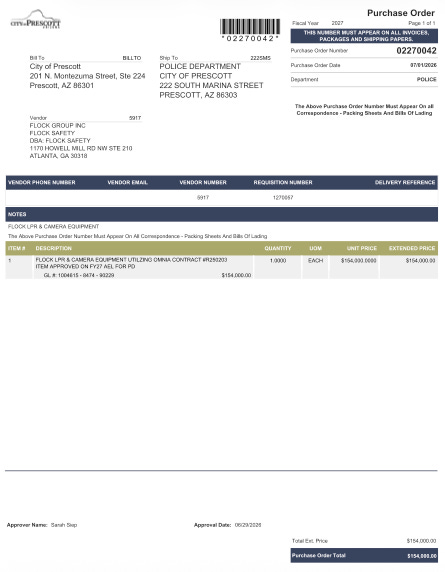
For the Prescott residents who contacted me about the City's vehicle surveillance program, the purchase came as a surprise to them.
Just weeks earlier, during Prescott’s April 27th budget workshop, Chief Bonney assured the City Council the department was:
“Finishing out specifically our LPR camera contract.”
You can watch that exchange here.
During the April 27, 2026 Town of Prescott budget meeting, Police Chief Amy Bonney indicated the department’s proposed budget does not include funding for expansion of the town’s automated license plate reader (ALPR) program.
Chief Bonney makes clear the department is “finishing out specifically our ALPR camera contract,” referencing existing obligations tied to current equipment.
Mayor Pro Tem Lois Fruhwirth questioned the absence of any visible budget line item and asked whether additional surveillance measures, as she called “eyes in the skies”, were planned. Chief Bonney responded, “No more growth with that program.”
When I asked Mayor Pro Tem Lois Fruhwirth about that exchange, she told me she understood the City's plan to renew existing contracts, not add new cameras or expand the program.
“Therefore, yes in my discussion with Chief Bonney at the April 2026 budget meeting, I was very clear on what equipment and software was already operational and would be renewed as part of the FY 27 budget; I was just seeking public confirmation that there was no expansion of Flock equipment in the ’27 budget, while understanding that Prescott would be renewing existing Flock contracts in FY 27. I took her response as a clear and satisfactory response to my question.”
Lois Fruhwirth | Mayor Pro Tem | August 5, 2026
So what changed? Or did anything change?
After reviewing the records and responding to detailed questions, Interim Police Chief Jon Brambila said the department never intended to expand beyond its existing camera network. Instead, he said the City was maintaining contracts that had already been approved while adding nothing new to the program.
“No more growth meant that we were not adding anything new at this time, and we would simply maintain what we currently have.”
Interim Chief Jon Brambila | Prescott Police Department | August 6, 2026
Brambila’s explanation aligned with Fruhwirth’s understanding of the budget process.
When I also asked whether the $154,000 renewal had been presented to the City Council, Mayor Pro Tem Lois Fruhwirth explained how it was handled.
“Yes Council received the renewal of the ALPR equipment lease ($154k) as part of the City Finance AEL (Authorized Expenditure Limit) process that was sent to council on May 11th, and that was ultimately approved by Council on June 23rd”
Lois Fruhwirth | Mayor Pro Tem | August 3, 2026
What follows is a chronological timeline built from more than 550 pages of public records, contracts, emails, invoices, budget documents, and interviews. It traces how Prescott's Flock Safety program came together, how the City's procurement process evolved over time, and how those decisions were presented to elected officials… and the public.
Editor’s Note: I’m genuinely grateful to the Prescott officials who took the time to answer my questions. Public records tell an important part of the story, but conversations like these provide context that documents alone can’t. My goal is always to give readers as complete a picture as possible, and their willingness to answer my questions helped make that possible.
A Timeline: How Flock License Plate Readers First Came To Prescott
A quick note before we get into the records: This section is longer than my typical reporting, but I think the details matter. The emails, contracts, budget documents, and meeting records show how Prescott's Flock program developed over several years. Just as important, Interim Police Chief Jon Brambila has now provided context about how the department views many of those decisions today.
In an August 6th response to my questions, Brambila wrote:
“I believe in total and complete transparency and consistently say that if we don't work with our community and have their trust, we cannot do this job effectively. I do believe in this technology because I have seen the results and how it benefits the victims of crime that has a significant impact on them to include emotional trauma and financial impacts of being a victim of a crime.”
Brambila also acknowledged that, looking back, he would have handled part of the rollout differently:
“I believe that we have not done anything that would be considered a violation of trust or violation of procurement rules in regard to our Flock implementation. Anytime a decision is made there is always an opportunity to review that decision and determine if it was the right one at that time and I have done that regularly with decision making and the outcomes.
I would not have approached the implementation in the same way that we did back in 2023. I would have asked that we present the program to our City Council in a study session which allows our elected officials the opportunity to learn and ask questions as well as our community. We don’t take every new program or piece of equipment we are implementing to Council but there are somethings that require additional input and public awareness.”
Brambila also said he believes Prescott followed its procurement rules, that officers have not misused the system, and that the technology has helped solve crimes and provide closure to victims.
On August 7th, he added:
“Yes, any changes to our contracts will be brought forward to our Council and community moving forward.”
Mayor Pro Tem Lois Fruhwirth also answered my questions, providing additional context about how she understood the City’s budget discussions and renewal process. I’ll include both of their responses where they help explain the records.
With that context, here’s what the records show.
Chapter 1: “They are on board.”
In the public records, Flock Safety's first proposal to Prescott was modest: a 30-day pilot using six automated license plate reader cameras for $19,600.
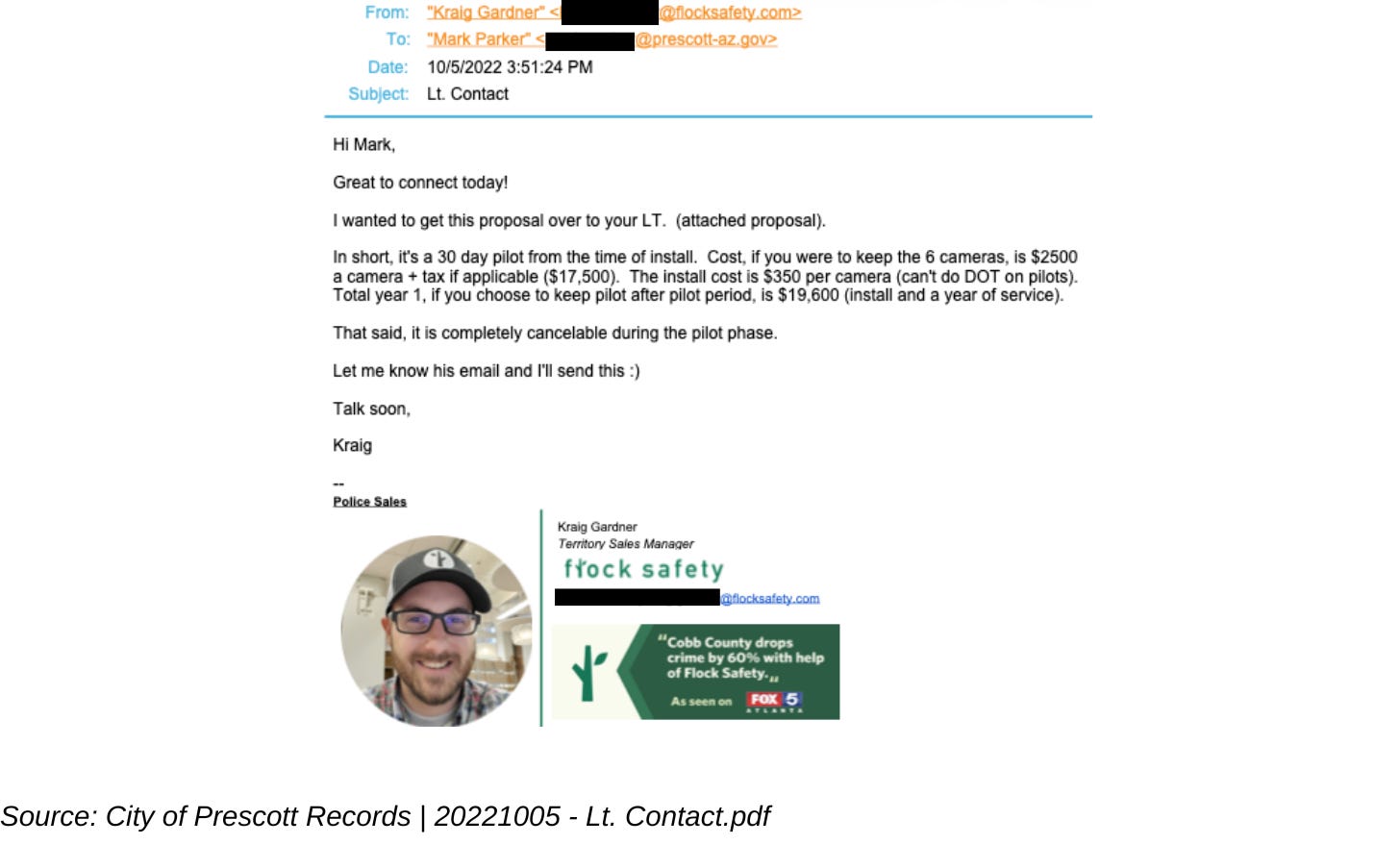
Six weeks later, Police Chief Amy Bonney met with Mayor Phil Goode and City Manager Michael Lamar to discuss the technology. After the meeting, she emailed Lt. Jason Small and copied Deputy Chief Jon Brambila:
“I spoke with the Mayor and City Manager about these cameras this morning. They are on board.”
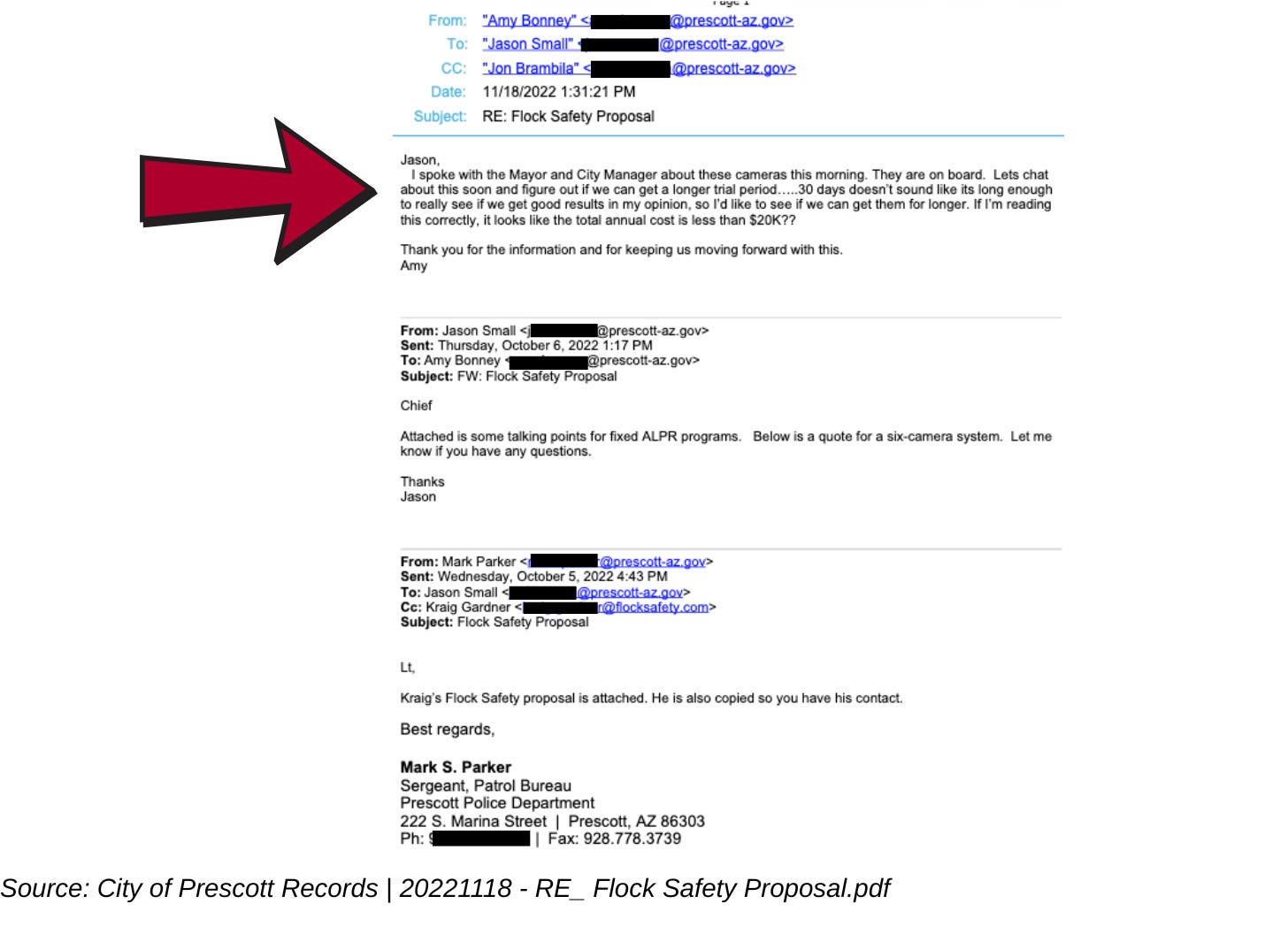
Bonney also asked staff to pursue a longer pilot, writing that 30 days did not seem like enough time to determine whether the cameras were producing meaningful results.
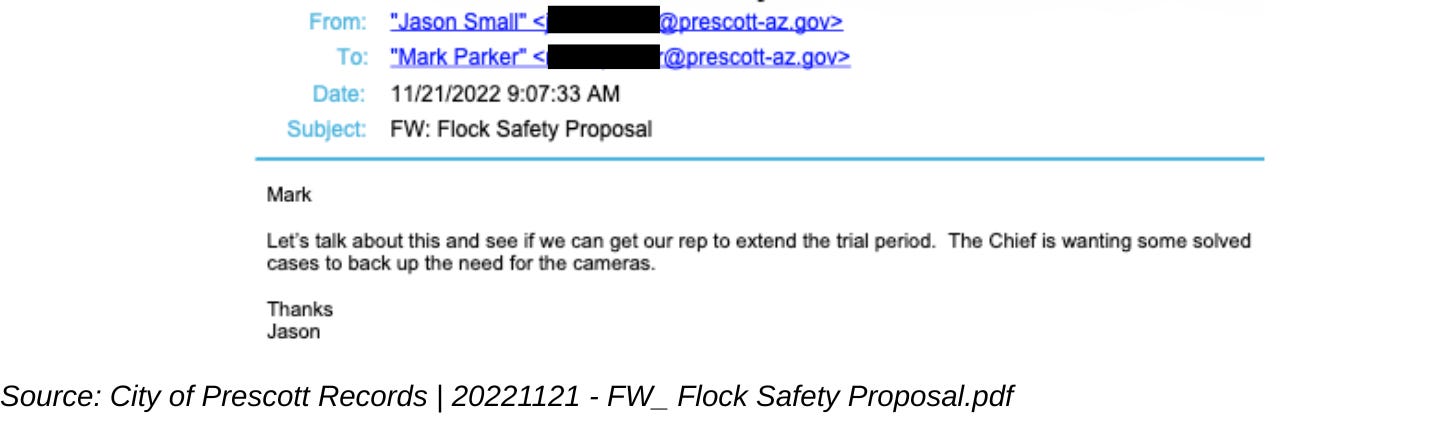
Three days later, Lt. Jason Small summarized Bonney’s thinking in an email, writing that she wanted enough time to develop “solved cases to back up the need for the cameras.”
Chapter 2: “This Will Save Me Having to Get Other Bids”
After Prescott’s legal department reviewed revisions to the proposed Flock agreement, Lt. Jason Small asked Flock whether it could provide a GSA contract, Arizona state contract or sole-source documentation.
His reason was direct:
“This will save me having to get other bids.”
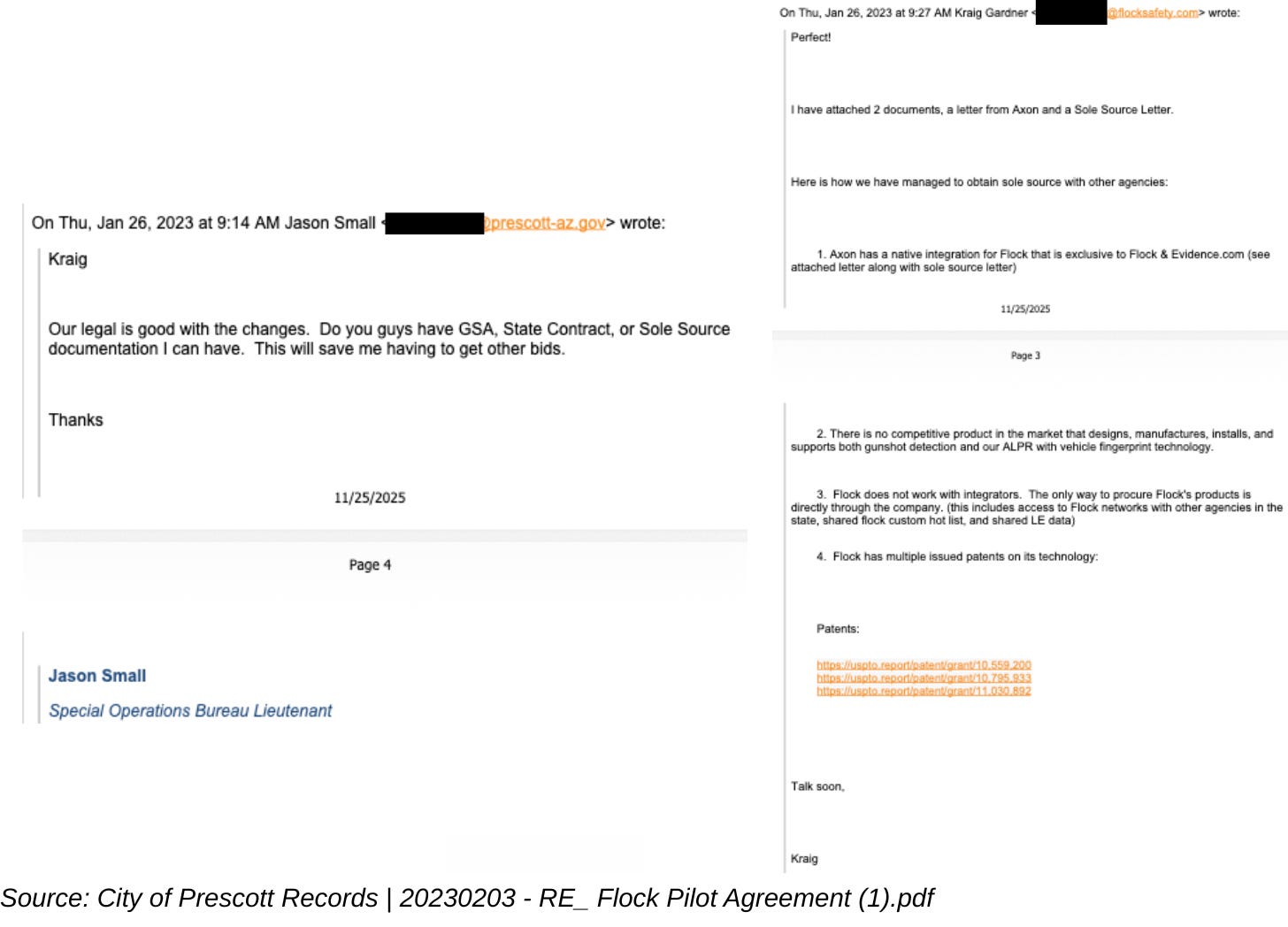
According to the records reviewed by Jen’s Two Cents, Flock responded with an Axon integration letter and a sole-source justification stating that its technology qualified for sole-source procurement based on its proprietary platform, patents, direct-sales model, and integration with Axon.
When I asked Interim Chief Jon Brambila about that exchange, he said the email should not be interpreted as an attempt to circumvent the City’s procurement requirements.
Instead, Brambila explained that obtaining three quotes is only one method available under the City’s purchasing policies. He said Prescott can also purchase through GSA pricing, cooperative purchasing agreements, requests for proposals, and other authorized procurement methods.
“I believe there might be some misunderstanding in that obtaining three quotes is only one way for us to procure items and nothing was circumvented in regard to proper procurement procedures. We can utilize GSA pricing contracts, cooperative agreements with other government agencies, requests for proposals, etc. For these contracts we are using a cooperative agreement through OMNIA Partners and specifically a contract between Flock and Region 4 Education Service Center for best pricing.”
Interim Chief Jon Brambila | Prescott Police Department | August 6, 2026
Chapter 3: “Allowing Us to Not Have to Go to Council for Approval”
On February 3, 2023, Lt. Jason Small told Flock Safety Prescott was ready to move forward with its pilot agreement but was waiting until February 11th, when new City procurement rules were expected to take effect.
Small writes:
“We are good to go with the contract. I am waiting until February 11th due to our procurement rules changing allowing us to not have to go to council for approval. The Chief will have the Mayor sign after the 11th.”
When I asked Interim Chief Jon Brambila about this email, he said the City's procurement process complied with applicable purchasing rules and that the original pilot later became part of the FY24 budget approved by Council.
Small also asks Flock to delay invoicing until after July 1, 2023, explaining that it coincides with the start of the City’s new fiscal year and “would make things much easier for us.”
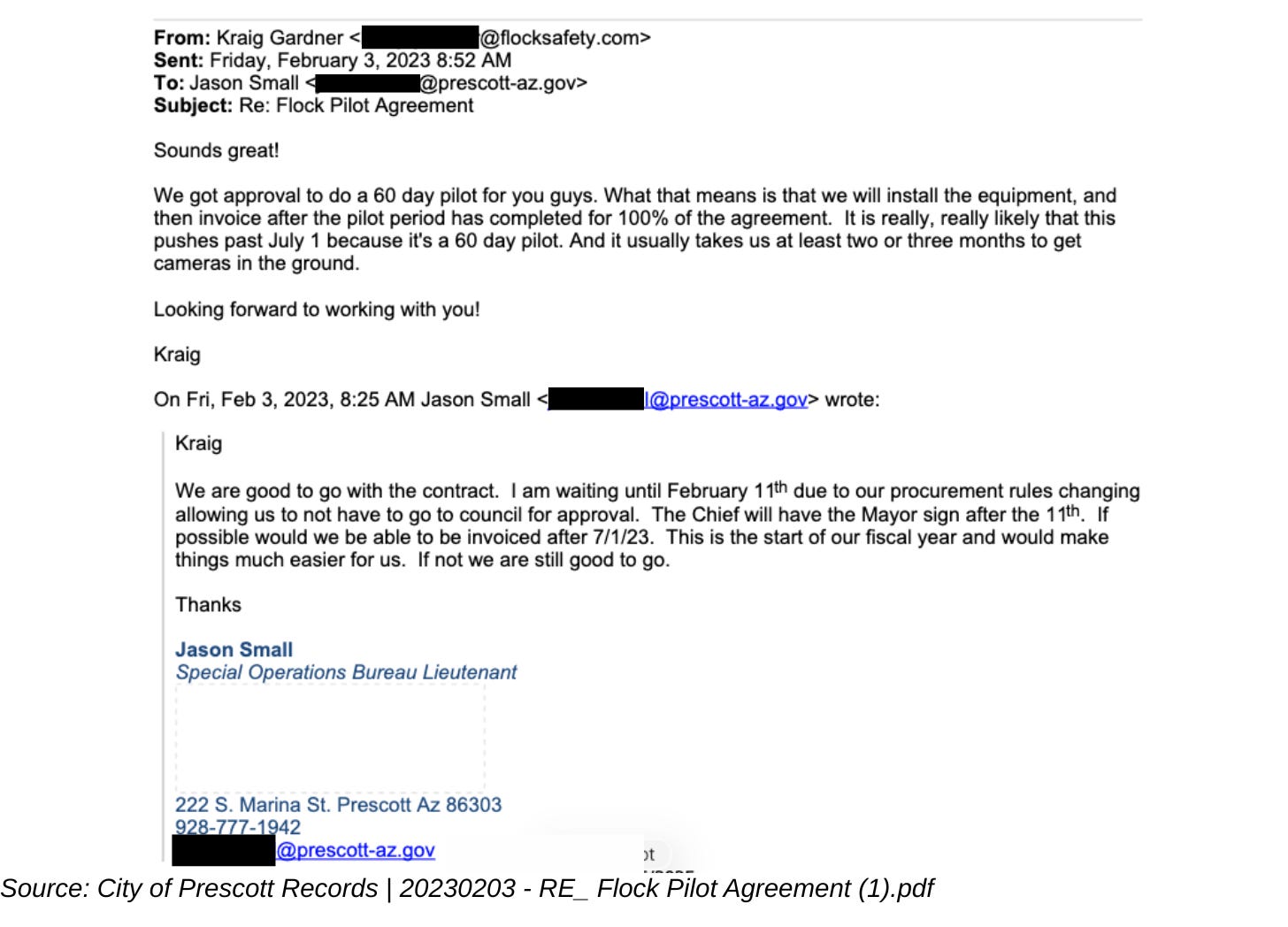
“It is really, really likely that this pushes past July 1 because it’s a 60 day pilot,” responds the Flock representative.
Flock responded that it had approved a 60-day pilot and expected billing to occur after the pilot period, making it likely invoicing would occur after July 1st.
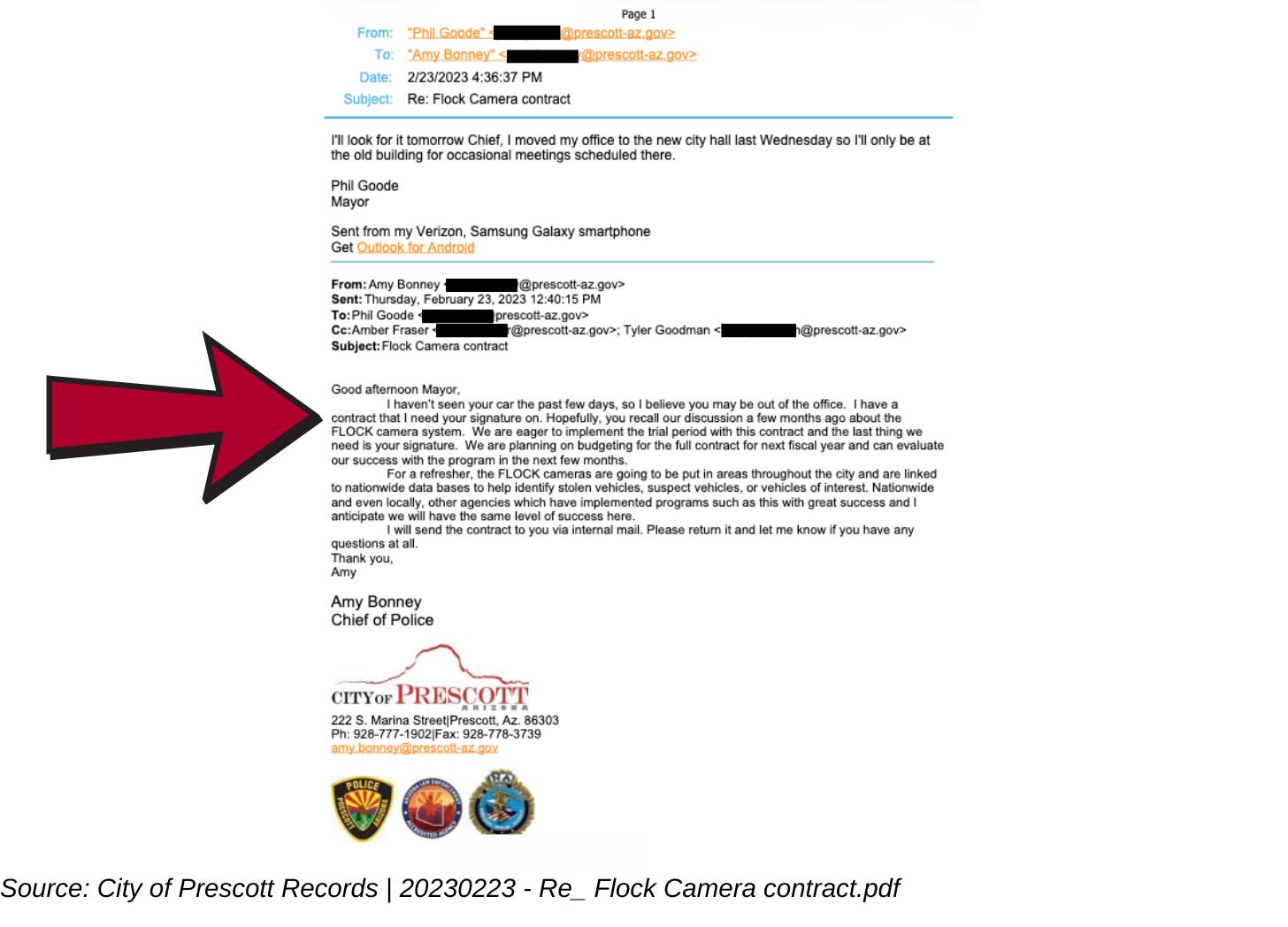
February 23, 2023 – Chief Requests Mayor’s Signature on Flock Contract
Chief Amy Bonney emails Mayor Phil Goode requesting his signature on the Flock camera contract, reminding him of their earlier discussions about the project.
Bonney writes:
“Hopefully, you recall our discussion a few months ago about the FLOCK camera system. We are eager to implement the trial period with this contract and the last thing we need is your signature.”
She explains the department plans to evaluate the pilot and budget for the full contract during the next fiscal year, writing:
“We are planning on budgeting for the full contract for next fiscal year and can evaluate our success with the program in the next few months.”
From the records, it appears Chief Bonney also provided the former Mayor with a summary of the system, explaining the cameras would be deployed throughout the city and connected to nationwide databases to help identify stolen vehicles, suspect vehicles, and vehicles of interest. She tells the Mayor the contract will be sent through interoffice mail for his signature.
Later that day, Mayor Goode responds, acknowledging the request and indicating he will sign the agreement after locating the paperwork:
“I’ll look for it tomorrow Chief...”
February 24, 2023 – Flock Added to Budget Planning
The Flock LPR Program is identified as a proposed Capital Improvement Project (CIP) during FY24 budget planning. The email is sent to Chief Amy Bonney and copies Deputy Chief Jon Brambila.
This is the email regarding a “budget scenario.”
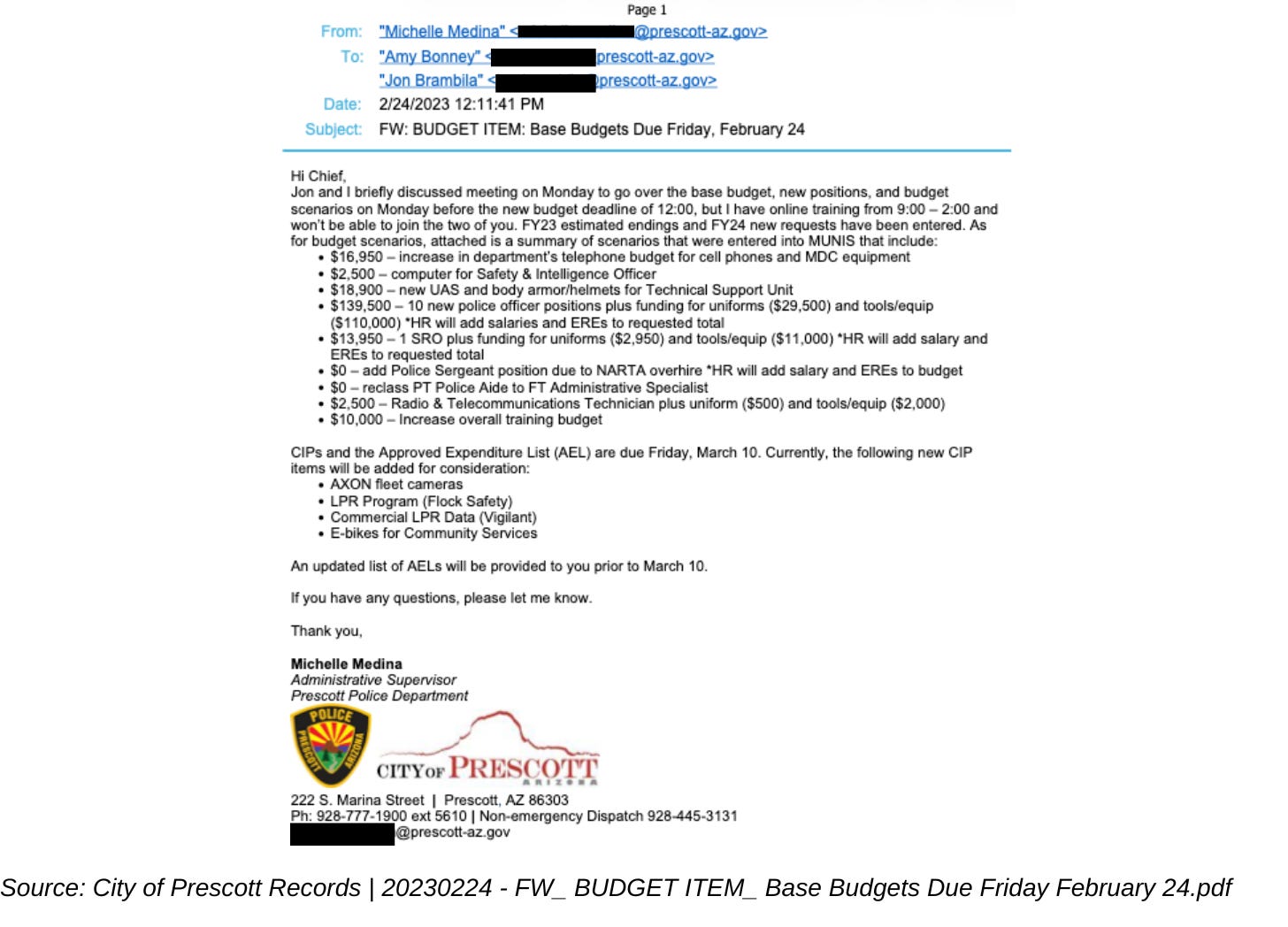
The Capital Improvement Projects (CIPs) and Approved Expenditure List included funding for Axon Fleet cameras, the Flock Safety automated license plate reader program, and access to Vigilant commercial license plate reader data.
March 3, 2023 – City Executes Flock Contract
The City of Prescott executes Contract No. 2023-151, formally approving a 60-day pilot program for 16 Flock Falcon automatic license plate reader (ALPR) cameras. The agreement is signed by Mayor Phil Goode on behalf of the City and includes Flock Safety Advanced Search and implementation services.

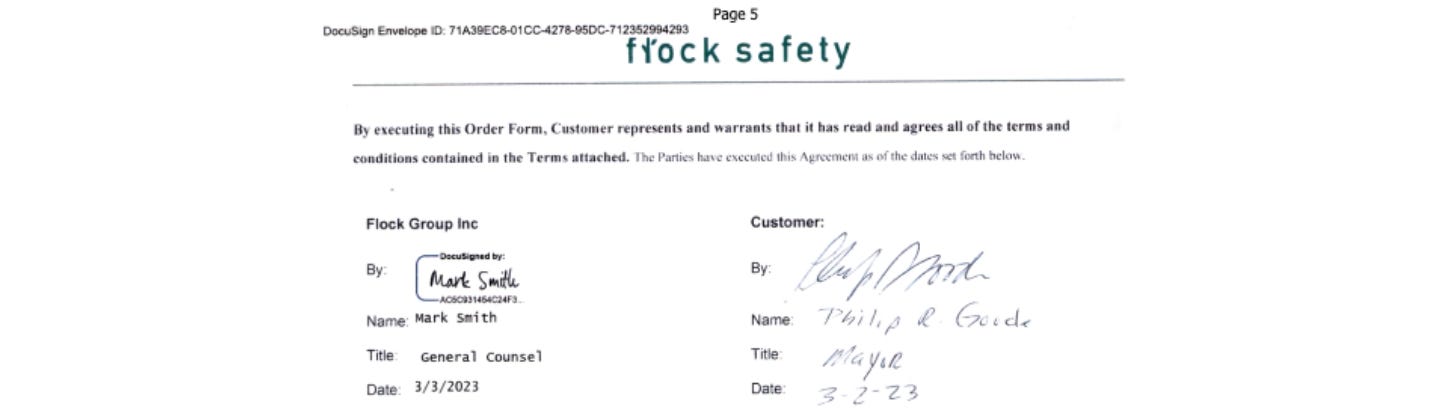
This 12-month contract is $48,100.
According to Chief Brambila, the initial 16-camera pilot later became part of the FY24 budget through what was then described as a “budget scenario,” and that the budget ultimately went to Council for approval.
“The original implementation was a pilot program with sixteen ALPR cameras that turned into a contract during the FY24 budget process. The request was part of our budget package through a process described at that time as a “budget scenario”. That budget went to Council for approval with that information.
The following fiscal year, FY25, we added the Flock OS software and again budgeted for the sixteen ALPR cameras, but this time the process used was the “Approved Expenditure List”. This list is presented in the budget process to our Council and once approved items on that list do not have to be brought back to Council for approval to purchase, but we are still bound by procurement rules, which we followed.”
Interim Chief Jon Brambila | Prescott Police Department | August 6, 2026
Chapter 4: “We Definitely Would Prefer That It Not, At Least Not Initially”
March 6, 2023 – Chief Bonney Recommends Delaying Public Discussion
After discussing the Flock camera program with Mayor Phil Goode, Interim City Manager Tyler Goodman asked Chief Amy Bonney whether the project had been presented during a City Council study session. Goodman noted that the Mayor “wanted to make the public aware of this at some point” and was asking about the rollout and timeline.
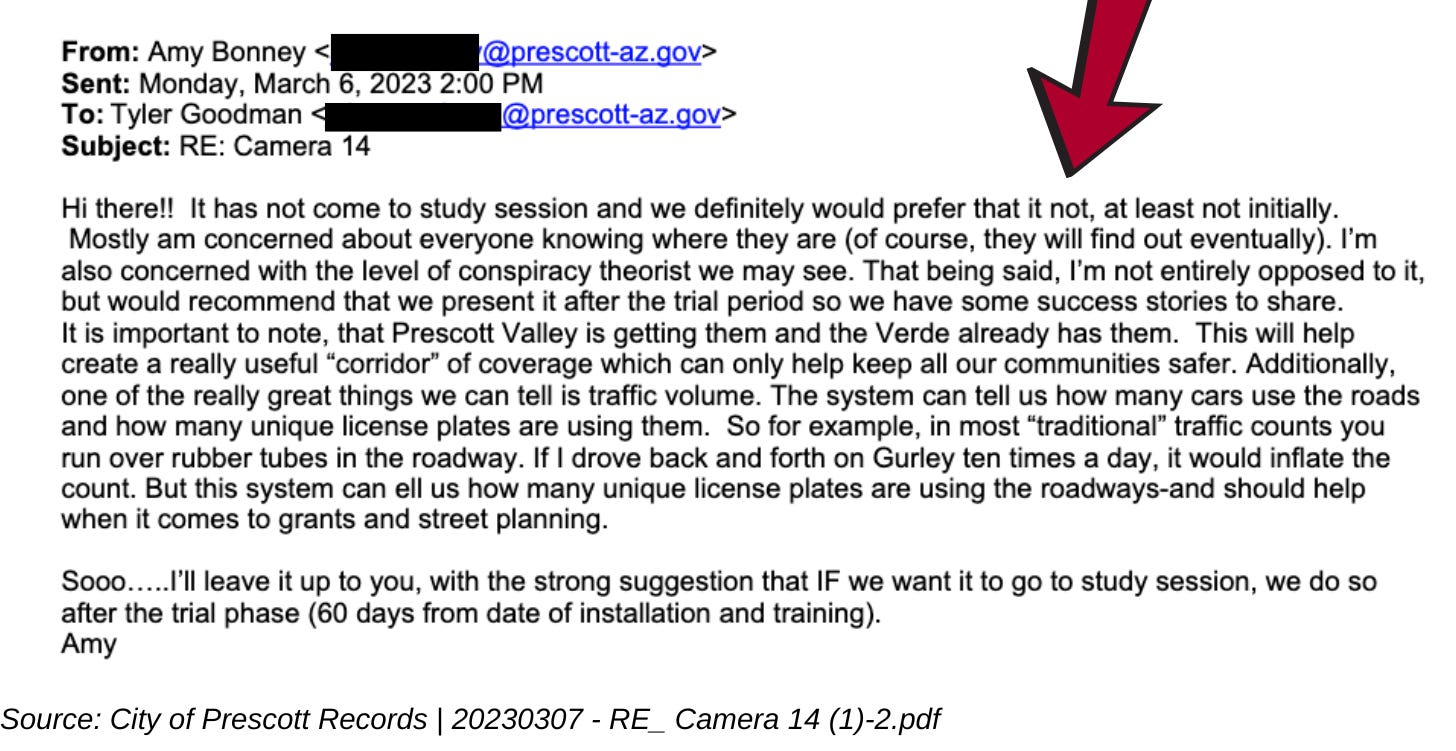
Chief Bonney responded that the program had not been presented during a study session and recommended waiting before bringing it forward publicly, writing:
“It has not come to study session and we definitely would prefer that it not, at least not initially.”
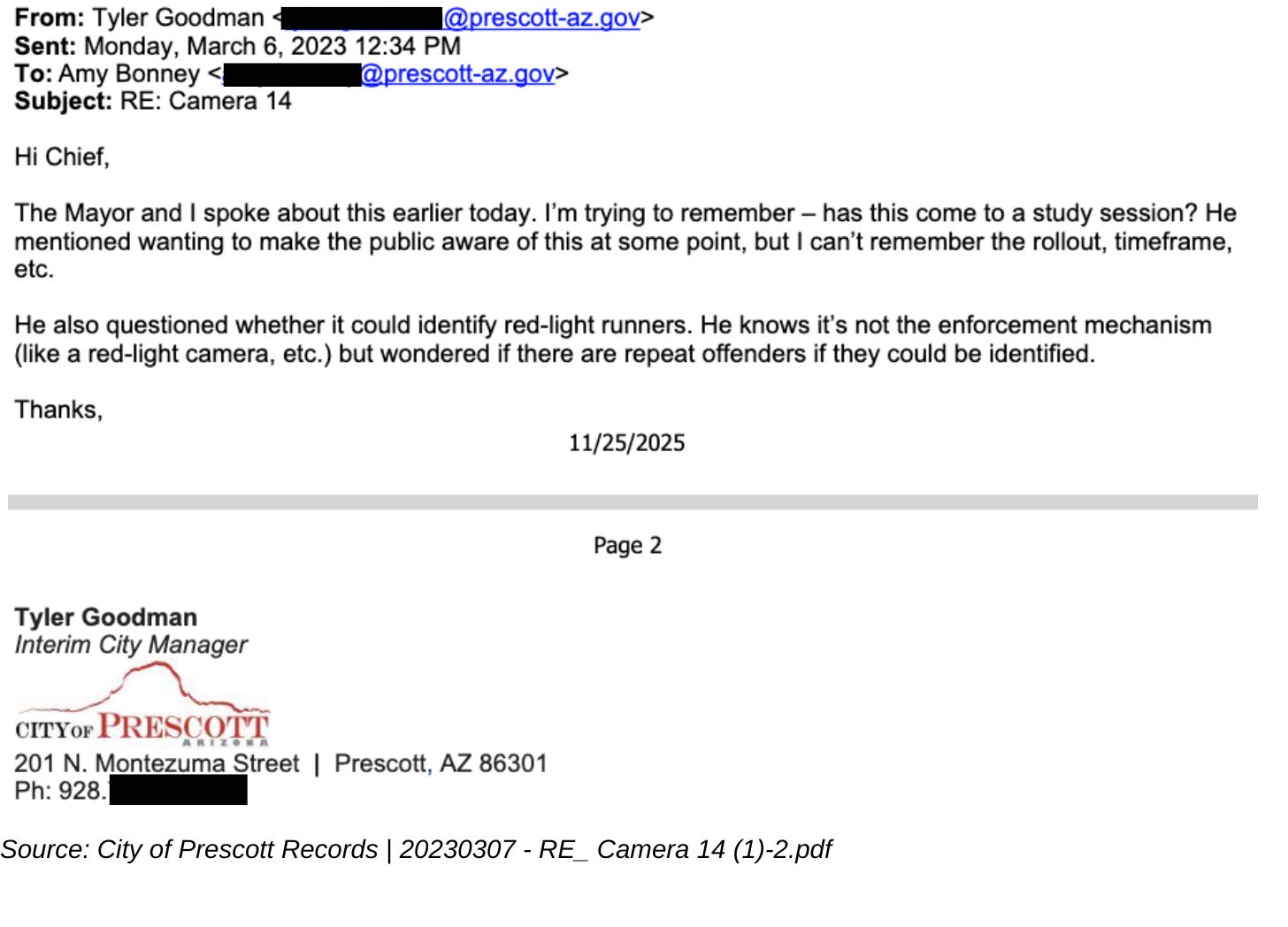
In the same email, Bonney explained why she believed waiting until after the pilot would be beneficial.
Bonney wrote that she was concerned about publicly identifying camera locations and the “level of conspiracy theorist we may see.”
Rather than introducing the program immediately, she recommended waiting until after the 60-day pilot so the department would have “some success stories to share” before presenting it publicly.
Bonney also noted that the cameras could provide valuable traffic data and help support future grant applications and street planning.
When I asked Interim Chief Jon Brambila about the rollout, he said he would have approached part of the implementation differently.
“I would not have approached the implementation in the same way that we did back in 2023. I would have asked that we present the program to our City Council in a study session which allows our elected officials the opportunity to learn and ask questions as well as our community. We don’t take every new program or piece of equipment we are implementing to Council but there are somethings that require additional input and public awareness.”
Interim Chief Jon Brambila | Prescott Police Department | August 6, 2026
Brambila added that not every new program or piece of equipment is presented to Council, but believes some initiatives warrant additional public awareness and discussion.
Chapter 5: “Hold Off on Paying This Yet”
August 25–September 26, 2023 – Invoice Held Pending Council Meeting
As the Police Department prepared to pay Flock Safety’s $46,048.75 invoice, Police Administrative Supervisor Michelle Medina asked Lt. Jason Small whether he had sole-source documentation or three written quotes to include with the requisition, indicating Finance was seeking procurement documentation before processing the payment.
Three days later, Small provided the sole-source letter and instructed Finance to delay payment, writing:
“Hold off on paying this yet until after September 26 when we have a study session with Council. We are currently on a pilot program with them.”
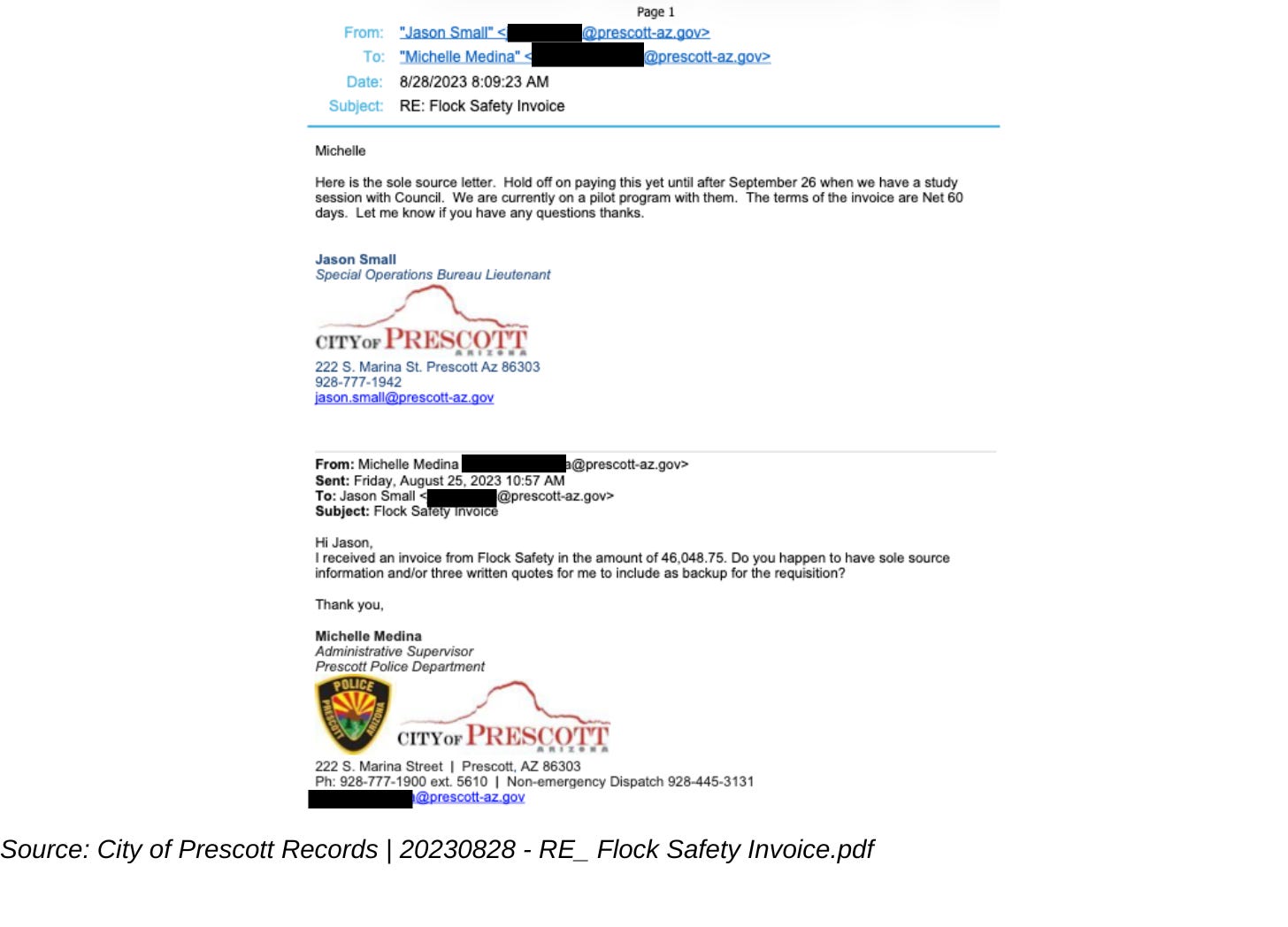
The publicly posted September 26, 2023 City Council Study Session agenda, however, does not include a Police Department presentation or discussion regarding Flock Safety.
The regular voting meeting meeting later that evening did include a Police Department agenda item, but it was limited to approval of three Arizona Governor's Office of Highway Safety grants totaling $137,471 for accident investigation equipment, DUI enforcement, and speed enforcement.
Were any Governor's Office of Highway Safety grants funding Prescott's Flock program? I asked Interim Chief Jon Brambila about that question, he responded:
“The grants we receive from the Governor's Office of Highway Safety have not been used to purchase anything related to Flock.”
Interim Chief Jon Brambila | Prescott Police Department | August 6, 2026
The records I reviewed do not identify any Governor's Office of Highway Safety funds being used to purchase Flock technology.
Interim Chief Jon Brambila says grant funding was not used for any of the contracts.
Chapter 6: “Once They Get Ready to Renew It Will Have to Go to Council”
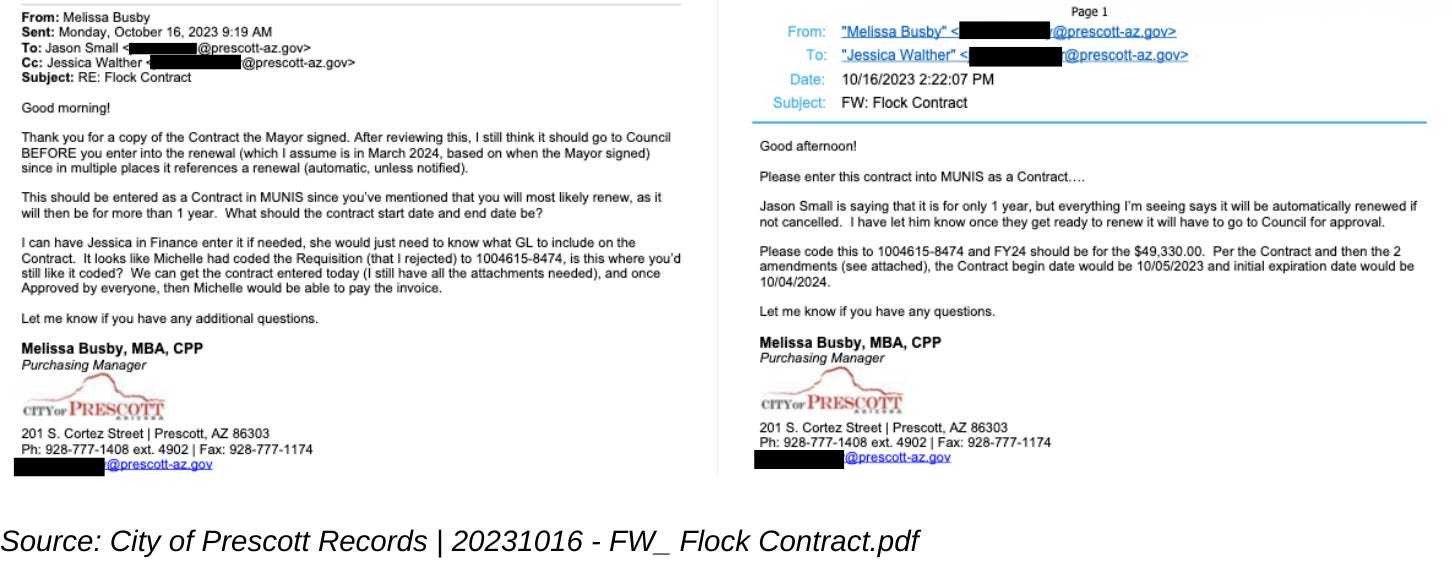
On October 16, 2023, records inspected show Prescott Purchasing Manager Melissa Busby reviewed the signed Flock contract and commented on how she believed future renewals should be handled.
In an email to Lt. Jason Small, she wrote:
“Thank you for a copy of the Contract the Mayor signed. After reviewing this, I still think it should go to Council BEFORE you enter into the renewal... since in multiple places it references a renewal (automatic, unless notified).”
She also advised Finance that, while the Police Department viewed the agreement as a one-year contract, the renewal language appeared to require future Council approval.
“Jason Small is saying that it is for only 1 year, but everything I’m seeing says it will be automatically renewed if not cancelled. I have let him know once they get ready to renew it will have to go to Council for approval.”
Busby directed staff to enter the agreement into the City’s contract management system with an initial term running from October 5, 2023, through October 4, 2024.
“Please code this to… and FY24 should be for the $49,330.00.”
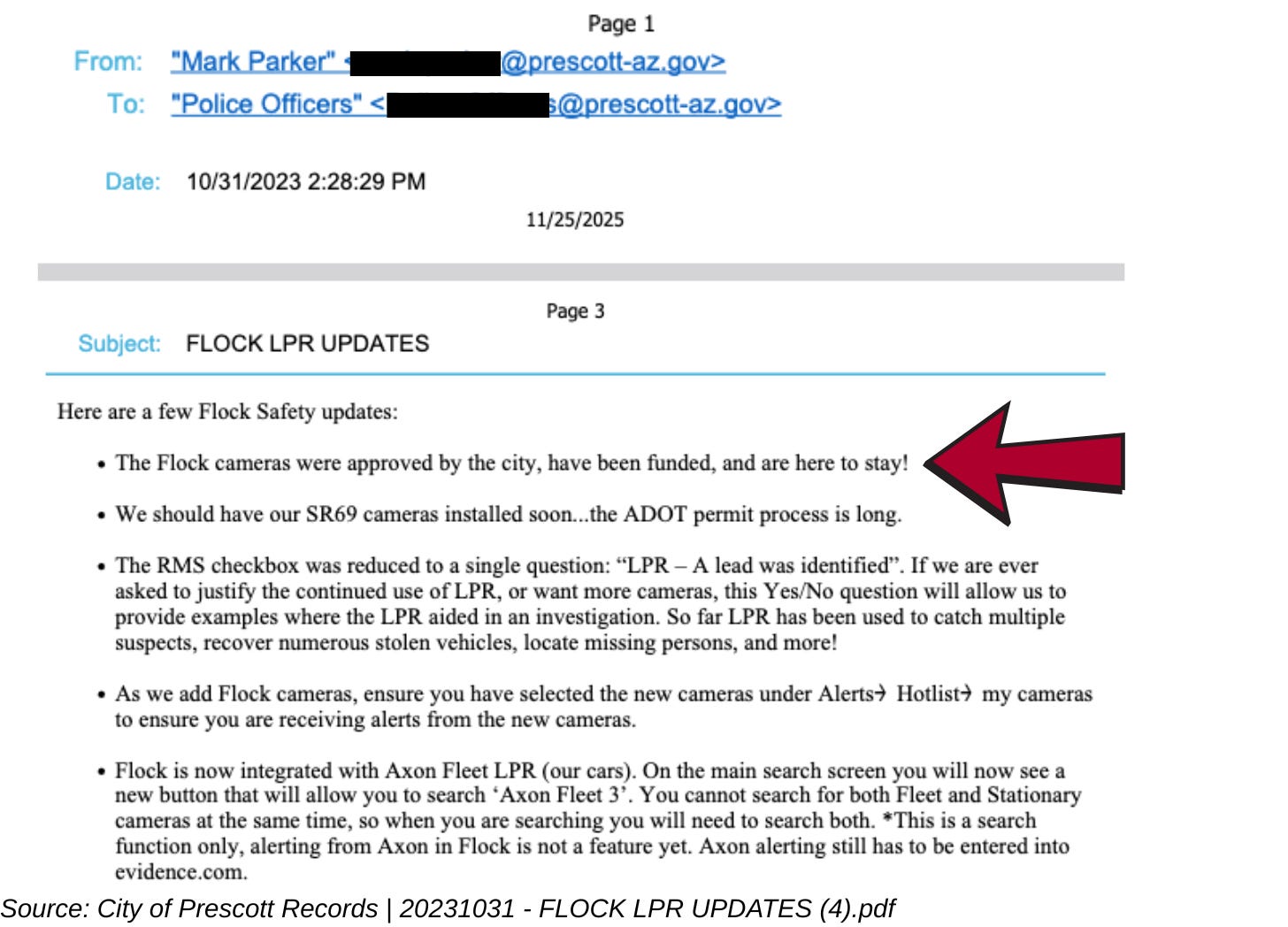
Just two weeks later, Sgt. Mark Parker notified Prescott police officers the program was "here to stay."
“The Flock cameras were approved by the city, have been funded, and are here to stay!”
The update also notes additional cameras are planned, encourages officers to document Flock-related investigative leads, and announces integration with Axon Fleet LPR.
After carefully reviewing City Council agendas, meeting minutes, study sessions, and voting meetings, I could not find a September or October 2023 presentation or agenda item seeking Council approval for a Flock Safety contract.
To better understand that gap, I went back to Interim Police Chief Jon Brambila for clarification.
Brambila explained that the original Flock contract was just under $50,000, which meant it did not require a separate Council vote under the City’s procurement rules at the time.
In fact, it appears that Flock contract missed the Council vote by just $670.
Instead, he said the expenditure was included as part of the City’s annual budget process rather than being presented as a standalone study session or consent or regular agenda item.
“The Council first approved the contract in the fall of 2023 (FY24) in the general budget process as a budget scenario that did not rise to the level of a council approval as part of either a consent or regular agenda item. That contract was under $50,000 so it was not required for that expenditure to go to Council for approval, the item had been placed into our budget, which was approved by the Council. We had to follow procurement rules which would be a sole source letter, 3 quotes, a GSA Contract or any other cooperative contract or agreement. There was no Council presentation and as I mentioned to you before and I think we should have done a presentation, but I can't go back and change that decision.”
Interim Chief Jon Brambila | Prescott Police Department | August 10, 2026
Brambila's explanation answered a key question that emerged during this investigation: why there was no public study session or standalone Council vote approving the original Flock contract in 2023. According to Brambila, the contract fell below the procurement threshold that would have required a separate Council approval and instead moved forward as part of the City's adopted budget.
How the City explains the renewal process today…
The $154K Purchase Order Explained
When I asked Interim Chief Jon Brambila about the procurement process, he said Prescott’s budgeting process changed after the original contract.
According to Brambila, beginning with the following fiscal year, Flock purchases were included on the City’s Approved Expenditure List (AEL) during the annual budget process.
Brambila explained:
“The following fiscal year, he said, Prescott began using the Approved Expenditure List, or AEL. Once Council approves an item through that budget process, it does not necessarily return as a standalone purchase request, although procurement rules still apply.”
Interim Chief Jon Brambila | Prescott Police Department | August 6, 2026
Mayor Pro Tem Lois Fruhwirth told me that matched her understanding of how the FY2027 renewal was presented to Council.
“Yes Council received the renewal of the ALPR equipment lease ($154k) as part of the City Finance AEL (Authorized Expenditure Limit) process that was sent to council on May 11th, and that was ultimately approved by Council on June 23rd”
Lois Fruhwirth | Mayor Pro Tem | August 3, 2026
Combined, the records show the original contract raised internal questions about future renewals, while current City officials say later renewals were presented to Council through the annual budget and Approved Expenditure List process.
Chapter 7: The Program Grows Beyond License Plate Readers
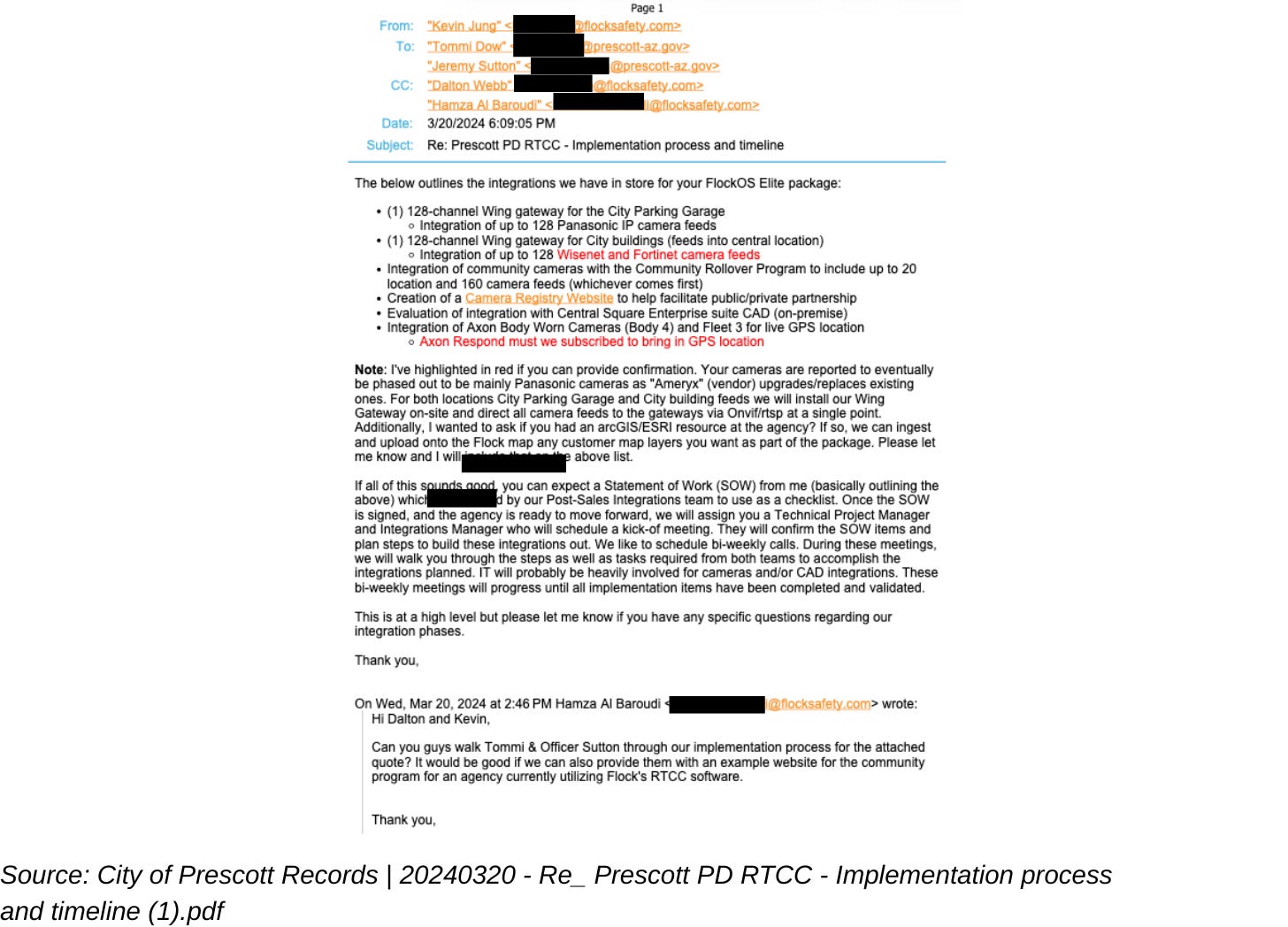
By 2024, the discussion was beginning to move beyond license plate readers alone. Records show the City exploring additional Flock products and integrations.
Records reviewed by Jen's Two Cents include discussions about a Real-Time Crime Center, FlockOS, video integration gateways, community camera registration, CAD integration, GIS mapping, and additional video cameras.
A February 2024 proposal totaled $45,000 and included Flock’s Community Camera Program. By March, Flock was providing Prescott with an implementation roadmap for integrating existing City cameras and other systems into FlockOS.
As the technology expanded, discussion of the program also became more public.
March 26, 2024 – What Appears to Be the First Public Council Discussion
Nearly 18 months passed between Flock's initial proposal and what appears to have been the program's first public discussion before the Prescott City Council. In the FY2025 Police Department budget work session, Chief Amy Bonney publicly described the stationary license plate reader system and its benefits.
In less than a minute, Bonney described the cameras as tools to help identify vehicles, investigate crimes, and support public safety partnerships through technology.
June 17, 2024 – Original ALPR System Renewed
Prescott renewed its original 16-camera Flock Falcon ALPR system for another 12-month term. The renewal included Advanced Search and totaled $55,800.25 for the 2024–2025 contract year.
Chapter 8: “You Asked Me to Be Here This Afternoon”
January 27, 2026 – The Public Discussion with Flock
Nearly three years after internal emails showed department leaders recommending the program not initially be presented publicly during its pilot phase, the Prescott City Council held an extended public discussion on Flock Safety and automated license plate readers.
At the beginning of her presentation, Chief Amy Bonney reminded Council:
“I will just remind you all that you asked me to be here this afternoon.”
The meeting included a presentation from the Prescott Police Department, testimony from Flock Safety representatives, questions from Council members, and public comment from residents.
When I asked Mayor Pro Tem Lois Fruhwirth about that meeting, she said it gave her confidence that the City was following industry best practices and answered her questions about the program before the FY2027 budget process.
“I found the January 27, 2026 public meeting materials and council presentation both educational and reassuring that Prescott was following industry best practices, including monthly audits. The Prescott Council Budget approval process is usually fairly high level. Besides the public meeting materials published ahead of meetings, it’s up to council to complete any desired premeeting due diligence and to come prepared to the budget workshops and voting meetings with additional questions or concerns on any details needed.”
Lois Fruhwirth | Mayor Pro Tem | August 3, 2026
Fruhwirth said she later completed her own due diligence before the FY2027 budget process and received confirmation during the April 27th budget workshop that the City was not planning to expand the program.
It’s worth noting, science engineer Benn Jordan responded to Flock’s comments made in the January 2026 meeting. Watch here.
Chapter 9: “No More Growth With That Program”
April 27, 2026 – Chief Says Flock Program Will Not Expand
During the FY2027 Police Department budget presentation, Chief Amy Bonney told the Prescott City Council the department is “finishing out specifically our ALPR camera contract.”
When Mayor Pro Tem Lois Fruhwirth asked whether there would be additional “eyes in the skies” or other surveillance expansion, Bonney replied:
“No more growth with that program.”
Bonney described the Flock system as a tool for investigating crimes and locating vehicles and indicated the City's license plate reader program was not expected to expand.
Fruhwirth tells me that at the time, she understood Bonney’s comments to mean the City would renew its existing Flock contracts but would not add new equipment.
“I was just seeking public confirmation that there was no expansion of Flock equipment in the FY27 budget, while understanding that Prescott would be renewing existing Flock contracts in FY27. I took her response as a clear and satisfactory response to my question.”
Lois Fruhwirth | Mayor Pro Tem | August 5, 2026
Chief Bonney retired on July 17, 2026.
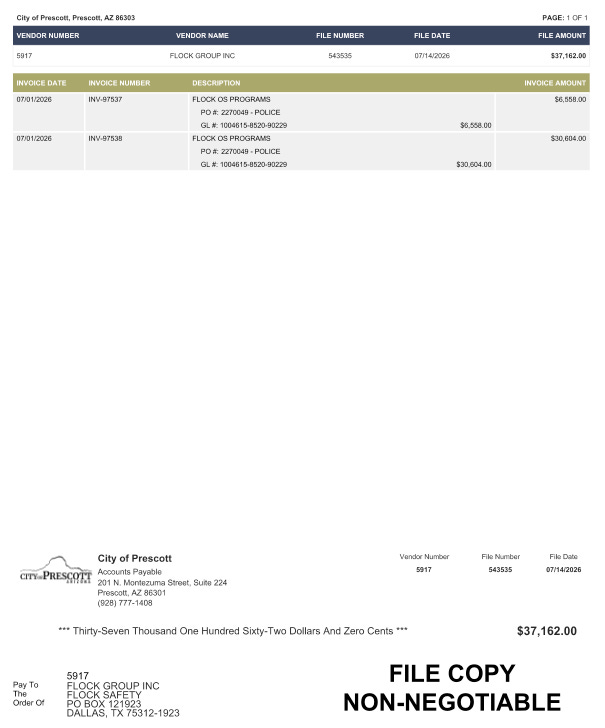
In the weeks that followed, public records reviewed by Jen's Two Cents show Prescott continued paying on existing Flock agreements, including renewals of the original 16-camera ALPR system and previously approved FlockOS software and video integration services.
Records reviewed by Jen’s Two Cents include:
July 14, 2026: $37,162 for FlockOS Elite, Platform Essentials, Video Integration Gateways, and related services under contracts that began in 2025.
July 20, 2026: $56,289.50 to renew Prescott’s original 16 Falcon ALPR cameras, Advanced Search, and Platform Essentials for the 2026-2027 contract year.
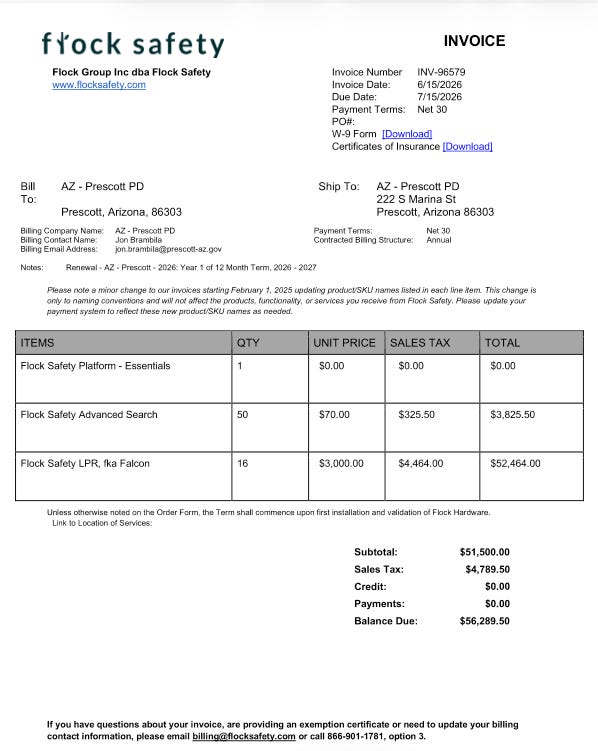
Those payments, along with a separate $154,000 purchase order approved during the FY2027 budget process, prompted questions from several residents who reached out to me asking whether the City was expanding the program.
When I asked Interim Chief Jon Brambila about those records, he said he could not speak for Bonney's remarks during the April budget meeting but said the department's position had not changed.
“…we as an agency decided that we were going to maintain all of our current contracts and not add anything else to those contracts.”
He explained that “no more growth” meant Prescott would continue renewing existing contracts while not expanding beyond its current camera network.
“We would renew them as they came up for renewal, but we felt that the cameras we had in place were all that we needed to assist our officers with solving crimes in our community. No more growth meant that we were not adding anything new at this time, and we would simply maintain what we currently have.”
Brambila said that if the department proposes expanding the program in the future, those changes would be presented to both the City Council and the community.
“Yes, any changes to our contracts will be brought forward to our Council and community moving forward.”
Interim Chief Jon Brambila | Prescott Police Department | August 6, 2026
Jen’s Two Cents.
As I wrap up this investigation, I also heard back from Prescott Mayor Cathey Rusing. Her response reminded me that this story isn’t entirely about purchase orders or procurement.
Dear Ms Barber,
I am more worried about the live streaming cameras on private property that monitor people in public and is posted on the internet. Anyone in the world can watch and use facial recognition. The same people installing these cameras are against flock? What a bunch of hypocrites.
I support the rule of law. Flock cameras are a tool to help law enforcement catch the bad guys and is admissible in court.
As a woman, I feel safer knowing a community has them.
If Nancy Guthrie’s neighborhood in the Tucson foothills had Flock, the kidnapper would be behind bars.
Mayor Rusing
The mayor’s response underscored something I’ve come to realize during this investigation: the conversation is about how communities decide what role technology should play in public safety.
While reporting this story, I also came across a discussion involving another Arizona mayor and police chief about using Flock cameras at the neighborhood level. That conversation raises a new set of questions about where these systems belong, how they should be deployed, and who gets to make those decisions.
As artificial intelligence becomes part of everyday policing, where should Arizona draw the line?
That’s where this investigation goes next.
After wrapping up this investigation, I came across a collection of public records that had also been shared online by Elliott Beaty. Although my reporting and timeline are based on my own independent review of public records, interviews, and city documents, I don’t want to take away from anyone else’s efforts to obtain or share public information.
I don’t know who originally submitted the public records requests to the City of Prescott that produced some of these documents. What matters is that the records are public and available for anyone to review.
I encourage readers to examine the documents for themselves, compare them with the public meeting record, and draw their own conclusions. Transparency works best when the public has access to the same information.