

License Plate Readers Power Arizona’s Real-Time Crime Centers — Inside One Contract and the Cameras Installed Before Council Votes
A city’s purchasing structure may allow surveillance technology to be acquired and deployed before a city council vote, raising questions about the timing of public input.
Scottsdale is known for its wide desert roads, glowing sunsets, and carefully planned neighborhoods where life moves at an easy pace. Along those same streets, a network of cameras monitors traffic moving through the city each day. Mounted on poles and intersections, automated license plate readers - or ALPRs - capture images of passing vehicles, recording license plate numbers along with the time and location of each detection.
Police agencies say license plate reader systems play a vital role in modern policing, helping locate stolen vehicles, find missing persons, and identify vehicles connected to serious crimes. The technology is widely used by law enforcement to generate investigative leads and assist officers during active investigations. Some departments describe it as a “force multiplier” during a time when many agencies face staffing shortages.
A public records request obtained by Jen’s Two Cents provides a detailed look at Scottsdale’s agreement with surveillance technology company Flock Safety, including documents outlining the system’s cost structure, contract terms, and governance provisions.
Understanding How Surveillance Contracts Work
In recent years, automated license plate reader (ALPR) systems have been installed in communities across Arizona. As the technology has expanded, residents and policymakers have repeatedly raised questions about how these systems are approved and deployed particularly when cameras appear in neighborhoods before public discussion or formal votes by elected officials.
Contracts like Scottsdale’s agreement with Flock Safety help provide insight into how these systems are structured, including the financial terms, operational responsibilities, and governance provisions that shape how the technology is used.
This report is based on contract documents and records obtained through public records requests. It does not assert wrongdoing by the City of Scottsdale, the Scottsdale Police Department, or Flock Safety. Instead, it is intended to document and explain the contractual framework governing the deployment and operation of automated license plate reader technology.
This afternoon, Flock Safety declined an opportunity to interview.
City Explains Administrative Approval Process for Flock Camera Contracts
On March 2nd and March 3rd, 2026, I emailed Scottsdale Mayor Lisa Borowsky requesting comment and asking whether she was aware of the deployment and expansion of Flock Safety automated license plate reader cameras and the associated data retention agreements. I also asked whether she believes the use, expansion, and governance of automated license plate reader surveillance should be discussed publicly and formally by the Scottsdale City Council. As of publication, the mayor has not responded.
I also contacted Tyler McAreavy, a Constituent Advisor for the City of Scottsdale. McAreavy explained that Scottsdale operates under a council-manager form of government, where certain contracts may be executed administratively under the city’s procurement code if they fall within the City Manager’s delegated authority, rather than requiring separate City Council approval.
McAreavy states the Scottsdale Police Department evaluates and deploys technology tools, including automated license plate reader systems, based on public safety needs. According to the city, camera placement decisions are made by the department using factors such as crime trends, traffic patterns, and investigative needs.
He further states Scottsdale maintains policies governing the access, use, and storage of data collected through public safety technologies, and that city officials are confirming the specific retention periods associated with the Flock Safety system and whether any extensions required formal council action.
“Regarding renewals, any future agreement that exceeds the City Manager’s authority would be presented to City Council for approval in a public meeting.”
-Tyler McAreavy | March 3, 2026
McAreavy confirmed today that my request from March 3rd for more information is still being processed.
This story will be updated if agencies provide additional information or clarification.
Contract Terms and Cost Structure
Total Contract Value: Approximately $1.2 Million
Contract documents obtained through a public records request include the Flock Safety Order Form (Exhibit B) outlining the cost structure for the system.
The billing schedule lists an initial payment of $256,700 at contract signing and an annual recurring cost of $237,500 for continued use of the Flock platform and associated services. The order form lists a contract total of $1,206,700 over the initial five-year term.
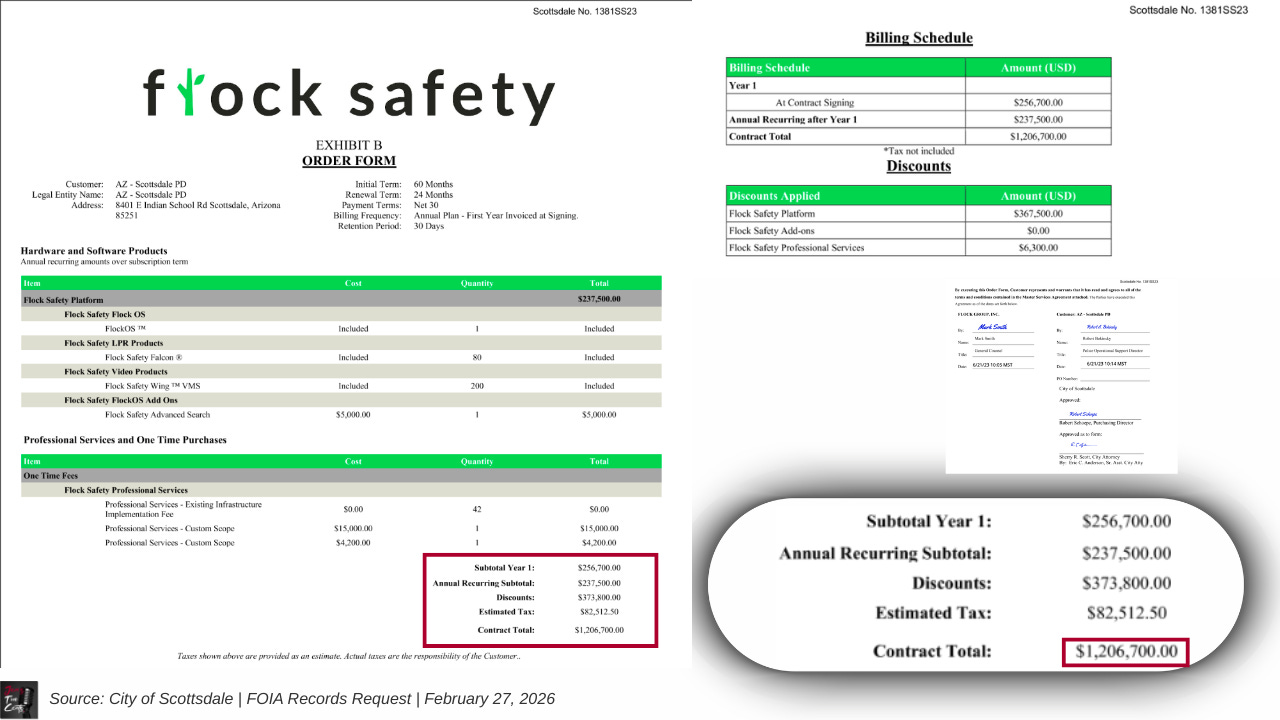
The platform includes:
80 Flock Falcon units
200 video integrations
FlockOS platform
Flock video management system
Advanced Search add-on ($5,000) This is typically the AI vehicle search tool (color, type, pattern matching).
It appears much of the cost is software subscription, not hardware.
“Flock Hardware is owned and shall remain the exclusive property of Flock.”
Flock Safety + AZ - Scottsdale PD Contract, June 2023 Agreement | Page 19 | Section 10.1
Separate documents associated with the agreement reference additional system components and services related to the department’s broader technology infrastructure, including computer-aided dispatch (CAD) integration and system connectors described in amendment materials tied to the agreement.
Discounts shown:
Platform discount: $367,500
Professional services discount: $6,300
Cameras Installed Prior to Execution of Amendment
Contract documents indicate that a portion of Scottsdale’s automated license plate reader cameras had already been installed prior to execution of the June 21, 2023 amendment to the Flock Safety agreement.
The amendment states that “on or about June 21, 2023, Customer previously received and installed 38 units as set forth in Scottsdale No. 1381SS23.” The document further states that the City had been invoiced for those units but had not yet paid the invoice at the time of the amendment.
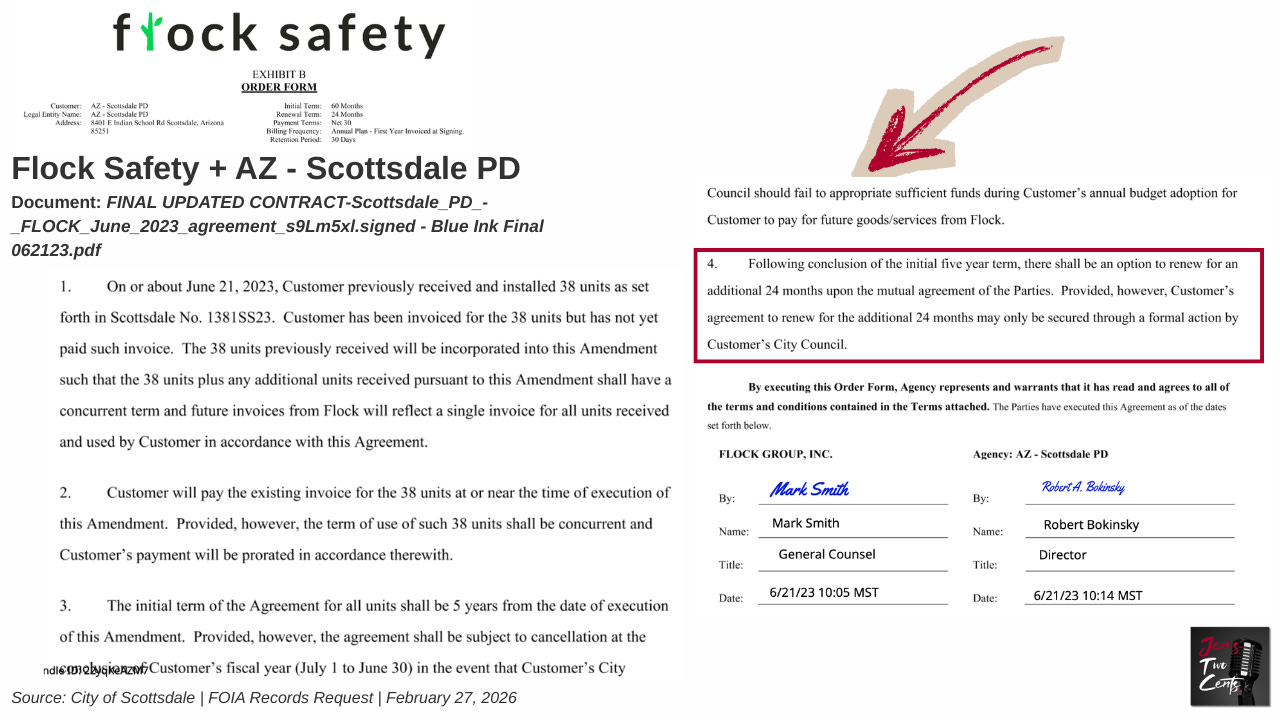
The amendment then incorporates those previously installed cameras into the agreement and provides that the 38 units, together with any additional units obtained under the amendment, will operate under a concurrent term and future invoices will reflect a single invoice for all units.
Under the same amendment, the initial contract term for all units is set at five years from the date of execution of the amendment, bringing the previously installed cameras under the contractual term beginning June 21, 2023.
Five-Year Term With Council Approval Required for Renewal
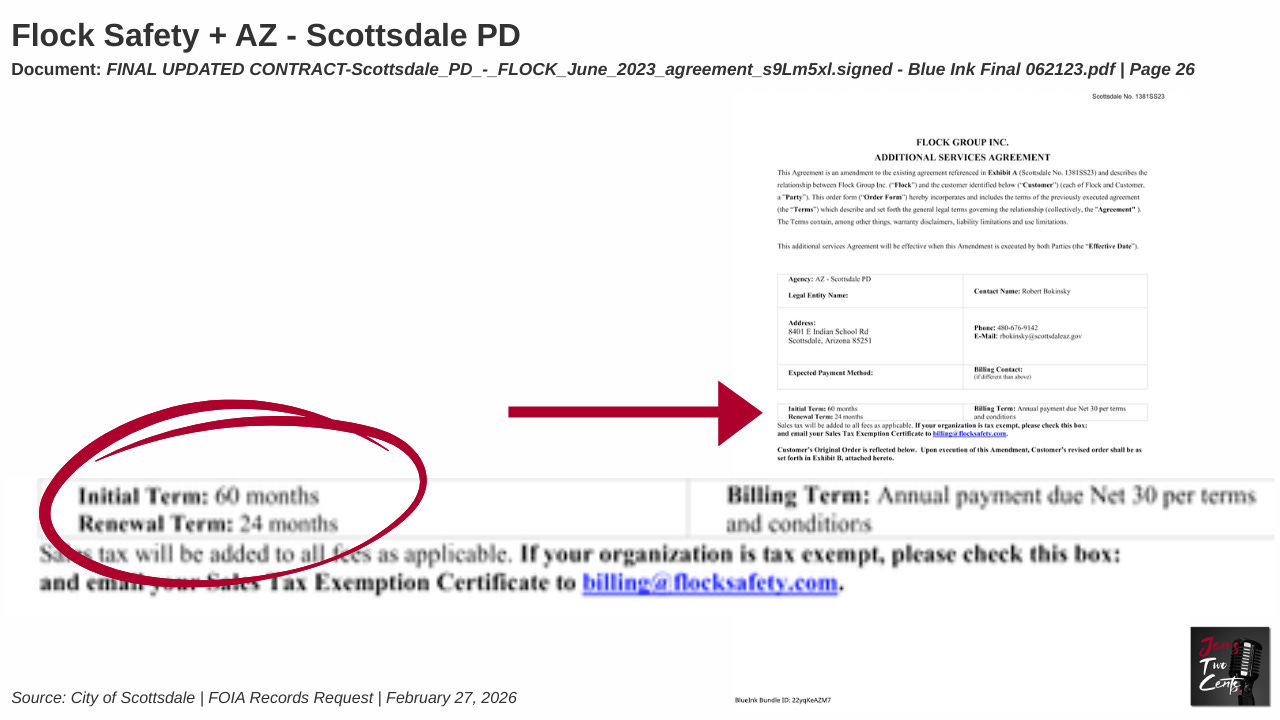
The amendment establishes a five-year initial contract term beginning June 21, 2023.
After the conclusion of the five-year term, the agreement provides an option to renew for an additional 24 months upon mutual agreement of the parties. However, the contract specifies that renewal may only occur through formal action by the Scottsdale City Council.
“Following the conclusion of the initial five year term, there shall be an option to renew for an additional 24 months upon the mutual agreement of the Parties. Provided, however, Customer’s agreement to renew for the additional 24 months may only be secured through a formal action by Customer’s City Council.”
Flock Safety + AZ - Scottsdale PD Contract, June 2023 Agreement, Page 28, Flock Group Inc. Additional Services Agreement
Under this structure, continuation of the Flock Safety system beyond the initial five-year term would require approval by the Scottsdale City Council in a public meeting.
What the Contract Says About Data Retention
The Scottsdale–Flock Safety agreement states that data captured by the automated license plate reader system is stored within the Flock platform for a limited period. According to the agreement, Flock deletes captured “Footage” on a rolling thirty (30) day basis, unless otherwise specified in the order form or preserved by law enforcement for investigative purposes.
The contract further states that the customer is responsible for extracting, downloading, or archiving any footage it wishes to retain beyond that period.
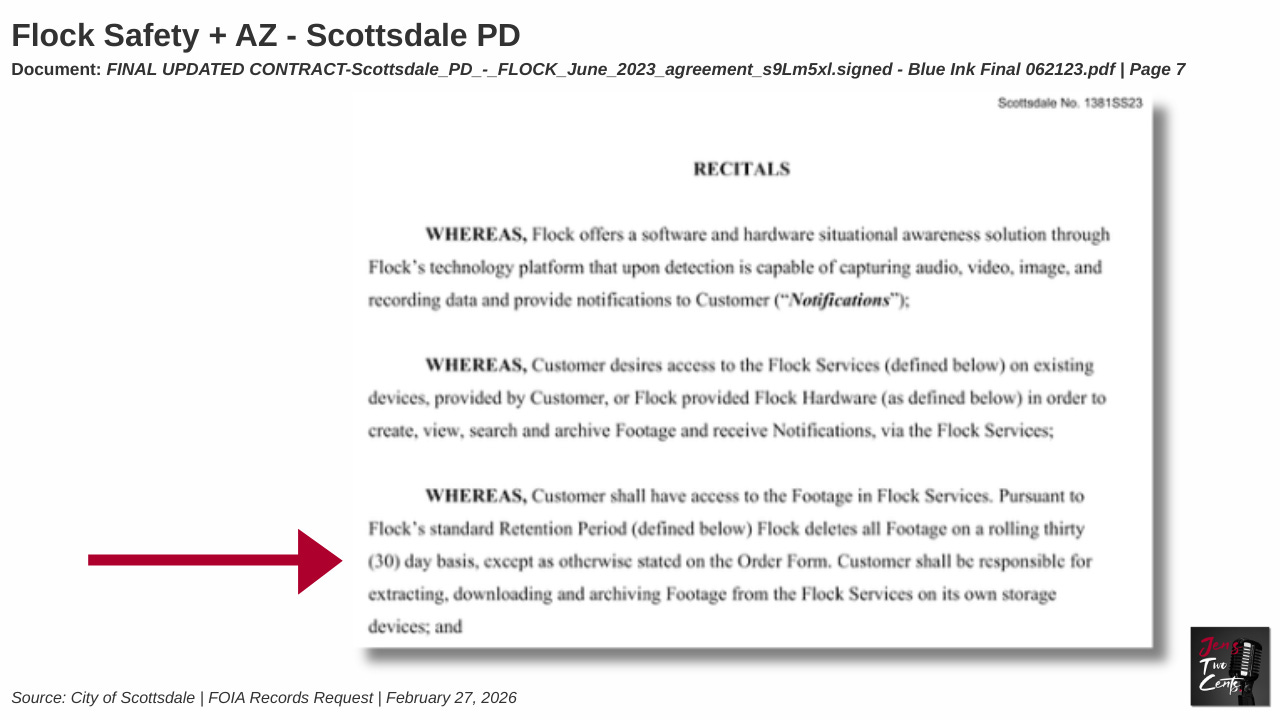
Records produced in response to a public records request also included Purchase Order PO100773 dated August 5, 2025, which references “Flock Safety Platform Extended Data Retention” in the amount of $27,552.75.
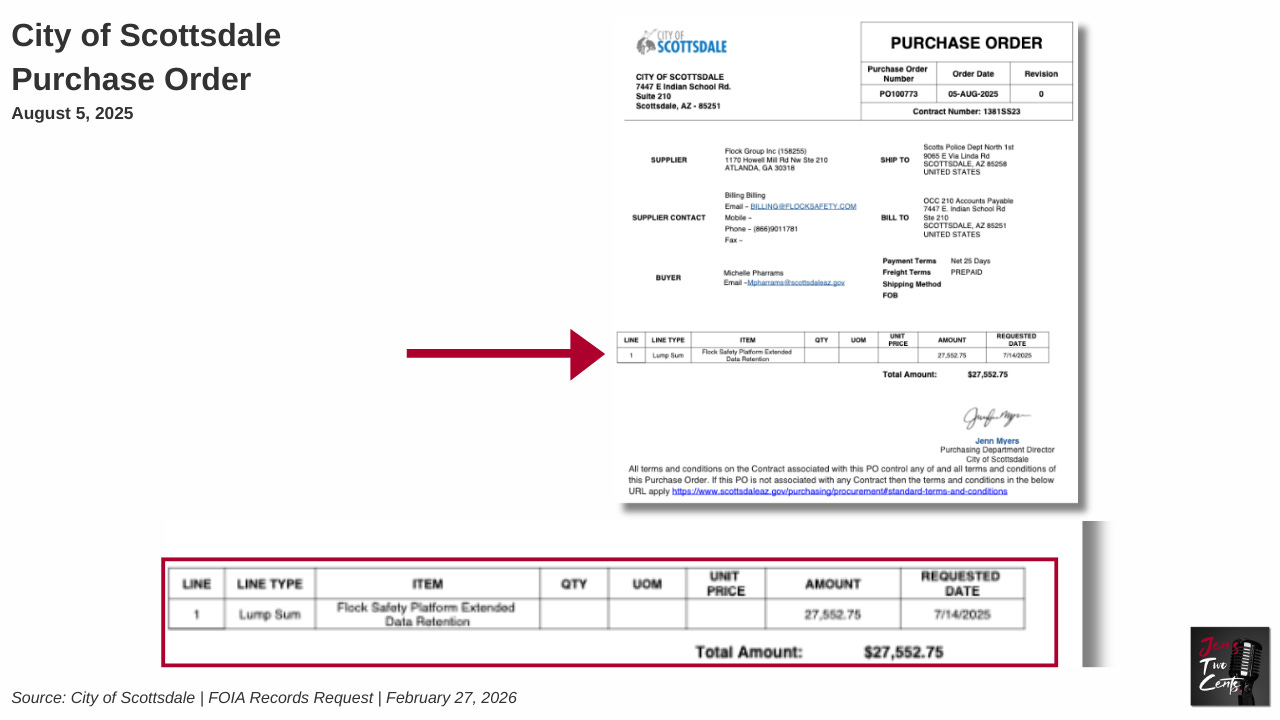
The purchase order does not specify the duration or technical parameters of the extended retention service. On March 3rd, I contacted the Scottsdale Purchasing Department for clarification and was told the inquiry would be forwarded to the Scottsdale Police Department. As of publication, no response has been received regarding the length or operational details of the extended retention referenced in the purchase order.
Recurring Service Structure
The Scottsdale–Flock Safety agreement establishes a 60-month initial service term with annual billing, indicating that the system operates under a recurring service arrangement rather than a one-time equipment purchase. Under the contract, the City pays ongoing fees for access to the Flock platform and related services during the term of the agreement.
System Performance Disclaimer
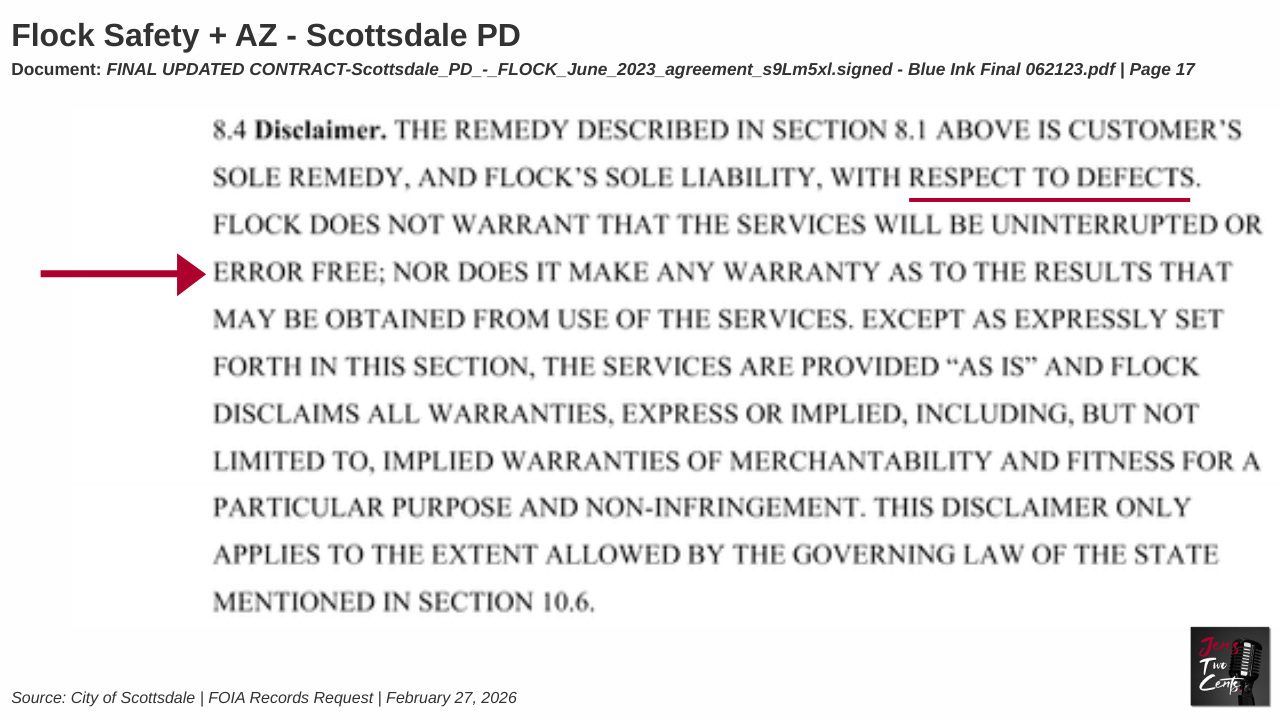
The agreement includes a warranty disclaimer stating that Flock does not guarantee the system will operate without interruption or error and does not warrant the results obtained from using the service.
Vendor May Use Anonymized Data to Improve the Platform
The agreement permits Flock Safety to anonymize certain data derived from the system and use that information to improve its technology. The contract states that anonymized data may be used to develop and enhance the platform, including training machine-learning algorithms and improving system performance.
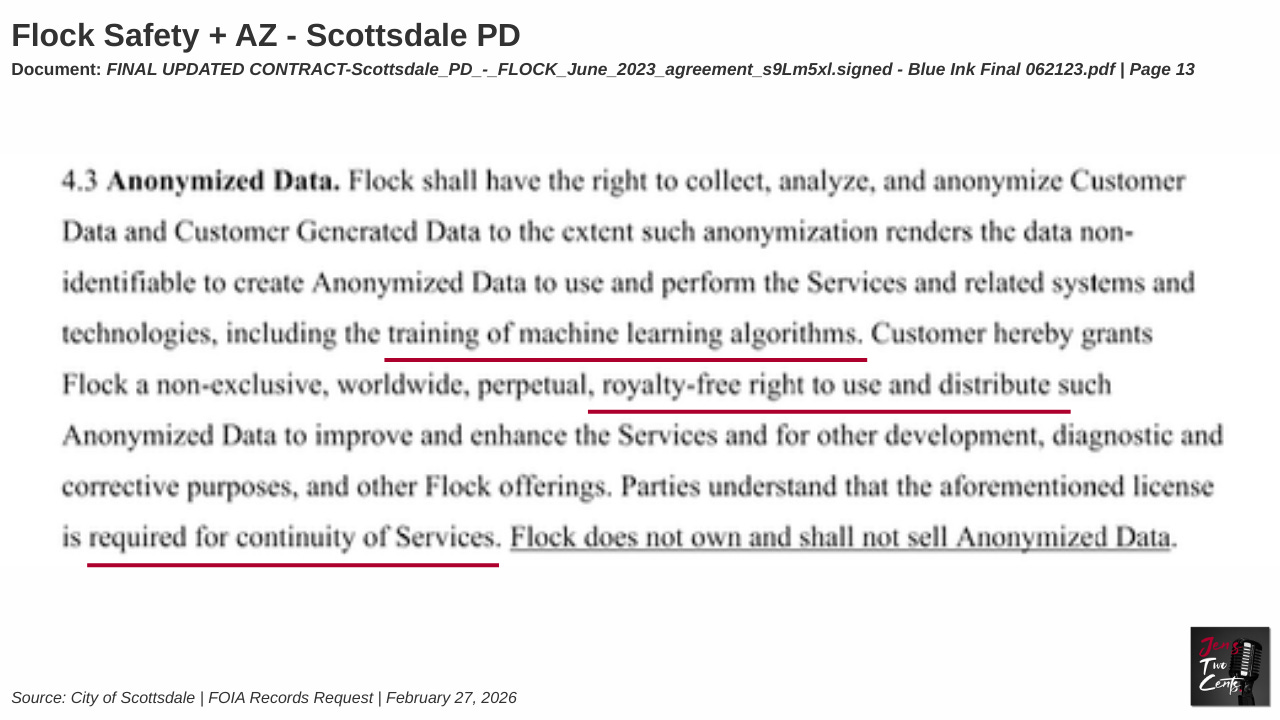
The document also states, “Flock does not own and shall not sell Anonymized Data.”
Vendor May Modify or Upgrade the Platform
The agreement allows Flock Safety to update or upgrade the platform during the term of the contract. The contract states that Flock may make upgrades it deems necessary to maintain or enhance the quality or delivery of its services.
Publicity Clause
The contract allows Flock Safety to reference the City of Scottsdale as a customer and disclose the nature of the services in its marketing and business development materials.
Partnerships and Shared Surveillance Networks
Outside the contract, Flock’s blog notes one key component of Scottsdale’s Real-Time Crime Center (RTCC) model is the ability to leverage cameras the city does not own.
According to materials describing the program, the RTCC can connect to thousands of video feeds from city agencies, schools, businesses, and other private partners. Rather than purchasing and maintaining every camera itself, the system integrates existing cameras into the platform, allowing analysts and officers to access the video in real time.
This approach can reduce direct government costs because businesses and partner organizations often purchase and maintain the cameras, while the city connects those feeds to the RTCC. Reports indicate Scottsdale’s system can access roughly 4,000 live video streams from partner sources.

Like many RTCC programs across the country, technology used in these systems may also be supported through federal and state funding sources such as Homeland Security grants, DOJ Byrne Justice Assistance Grants (JAG), and Urban Area Security Initiative (UASI) funds, which allow agencies to purchase surveillance tools, license plate readers, and command-center software.
The network is further expanded through regional data-sharing agreements, allowing agencies to connect across jurisdictions. These partnerships can include camera-sharing networks, license plate reader data sharing, and access to regional investigative databases.
According to Flock, Arizona has nearly twenty Real-Time Crime Centers operating across different jurisdictions, creating a broader technology network that allows agencies to share information and investigative resources.
“Scottsdale isn’t operating in a vacuum. Since 2021, the number of RTCCs in Arizona has grown from two to nearly 20, forming a regional safety net. Data and insights are shared fluidly between jurisdictions, enabling agencies to maintain continuity in investigations and patrol support across borders.”
-Flock Blog | August 13, 2025
In an earlier report examining Scottsdale’s expanding surveillance infrastructure, I identified a YouTube discussion from August 13, 2025 featuring Chris Henningsen, Manager of the Scottsdale Police Department’s Real-Time Crime Center (RTCC). During that discussion, Henningsen described the development of the city’s real-time policing capabilities as a gradual internal process.
When asked how Scottsdale established its Real-Time Crime Center during the COVID-19 pandemic period, Henningsen explained that the initiative progressed through internal proposals and departmental review over several years.
“We submitted a proposal to go through the department. It took a few years to get through that. To get buy-in. The problem is that it is very new on the west side of the United States.”

Additional Resources
Learn more about the National Real Time Crime Center Association: Link
Flock Blog about Scottsdale Real Time Crime Center: Link
Scottsdale Police Department: Link
The Scottsdale Police Department’s 2024–2027 Strategic Plan identifies expanded use of technologies such as e-citations, drones, and integrated policing software as part of its goal of building “industry-leading infrastructure and technology.”
Arizona License Plate Data Accessible Nationwide
As of March 13, 2026, the Payson Police Department’s Flock Safety transparency portal lists more than 400 law-enforcement organizations with access to its license plate reader data, including nearly 40 agencies in Arizona, as well as police departments from across the country and several federal entities.
Arizona Agencies in the Flock Network
Apache Junction AZ PD
Arizona Department of Public Safety
Arizona Department of Public Safety [Inactive]
Avondale AZ PD
Benson AZ PD
Buckeye AZ PD
Casa Grande AZ PD
Cave Creek AZ Marshal’s Office
Chandler AZ PD
Chino Valley AZ PD
City of Peoria PD AZ
City of Sierra Vista AZ
Coconino AZ SO
Douglas AZ PD
El Mirage AZ PD
Eloy AZ PD
Gila River AZ PD
Goodyear AZ PD
Graham County AZ SO
La Paz County AZ SO
Maricopa County AZ SO
Mesa AZ PD
Mohave County AZ SO
Navajo County AZ SO
Northern Arizona University Campus AZ PD
Oro Valley AZ PD
Page AZ PD
Paradise Valley AZ PD
Parker AZ PD
Phoenix AZ PD
Pima County AZ SO
Pinal County AZ SO
Prescott AZ PD
Prescott Valley AZ PD
Queen Creek AZ PD
San Luis AZ PD
Safford AZ PD
Scottsdale AZ PD
Show Low AZ PD
Snowflake-Taylor AZ PD
South Tucson AZ PD
Springerville AZ PD
Saint Johns AZ PD
Thatcher AZ PD
Tempe AZ PD
Tolleson AZ PD
Tombstone Marshals Office (AZ)
Tonto Apache AZ PD
University of Arizona Campus AZ PD
Williams AZ PD
The Payson Police Department’s transparency portal shows the network extends far beyond Arizona.
Agencies granted access include the U.S. Postal Inspection Service, Wright-Patterson Air Force Base, and Lake Mead National Recreation Area, along with police departments from Texas, Florida, Georgia, North Carolina, Wisconsin, Washington, Missouri, Ohio, California, and Colorado. In practice, it means license plate detections captured in Arizona may be searchable by investigators across the country.
Currently, no Arizona state law appears to specifically address this type of cross-agency data-sharing network, and the issue does not appear to have been challenged in Arizona courts.
As Arizona continues building real-time crime centers, the networks connecting cameras, databases, and agencies are expanding faster than the laws governing how that data is stored and shared.