

New Bill Would Codify License Plate Readers in Arizona Law—And Limit Public Records Requests
Technology evolves faster than the law, and lawmakers are now trying to catch up after these systems were already rolled out in communities across the state.
Police departments across Arizona are under real strain—short staffing, nonstop calls for service, and the daily reality of making split-second decisions in unpredictable situations. Technology can help close that gap, and license plate readers are one tool agencies say can quickly locate stolen vehicles, identify suspects, and solve crimes faster. But these systems don’t just capture suspected criminals—they capture everyday drivers, too. And as Arizona lawmakers move to codify license plate readers into state law through a bill promoted as a public safety measure, the debate isn’t just about fighting crime anymore. It’s about whether the push to help law enforcement is coming at the expense of privacy, transparency, and the public’s right to know what data is being collected—and who gets access to it.
I have the utmost respect for law enforcement, and I don’t believe this has to be an either/or fight. We can support our officers and still find common ground in protecting privacy, transparency, and the rights of everyday people who aren’t suspected of wrongdoing.
During a January 12, 2026 Goodyear City Council worksession, officials acknowledged changes to how automated license plate reader (ALPR) public records requests are handled, and also discussed something else: state lawmakers are now moving to codify license plate reader systems into Arizona law.
That revelation surfaced during a discussion about how Goodyear previously fulfilled an ALPR records request—and why the city says it would not do so the same way today. The conversation centered on past practices, including whether fulfilling a public records request involved placing a resident’s license plate into a law-enforcement “hotlist.”
The discussion matters because it sheds light on how ALPR data has been accessed, queried, and produced under Arizona public records law—and how agencies are now adjusting their approach as lawmakers consider new legislation and cities revisit their policies.
Based on the context, I understood the request being discussed to be mine.
In 2025, I requested my own ALPR data from the City of Goodyear. In response, the city produced a file showing my vehicle’s location history by date and time, along with hundreds of images.
I’ve referred to it as my “Flock file” because it represents a compiled set of my location data and images captured through the city’s Flock ALPR system and produced for the city’s use. While officials have stated they do not keep “files on residents” and that the city considers this data city-owned, based on the records I received, my license plate could be queried and my information produced as a compiled set in response to a public records request.
During the January 12th worksession, officials discussed how those records were generated and the subsequent development of a new city policy governing ALPR public records.
Goodyear City Councilmember Trey Terry stated:
“We did honor that request at the time. My understanding is the City of Surprise does not create a ‘hit’ - uh - Because when somebody would put in a public records request, it forces us to create a ‘hit’ - or put a plate on a hotlist to then be able to capture that data.”
That comment immediately raised questions for me. The idea that a resident’s license plate could be entered into a law-enforcement “hotlist” as part of fulfilling a public records request is significant—and it was not explained to me during the records request process. If the request being discussed was mine, I was not contacted by the City of Goodyear at the time to clarify whether any “hotlist” step was used in producing my records.
I emailed the city attorney seeking clarification.
The following afternoon, January 13th, Goodyear Police Chief Brian Issitt responded:
No, the creation of Hotlist entry was not required nor was one created in order to locate or produce a response to your public records request. A query of your license plate was created based on your public records request, which produced the information you received.
Goodyear Police Chief Brian Issitt | January 13, 2026
In the worksession, Councilmember Trey Terry went on to cite other Arizona cities, saying Surprise and Peoria do not provide the data, while Glendale “redacts everything.”
Terry continued:
“In a manner of transparency, I fully appreciate, we honored that request. But I know we’ve been reviewing our policy. How has that changed? And how are we—and are we now more aligned with Peoria, Glendale and Surprise have been treating this?”
Goodyear City Attorney Roric Massey responded that the city’s approach has changed:
“The short answer is ‘yes.’ Working with the Police Department, we’ve developed a policy on how to handle these public records requests and what is public records generally accessible to the public—and what does fall within those exceptions for privacy interests or best interests of the state.”
Massey acknowledged the absence of clear statutory guidance governing license plate reader systems:
“As you state, there’s no state statute that directly addresses LPRs and, as often happens when you have these fast-emerging new technologies, it takes a while for government to catch up.”
He added:
“There’s no case law on it. You have to look at what is analogous records and statute—what is now records in previous case decisions—and try to figure out where that fits.”
Massey said the city spent months evaluating how to balance access and privacy interests:
“Working with the Police Department, we spent quite a bit of time over the last couple of months really diving into what makes the most sense in providing access, and respecting the general Arizona law provision that public records should be open to the public unless it fits into one of these exceptions—that’s well-developed in case law.”
He continued:
“We think certain aspects of this probably do fall within those exceptions. There are some privacy interests that probably need to be respected. There are some operational issues that the Police Department needs to protect from public records.”
Massey concluded:
“Working with the Police Department, we developed what we think is a defensible policy, and we probably would not handle that exactly the same way we handled it back then.”
The comments reflect how Goodyear is reassessing ALPR records access in the absence of clear state law and court guidance.
From Local Records Request to State Capitol: Did This Spark SB 1111?
The timing raises a question: did public records requests like mine help bring license plate reader policy to lawmakers’ attention?
The January 12th discussion also referenced legislative outreach. Councilmember Trey Terry said he has spoken with Arizona Senate President Warren Petersen and had breakfast with House Speaker Steve Montenegro just weeks earlier regarding license plate reader systems.
Shortly thereafter, lawmakers introduced legislation that would place license plate reader technology into Arizona statute.
SB 1111, introduced by Senator Kevin Payne, would codify automated license plate reader (ALPR) systems and establish a statewide framework for how captured plate data is used and accessed, including limits on its purpose and disclosure.

Notably, this is not the first time Senator Kevin Payne has pushed to expand automated enforcement technology. Last year, he and Senator Frank Carroll introduced SB 1146, a measure specifying use of automated traffic enforcement—another system that tracks license plates. The bill advanced to a second read before stalling and failing to gain further traction in the Legislature.
When I pointed out on X this new legislation states “captured plate data is not subject to public review pursuant to a public records request, except an agency or law enforcement agency shall share captured plate data pursuant to a subpoena,” the response was immediate—and intense.

International privacy expert Naomi Brockwell, founder and host of NBTV, a project of the Ludlow Institute, weighed in publicly.
Responding on X, Brockwell wrote:

Her response echoed concerns raised by Arizona residents and transparency advocates: ALPR questions have led some citizens to seek their own records, while some cities have since restricted access—and lawmakers are now advancing legislation that would further limit public access to captured plate data.
The reaction from a national privacy advocate underscores that what began as a local records dispute is now drawing attention well beyond Arizona.
The bill also states that any “captured plate data is not subject to public review” or a public records request. Instead, any data captured by ALPR cameras could only be viewed by a law enforcement or a subpoena.
Jerod MacDonald-Evoy | January 14, 2026 | AZMirror
In response to an article by Jerod MacDonald-Evoy published by Arizona Mirror, titled “Police-backed GOP bill would shield license plate reader data from public review,” Senator Jake Hoffman posted a brief, unequivocal statement on X:

Another area of concern in SB 1111 is that it largely leaves retention limits to local policy.
To put that in context, consider how officials describe data collection on public roadways. During Goodyear’s January 12, 2026 worksession, Police Chief Brian Issitt was asked about the public’s expectation of privacy. Issitt said that if you’re in public—on a road, sidewalk, or thoroughfare—there is “really no reasonable expectation of privacy.” He emphasized that Goodyear’s Real Time Crime Center and drone-as-first-responder program are not designed to “spy” on residents, and said the technology is intended for solving crimes or responding to calls for service, with access governed by policies and limited to legitimate law enforcement purposes.
The question is: how long can agencies store the data?
Under SB 1111, agencies would be required to adopt and publicly post policies for obtaining, retaining, and destroying captured plate data—but the bill sets no uniform statewide retention limit.

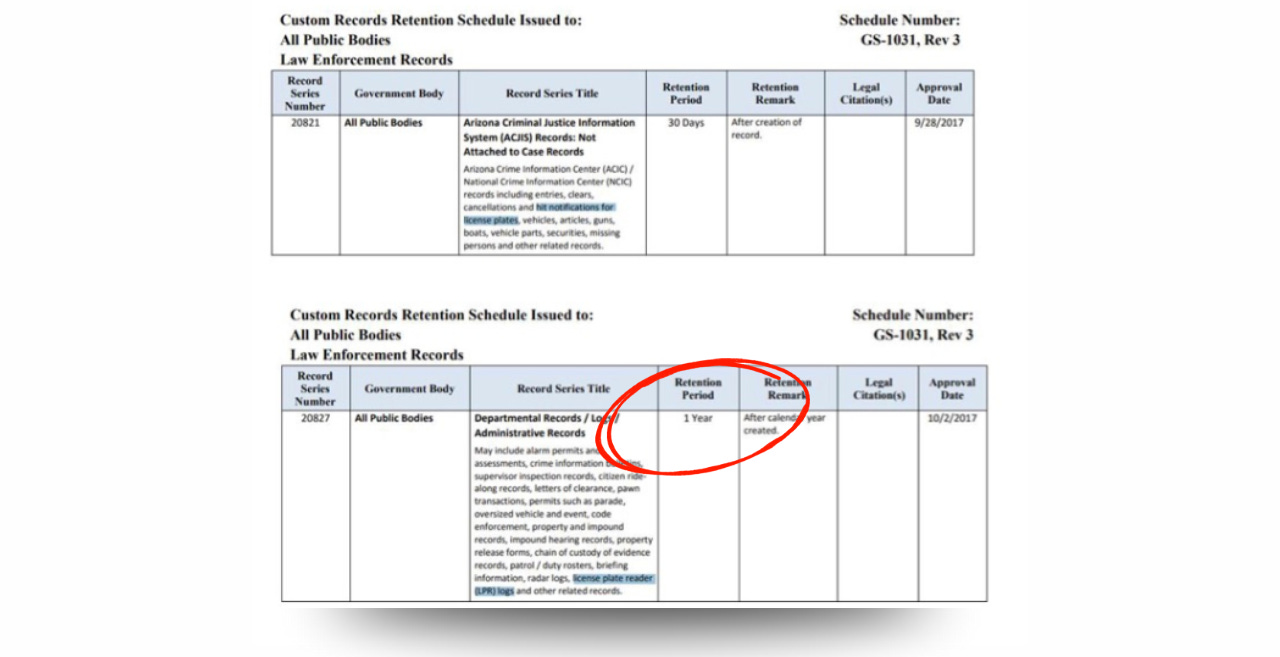
Based on records, policies, and contracts I’ve reviewed, that discretion already results in wide variation across Arizona, with retention periods ranging from as little as two weeks to as long as one year.
The consequences of that variability are not theoretical. A records request filed by Pam Kirby, a resident of Paradise Valley, returned a full year of her vehicle’s location data along with 429 images. For privacy and safety reasons—and to avoid publishing third-party plate data—I will not be sharing those images in my reporting.
Below is the town’s data retention policy returned as part of her request.
My “Flock file” showed the scope of what was collected about me. The records spanned 185 days, with 243 linked data points documenting my vehicle and 273 photos total, including images of other vehicles and license plates. Even more concerning, two different police departments told me the data errors reflected in these systems could not be corrected after the fact.
A resident in a northern Arizona town was denied his public records request for his own license plate reader data. He asked to remain anonymous, but shared this statement with me today:
“Being in public does not mean you are entirely deprived of privacy. Your movement from place to place should not be tracked without a warrant. Courts have already decided this in cases regarding GPS trackers on vehicles, as well as using cell tower location data. Government cameras watching us is a bar much too far.”
Anonymous | January 15, 2026
Another Arizona resident, James Ellis, also sought access to his license plate reader data—this time from the City of Surprise.
His case was extensively reported by Elena Santa Cruz of Arizona Republic, detailing the city’s refusal to release his records. Ellis later shared his denial letter with Jen’s Two Cents.
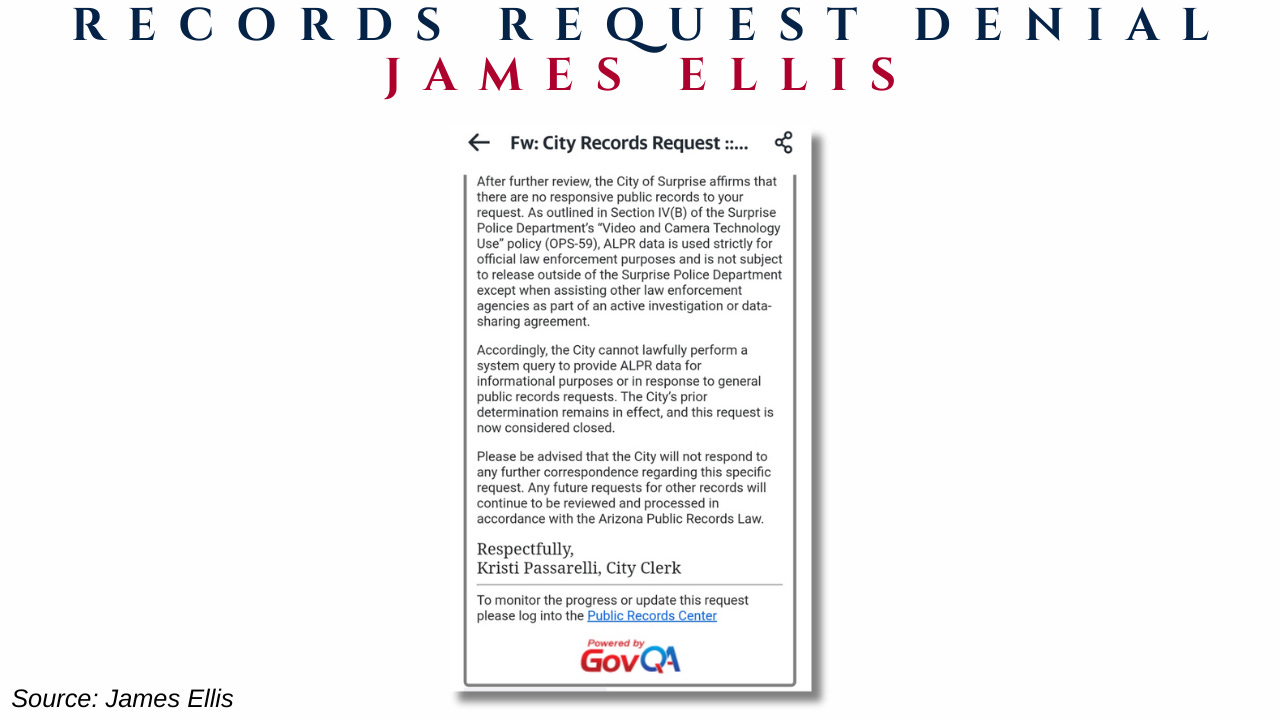
When asked for his thoughts on SB 1111, Ellis says:
“I have to say I’m disappointed in these bills especially from Arizona GOP lawmakers who preach limited government. I would have expected more restrictions and transparency on the use of such mass surveillance technologies. Instead, they are protecting government mass surveillance over the citizens.”
James Ellis | January 15, 2026
Data Sharing
SB 1111 would impose internal safeguards, including limiting access to authorized personnel, mandatory training on privacy and legal compliance, query logging, and annual audits of access logs. It would also prohibit agencies from selling or exchanging captured plate data for non-law-enforcement purposes.

However, the bill still permits law enforcement agencies to share license plate reader data for law-enforcement purposes—and that is where unresolved concerns remain.
As I previously reported in Prescott Valley, the police department there reported 267 data-sharing partners connected to its Flock license plate reader system.
When I asked two different Arizona police departments how they ensure outside agencies follow the same access, retention, and privacy standards, neither could confirm that receiving agencies are required to adhere to identical rules.
That gap matters. SB 1111 apparently permits sharing beyond the originating agency—including sharing outside of Arizona—yet it does not clearly specify how training, auditing, retention, and access standards are enforced once the data leaves local control.
I’ve written multiple stories on automated license plate readers (ALPRs) in Arizona and how these systems are being deployed, used, and governed—often with limited public discussion until after cameras are already installed. While Flock Safety and Verra Mobility have not responded to my past requests for comment, they are always welcome to do so.
One exchange that captures the tension at the heart of this issue took place during a June 2025 Prescott Valley study session, when Mayor Kell Palguta raised privacy concerns about the town’s expanding use of Flock Safety’s camera system:
“So I’m sure you hear this a lot or you’ve had this question,” Palguta said. “And I’ve seen it before too—this is a great tool for our law enforcement officers. But it’s that fine line where you have those people that argue ‘Big Brother is watching.’ What do you say? What does your company say to those folks?”
A Flock representative, Hamza Al Baroudi, acknowledged the concern and said the company builds safeguards into the system to prevent misuse:
“The system—we try to draw as much parameters as we possibly can to make sure there is an audit trail and make sure there’s not a misuse in the system,” he said, noting that users must provide a reason for every search.
He also stated:
“We have a 30-day retention policy on this, so we’re not just holding on to data and getting to the point where we’re over-policing.”
Bottom line: SB 1111 appears to strengthen internal safeguards while leaving inter-agency sharing largely governed by agency policies and intergovernmental agreements—an issue that becomes more significant as data networks expand across jurisdictions and state lines.
Jen’s Two Cents.
Mainstream media coverage of SB 1111 varies widely. In recent reporting by AZFamily and KJZZ, the bill is largely framed as a regulatory effort focused on training, audits, and internal controls. Those stories did not address key provisions and open questions that matter to residents, including limits on public records access to captured plate data, the scope of inter-agency sharing (including outside Arizona), and the fact that the bill sets no uniform statewide retention limit. Those details shape how this law would affect real people seeking access to their own data—and they’re exactly why independent journalism remains essential.
Supporting public safety and protecting privacy shouldn’t be opposing goals—and Arizona lawmakers can do both if they’re willing to write clear limits into law.
What can you do? Use Request to Speak (RTS).
The Arizona Legislative Information Service (ALIS) Request to Speak (RTS) program lets the public register a position on bills and request to speak when those bills are heard in committee. It’s one of the most effective ways for residents to be on the record—directly in front of lawmakers.
You can create an account at home. However, to activate RTS, you may need to visit the Capitol and log in at one of the kiosks the first time you use the system.
If you are unable to make it to the capitol, two organizations are offering to help.
Get started here:
Maricopa County Libertarian Party (RTS sign-up & guidance):
https://lpmaricopa.org/request-to-speakRTS setup assistance offered by Merissa Caldwell (EZAZ / PIE), whose mission is “making civic education and action easy as pie 🥧 so the people become the chief stakeholders of their government.”
https://www.ezaz.org/rts
If you want your voice counted—this is how. We appreciate both organizations helping out our readers!
RTS lets you weigh in on more than SB 1111. It will also allow you to chime in on additional legislation highlighted by Live Free AZ, including:
✅ HCR 2004 — Stop Photo Enforcement (House)
This resolution would let Arizona voters decide whether to ban traffic photo enforcement systems.
Why it matters: Law enforcement should remain with trained officers—not outsourced to private, for-profit companies. This measure protects due process and helps reduce incentives for enforcement driven by revenue rather than safety.
✅ SCR 1004 — Stop Photo Enforcement (Senate)
The Senate companion to HCR 2004, also sending the issue directly to voters.
Why it matters: Same principle, same stakes—voters decide, not vendors. This is about accountability, transparency, and keeping enforcement human.
🛑 SB 1088 — Cybersecurity Funding Without Privacy Guardrails
This bill would allocate $2.5 million for cybersecurity efforts, including generative AI programs, without explicit privacy guardrails written into the bill text.
Facial Recognition Clarification — Different Types of Technology
SB 1111 does not mention facial recognition. It focuses on ALPR use for criminal investigations, missing persons, or persons in danger, and states ALPR data is not to be used for routine traffic enforcement (except crashes or hazards).

ALPR technology isn’t one-size-fits-all—cities use different vendors with different capabilities. Goodyear officials said their Flock cameras aren’t designed to capture faces. Alternatively, records I obtained in Paradise Valley showed Verra Mobility photo enforcement images could be zoomed in enough for detectives to identify details and compare them to social media photos.

Even if a system isn’t designed to capture faces today, future upgrades—or different vendors—could expand what’s possible. That’s why the guardrails matter now, not later—because once surveillance becomes normal, it rarely rolls back.
I saw a quote this week that stuck with me: “Without privacy, there’s no freedom. Without freedom, there’s no choice.” That’s the crossroads Arizona is standing at with SB 1111. We can support law enforcement, embrace tools that solve real crimes, and still insist on clear limits, transparency, and accountability for the rest of us who are simply living our lives.
To get a deeper understanding of why this AI-powered technology matters—and the broader privacy implications—check out this interview I did with privacy expert Naomi Brockwell: