

Scale of the System: Records Indicate Arizona Vehicle Surveillance Networks Can Reach 95,000+ Cameras
Exclusive records show vehicle plate searches in Arizona can extend across tens of thousands of cameras, with policies set locally and much of the network operating beyond public view.
Law enforcement agencies across Arizona have raised concerns about shrinking staffing levels and have increasingly turned to technology to supplement operations. As surveillance tools expand, the balance between public safety and personal privacy is no longer abstract. It can be examined through available data.
Across the state, departments are using automated license plate readers (ALPRs) as force multipliers, extending the reach of an agency beyond the number of officers on the street.
According to the Avondale Police Department, license plate reader technology has been used in recent incidents to assist officers during active calls. In one case, officers responded to a missing person report that was escalating toward a Silver Alert. Using the system, they were able to quickly locate the individual before the situation intensified.
These examples illustrate how the technology is used in individual cases. The records, however, show how far the system can reach across connected networks.
Arizona does not have a single statewide framework governing how license plate reader systems are used, shared, or audited across agencies. Instead, policies are set at the local level, creating variation in how data is retained, accessed, and shared.
At the same time, the dataset reflects only government agency participation. It does not include private companies, homeowners associations, or other non-government entities that may operate license plate reader systems. As a result, the total number of cameras and the full scope of the network are likely larger than what is reflected in these records.
What the records do show is scale.
Thousands of connected networks. Tens of thousands of cameras. In some instances, a single query was capable of including more than 95,000 devices across connected networks.
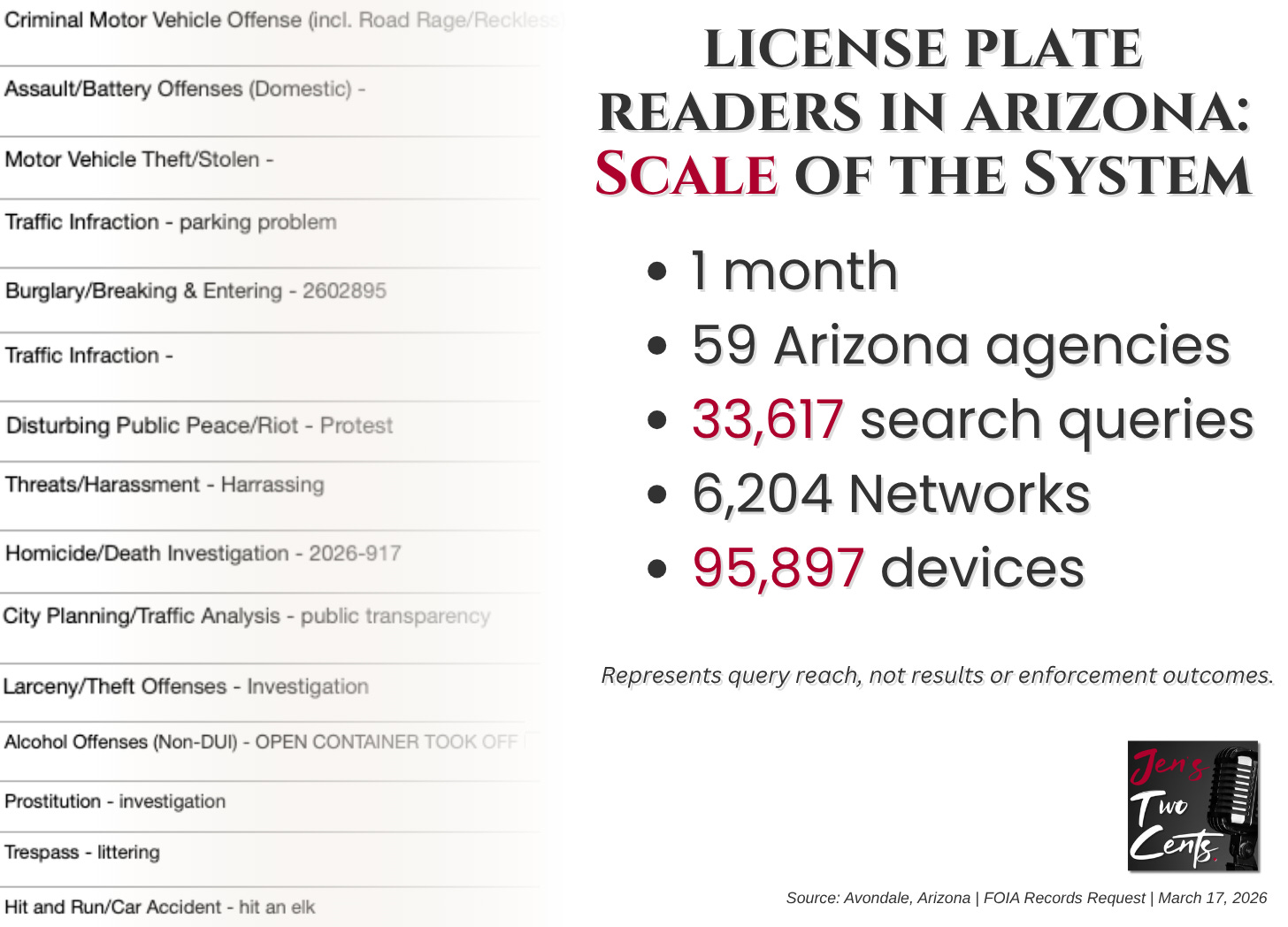
The figures in this report reflect the potential reach of the system based on connected networks and devices. They do not indicate that every camera was actively searched, reviewed, or returned results in each query. Instead, they show how broadly a single query can extend across participating agencies.
At the same time, Arizona lawmakers have spent the current legislative session debating what limits, if any, should exist around the use of this technology. In practice, local agencies appear to set their own policies on data retention, sharing, and access, as reflected in this dataset.
Records for this investigation were obtained through a public records request to the Avondale Police Department. The request returned two datasets: one reflecting Avondale’s internal activity, and another identifying Arizona agencies connected through its network, along with detailed search data, including the number of networks and devices queried.
Jen’s Two Cents welcomes feedback and additional context from agencies and companies involved in the operation of license plate reader systems in Arizona. A request for comment was sent to Flock Safety; no response has been received as of publication.
This reporting does not assert wrongdoing by any agency. It reflects documented activity and is intended to provide transparency into how these systems are being used.
Arizona Audit Data: Scope and Reach
This document reflects Arizona-originating searches and lookups conducted through the Flock Safety operating system including those connected to Avondale. It is unclear whether this represents the full scope of Arizona agency activity, as searches may also occur through networks and devices that do not include Avondale.
View the Public Records Request - External Audit - Avondale Police Department

A “query” refers to a search entered into the system using identifiers such as a license plate, partial plate, or vehicle description.
The records request produced a dataset of 33,617 search queries over a single month. Logged between January 2 and February 2, 2026, it reflects an automated vehicle tracking system extending beyond a single jurisdiction.
In some cases, a single query was capable of reaching more than 95,000 devices across thousands of networks connected to multiple agencies.
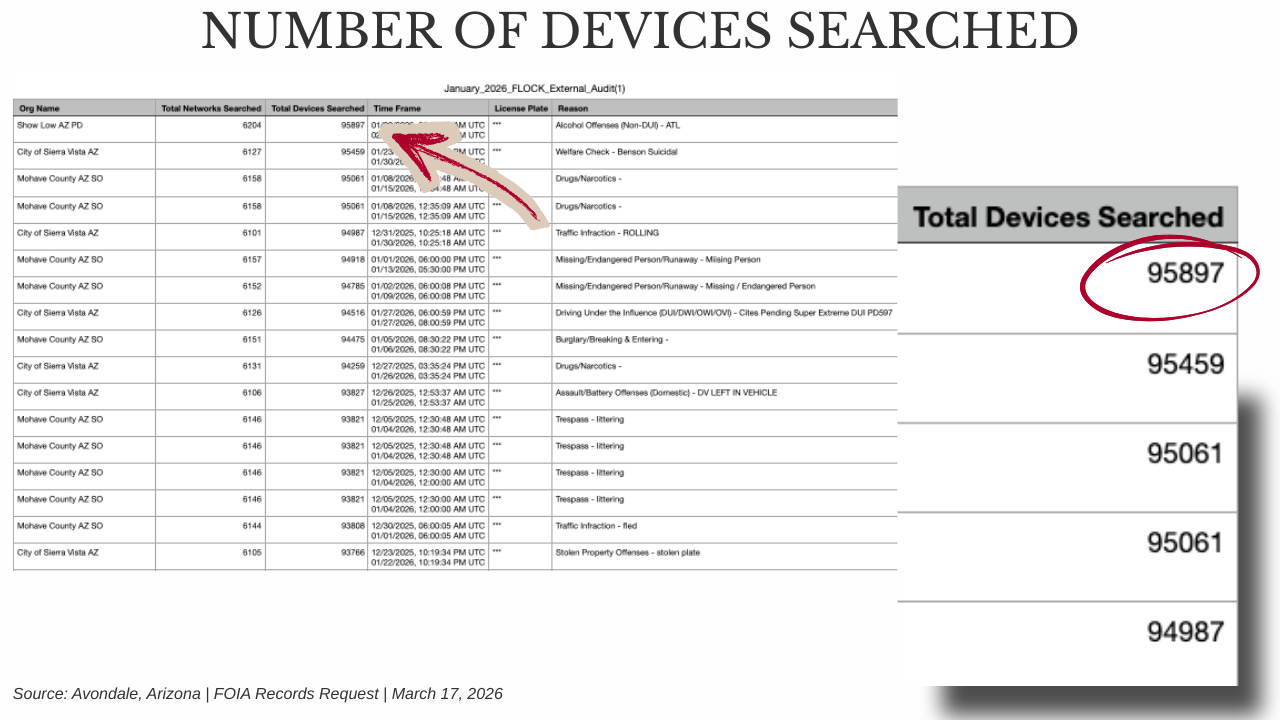
While several companies provide license plate reader technology, this analysis focuses on the Flock Safety system based on records obtained following Avondale’s March 2026 proposal to expand its system by 58 additional Flock license plate readers.
The dataset captures a single month of activity and reflects a statewide cross-section of 59 Arizona law enforcement and related agencies. These include city police departments, county sheriff’s offices, campus police agencies, tribal police departments, the Arizona Department of Public Safety, and the Pinal County Attorney’s Office.
Because it covers only one month, the records should be understood as a limited snapshot rather than a complete picture of all Arizona agency activity over time. In addition, this dataset reflects only a portion of the broader ecosystem, as it does not include privately operated license plate reader systems that may also be connected through shared networks.
This reporting does not allege wrongdoing. It presents documented activity to provide a clearer understanding of how these systems operate in practice.
Networks and Devices: How Far a Single Search Can Reach
Flock Safety’s system operates as a connected network of license plate reader cameras. Participating agencies can choose to share access to their data with other agencies, allowing searches to extend across jurisdictions. According to Flock Safety, agencies retain ownership of their data and control access permissions, while the platform enables real-time searches and alerts across a broader network that can span multiple cities and states.
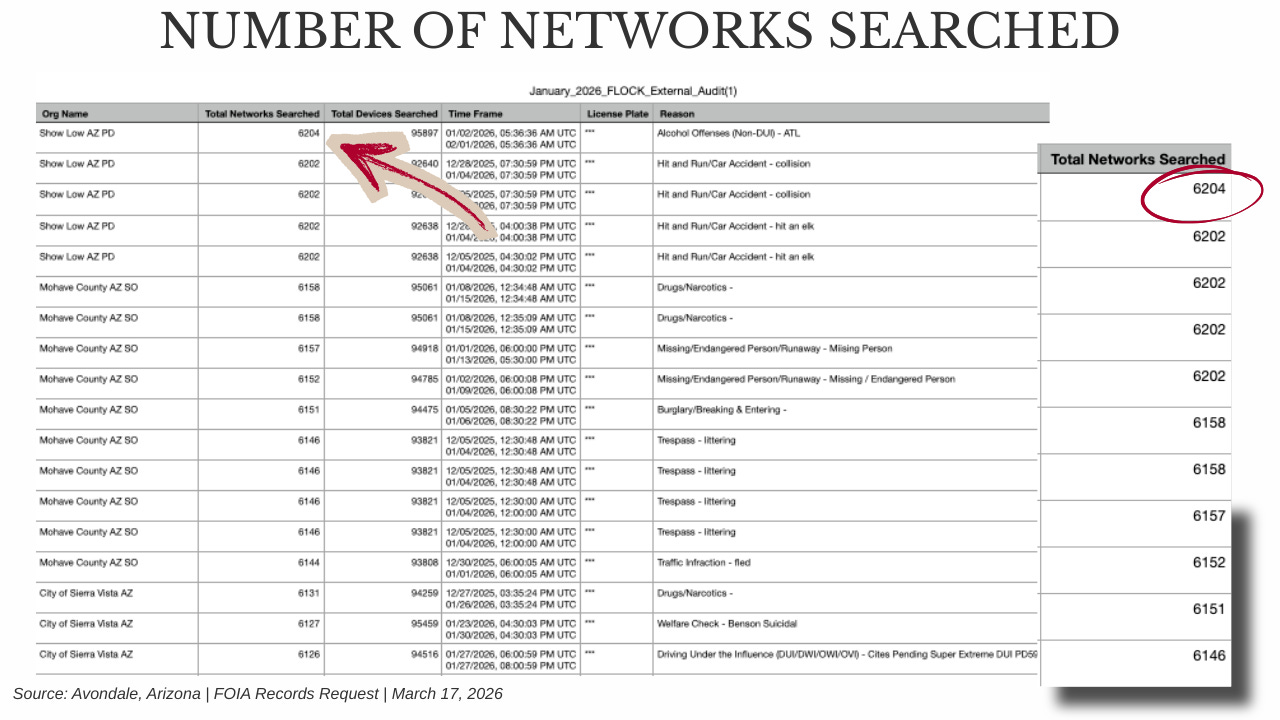
Each network represents a participating agency, such as a police department or county sheriff’s office. However, a network does not correspond to a single camera. Based on information provided in the records and supporting materials, each “device” reflects an individual camera, meaning a single agency network can contain multiple devices.
Avondale, for example, may appear as a single network while still including approximately 15 separate cameras. When aggregated across participating agencies, this structure helps explain how a single query can be capable of reaching more than 95,000 devices across multiple jurisdictions.
FLOCK NATIONAL LPR NETWORK
According to Flock Safety, its network spans more than 49 states and processes over 20 billion license plate reads per month, reflecting the scale of data accessible within the system.

In Arizona alone, records obtained by Jen’s Two Cents show that some queries extended across more than 6,000 networks.
How to Read the Data
The figures in this report reflect the scope of networks and devices included within a query, not the number of results returned or reviewed. When a query includes thousands of networks or tens of thousands of devices, it represents the potential reach of the search parameters rather than confirmed matches or investigative outcomes. The records do not include information on whether a query produced a match, alert, or enforcement action.
Top 10 Largest Network Searches
The following represents the ten largest network-level queries identified in the dataset, illustrating how broadly a single search can extend across connected agencies.
Show Low AZ PD — 6,204 networks searched
Mohave County AZ SO — 6,202 networks searched
Sierra Vista AZ PD — 6,126 networks searched
Mesa AZ PD — 6,055 networks searched
Maricopa County AZ SO — 5,989 networks searched
Peoria AZ PD — 5,984 networks searched
Surprise AZ PD — 5,966 networks searched
San Luis AZ PD — 5,961 networks searched
Navajo County AZ SO — 5,951 networks searched
Phoenix AZ PD — 5,944 networks searched
Top 10 Largest Device Searches
Below are the ten largest single-query returns by agency, showing the number of devices included within a single search query.
These figures represent the number of devices included within a query’s search range. They do not indicate that each device returned data or was individually reviewed.
Show Low AZ PD — 95,897 devices (Alcohol Offenses Non-DUI - ATL)
Sierra Vista AZ PD — 95,459 devices (Welfare Check - Benson Suicidal)
Mohave County AZ SO — 95,061 devices (Drugs Narcotics)
Peoria AZ PD — 92,116 devices (Disorderly Conduct Investigation)
Navajo County AZ SO — 91,909 devices (Burglary Breaking and Entering)
Casa Grande AZ PD — 91,839 devices (Drugs Narcotics)
Maricopa County AZ SO — 91,836 devices (Motor Vehicle Theft Stolen)
Phoenix AZ PD — 91,835 devices (Missing Endangered Person / Runaway)
Surprise AZ PD — 91,635 devices (Motor Vehicle Theft Stolen)
Gilbert AZ PD — 91,596 devices (Homicide Death Investigation)
Search and Lookup Reasons Listed by Category
Categories range from traffic-related activity to serious crimes including homicide, kidnapping, and terrorism.
City Planning / Traffic Analysis – traffic pattern
Secured Area Access Control
Trespass – Littering
Parking Problem
Speeding
Traffic Infraction / Traffic Stop
Alcohol Offenses (Non-DUI)
Alcohol Offenses (Non-DUI) – Open Container / Subject Fled
Curfew / Loitering / Vagrancy – Investigation
Curfew / Loitering / Vagrancy – Suspicious Vehicle
Disorderly Conduct / Disturbance
Disturbing Public Peace / Riot – Protest
Indecent Exposure / Lewd
Trespass / Suspicious Activity / Investigation
Threats / Harassment
Obstructing Justice – Fake Plate
Obstructing Police (Fleeing / Eluding)
Destruction / Damage / Vandalism of Property – ATL
Counterfeiting / Forgery
Prostitution
Financial Crime (Embezzlement / Fraud)
Extortion / Blackmail – Vehicle Tracking
Property Crimes (Theft / Larceny / Shoplifting)
Burglary / Breaking and Entering
Arson
Animal Offenses (Cruelty / Neglect / Poaching)
Drugs / Narcotics
Motor Vehicle Theft / Stolen Vehicle
Wanted Person (Warrant / Fugitive)
Protective Order – Attempt to Locate
Assault / Battery
Robbery
Weapons Offenses / Violations
Weapons (Guns / Shots Fired)
Hit and Run (Injury Risk)
Stalking
Missing / Endangered Person / Runaway
Welfare Check (Suicidal / Mental Health Crisis)
Kidnapping / Abduction
Child Abuse / Neglect
Sex Offenses (Sexual Exploitation of a Minor)
Human Trafficking – Investigation
Terrorism / Terroristic Threats
Homicide / Death Investigation
Avondale PD: Data Retention, Sharing, and Public Access
West of Phoenix sits Avondale, Arizona, a rapidly growing and highly diverse community of more than 96,000 residents where public safety, technology, and growth are increasingly intersecting.
City data shows a community with strong homeownership, a broad economic base across retail, healthcare, construction, and public administration, and shifting public safety trends. In 2025, crimes against persons, primarily domestic violence-related assaults, reportedly increased by 11.25 percent. Crimes against property decreased by 3.2 percent, and crimes against society declined by 8.43 percent.
Amid reported staffing shortages and retention challenges, the Avondale Police Department has proposed expanding its use of technology as part of its overall strategy. The proposal is part of a broader trend of agencies incorporating technology to supplement staffing and operational capacity.
According to Police Chief Memo Espinoza, a significant number of recruits leave during the academy or field training process.
“We lost a majority during the Academy and during our Field Officer Training program,” Avondale Police Chief Memo Espinoza told council members.
“A lot of individuals, we bring them on board, we try to explain to them the difficulties of this position… But at the end of the day, once they start the Academy, ‘you know, this is not for me,’ and they move on.”
Even among those who complete training, the chief says some decide the profession is not the right fit after beginning work in the field.
Current initiatives include AI-assisted report writing software, a Drone as First Responder program, and an expanding network of license plate readers.
Avondale currently operates 15 Flock Safety cameras and has proposed adding 58 more, as city leaders weigh staffing challenges, public safety priorities, and the role of technology in policing.
While multiple companies provide license plate reader technology, this records request focuses on Flock Safety in connection with Avondale’s March 2026 proposal to expand its system. The purpose is to better understand how the system is used and the scale of its reach.
License Plate Reader Queries Through the Flock Safety System in Avondale
The dataset specific to the Avondale Police Department provides a detailed view of how the system is used in practice, capturing individual queries conducted through the Flock Safety platform within the city’s network.
Access to the system is limited to trained personnel such as officers, detectives, dispatchers, and authorized staff, according to the Avondale Police Department.
Jen’s Two Cents has chosen not to publish the Avondale-specific records in full, and instead provides a summary to balance transparency with considerations related to employee privacy.
While the records document how the system is queried, they do not indicate whether those searches produced results or led to enforcement actions. The Avondale Police Department has highlighted successful uses of the technology in media reports and city council presentations.
The absence of outcome data in this dataset limits the ability to independently assess the effectiveness of individual queries.
Department leadership described how the system is used in practice. In March, Police Chief Memo Espinoza told council:
“In Avondale, we simply utilize them for the purpose as an investigative tool for our officers or detectives. We do not use them to chase cars around or anything like that.”
He added the department uses Flock cameras as an investigative tool and not to actively track or pursue vehicles.
Key Highlights from the Avondale-Only Records
837 total queries were recorded between January 3rd and February 1, 2026.
The records indicate that a single query could extend across as many as 178 networks simultaneously.
At its highest, a single query included up to 4,409 devices (cameras), illustrating how broadly a single lookup can extend.
Over the one-month period, the records identify 58 unique users conducting searches and queries within the system.
“The unique names you are referring to are all Avondale Police Department staff members (officers, detectives, community service officers or dispatchers) who queried the information on the logs,” said Officer Daniel Benavidez of the Avondale Police Department.
Queries sometimes included specific license plates or filters such as vehicle type, make, color, full plate numbers, or partial plate inputs.
The records show search queries included license plates from multiple states, including:
Arizona
California
Florida
Idaho
Indiana
Montana
Nevada
North Carolina
Oklahoma
Texas
Wisconsin
In response to the public records request, the Avondale Police Department provided additional detail on how its Flock Safety automated license plate reader (ALPR) system is managed, including data retention, network sharing, and public access.
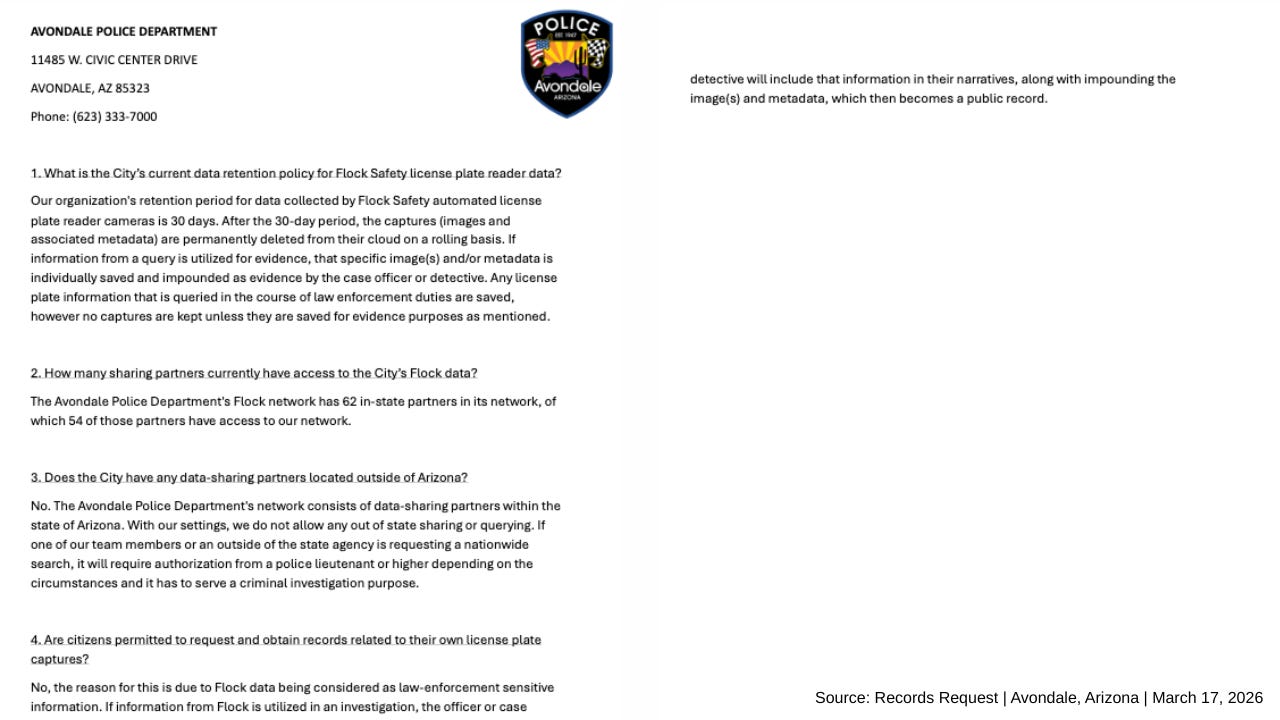
According to the department, ALPR data is retained for 30 days, after which images and associated metadata are automatically deleted on a rolling basis. The only exception is when data is tied to an investigation. In those cases, relevant images or metadata may be saved and impounded as evidence, becoming part of a case file.
The response also confirms that Avondale participates in a shared network of 62 in-state partners, with 54 agencies currently able to access Avondale’s system. While the department states that its network is limited to Arizona agencies, it acknowledges that broader, nationwide searches may occur with supervisory approval and must be tied to a criminal investigation.
When it comes to public access, the department states that private individuals are not permitted to use FOIA to obtain records related to their own license plate captures. The data is considered law enforcement sensitive, and access is restricted unless it is used as part of a formal investigation, at which point it may become part of the public record through case documentation.
Avondale Police Department Neighborhood Resource Officer Daniel Benavidez responded to additional follow-up questions for this investigation.
Q. How is the license plate reader system helping the department right now, especially with current staffing or recruitment challenges?
A. “License Plate readers are not a replacement for law enforcement officers. They are a tool that gives our staff useful information in investigating crimes. The purpose of the license plate reader is to accurately identify vehicles that may have been used in the commission of a crime and in locating individuals who may need assistance i.e. Silver Alert. Our license plate reader system is Flock, a proprietary system that securely captures images and uses Vehicle Fingerprint technology to identify the license place, vehicle make, type, and color.”
Q. The audit logs show searches that can reach a large number of networks and devices. Can you help explain how that access works and what safeguards are in place?
A. “The Avondale Police Department’s Flock network consists of 62 in-state partners in its network. The Avondale Police Department’s network consists of data-sharing partners within the state of Arizona. With our settings, we do not allow any out of state sharing or querying. If one of our team members or an outside of the state agency is requesting a nationwide search, it will require authorization from a police lieutenant or higher depending on the circumstances and it has to serve a criminal investigation purpose. Our staff who are trained in license plate readers are assigned username and login credentials. Our staff who have access to the system are directly involved in responding to crimes and investigating crimes. The license plate reader is used for investigatory purposes only. Our policy prohibits using Flock for personal use. Staff are required to assign a Department Report number and report type to queries. Staff with license plate reader access are trained by our Flock designated liaison and Administrators.”
Q. How do you determine which employees are able to access and run searches in the system?
A. “Only officers, detectives and staff (dispatchers and community service officers)who are responding to and investigating criminal activity have access to the system. We also grant access to dispatchers who recieve and input information, which may use Flock to assist officers respondin to calls. This staff is trained by our license plate reader liaison and adminstrators. No staff is allowed to use the system unless they have been trained.”
Q. What policies guide when and how officers are allowed to use it?
A. “The Avondale Police Department has a policy that governs the use of Flock in which the license plate readers can only be used for law enforcement purposes only.”
Q. Do you track outcomes from these searches, like arrests, recovered vehicles, or cases solved?
A. “Right now, we celebrate the uses of the license plate reader by word of mouth and by sharing results in department wide incident briefings. Outcomes are also noted in our department reports. The purpose of including results in department reports is so that we document where information was obtained. When the system captures footage of evidential value, the photographs are uploaded into our digital evidence storage and assigned with the associated department report number.”
Q. If possible, are there any recent success stories from this timeframe you’d be willing to share?
A. “Last week, we responded to a missing person call for service, which was rapidly evolving into a Silver Alert. However, by use of our license plate reader system, we were able to quickly locate the senior.”
Q. How does the department balance using this technology with privacy considerations for residents?
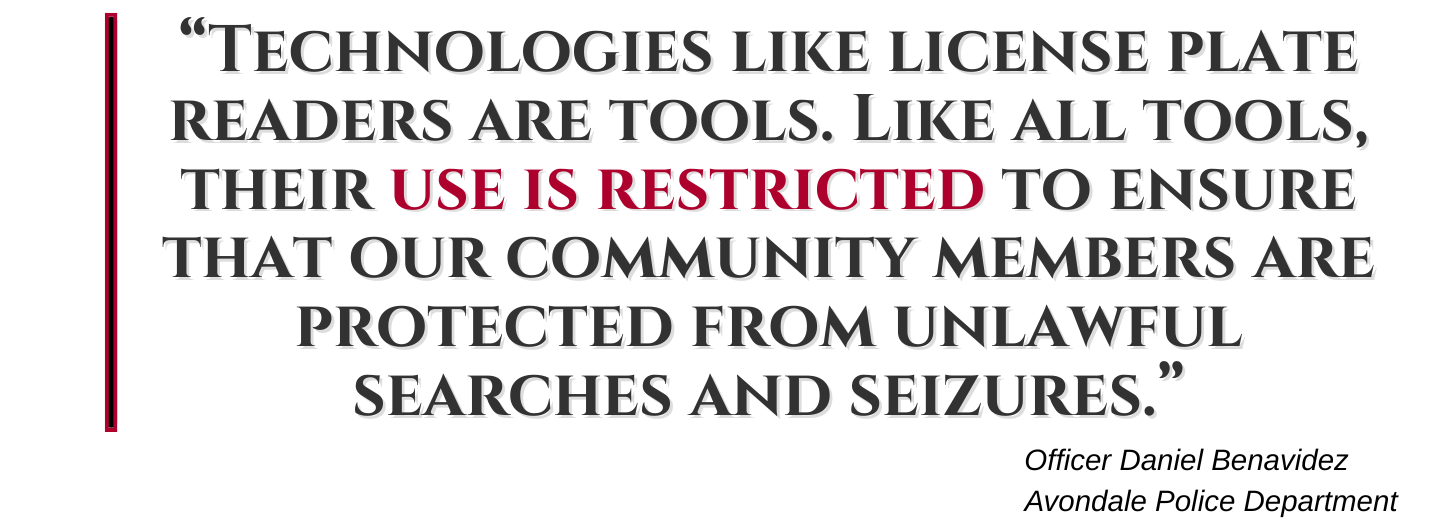
A. “Technologies like license plate readers are tools. Like all tools, their use is restricted to ensure that our community members are protected from unlawful searches and seizures. Avondale Police only use technology that aligns with court case law which outlines what is and what is not an unreasonable search and seizure. Our department relies on legal counsel when implementing new technology and our legal counsel keeps us updated to any court case decisions that require us to review and modify our practices.”
Q. When will the department return to council regarding the March 2026 proposal to expand the system by 58 additional cameras?
A. “The police department will not be returning to council to discuss the increased number of Flock cameras, however, this will be discussed in upcoming, city-wide council budget meetings.”
While the Avondale Police Department’s response outlines how the system is structured including data retention, network sharing, and access, the audit logs provide additional insight into how that access is used across agencies.
Areas Identified for Further Review
Two areas in the Arizona-wide dataset prompted additional follow-up:
Pinal County Attorney’s Office Queries
Records show that a prosecutorial office not typically associated with patrol-level use of license plate readers conducted queries within the system reaching 90K+ devices in a single lookup. The majority of these queries were categorized as warrant-related. The presence of both the County Attorney’s Office and the Sheriff’s Office as separate entities in the system provides additional context for how access may be structured across agencies.
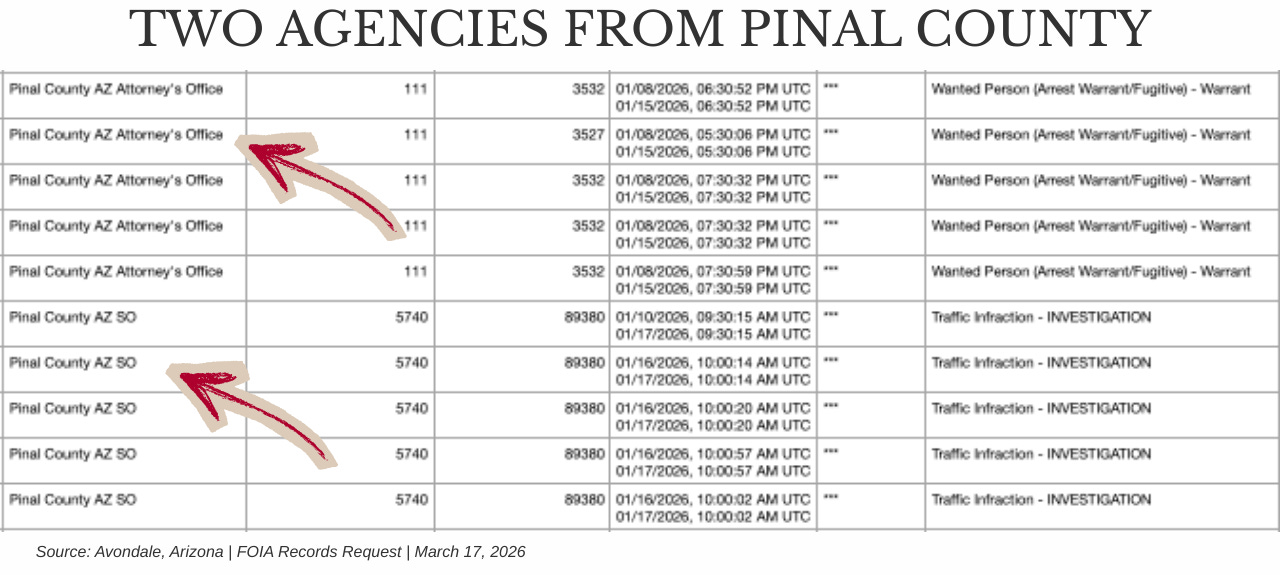
A spokesperson for Pinal County Attorney Brad Miller’s Office said a response is expected Monday, noting the office must review the matter with its civil division, as the contracts were executed prior to Miller taking office.
Traffic Analysis Query Category by Arizona DPS
Audit logs include a “City Planning / Traffic Analysis – traffic pattern” category used by the Arizona Department of Public Safety. Unlike entries tied to active cases, this category is not clearly associated with a specific criminal investigation and appeared in a clustered set of queries logged on January 17th and 18th, the weekend leading into Martin Luther King Jr. Day.
Both agencies have been contacted for comment.
Arizona Agencies Reflected in This Snapshot
The records reflect a single point in time. The dataset identifies which Arizona agencies appeared during one month of activity, representing a mix of major cities, smaller jurisdictions, and specialized agencies connected within the same operational footprint.
The agencies included in this dataset are:
Apache Junction AZ PD
Arizona Department of Public Safety
ASU AZ PD
Avondale AZ PD
AZ - Yuma PD
Benson AZ PD
Buckeye AZ PD
Casa Grande AZ PD
Chandler AZ PD
Chino Valley AZ PD
City of Peoria PD AZ
City of Sierra Vista AZ
Coconino AZ SO
Coolidge AZ PD
Cottonwood AZ PD
Douglas AZ PD
El Mirage AZ PD
Eloy AZ PD
Florence AZ PD
Gila River AZ PD
Gilbert AZ PD
Glendale AZ PD
Goodyear AZ PD
Graham County AZ SO
La Paz County AZ SO
Lake Havasu City AZ PD
Maricopa AZ PD
Maricopa County AZ SO
Mesa AZ PD
Mohave County AZ SO
Navajo County AZ SO
Northern Arizona University Campus AZ PD
Oro Valley AZ PD
Page AZ PD
Paradise Valley AZ PD
Parker AZ PD
Payson AZ PD
Phoenix AZ PD
Pinal County AZ Attorney’s Office
Pinal County AZ SO
Prescott AZ PD
Prescott Valley AZ PD
Queen Creek AZ PD
Safford AZ PD
Saint Johns AZ PD
San Luis AZ PD
Scottsdale AZ PD
Show Low AZ PD
Somerton AZ PD
Springerville AZ PD
Surprise AZ PD
Tempe AZ PD
Thatcher AZ PD
Tolleson AZ PD
Tombstone Marshals Office (AZ)
Tonto Apache AZ PD
University of Arizona Campus AZ PD
Wellton AZ PD
Yavapai County AZ SO
Note: This dataset reflects government agency sharing within Arizona and does not include private companies, homeowners associations, or other non-government entities that may operate license plate reader systems. As a result, the total number of connected devices and the full scope of the network remain unknown.
Jen’s Two Cents.
What these records show is not just how often the system is used, but how broadly it can operate… extending across thousands of networks and tens of thousands of cameras in a single query.
At the same time, key questions remain unanswered. The records do not show how often queries result in actionable leads, how long data is retained across all participating agencies, or how access is audited across jurisdictions.
Arizona does not have a single statewide framework governing how these systems are used, shared, or audited across agencies, leaving policies largely to local jurisdictions.
While these systems operate across jurisdictions and connect thousands of cameras, public visibility into how they function remains limited.
This report is based on public records obtained from the Avondale Police Department and reflects documented system activity over a defined period. It does not attempt to assign motive or wrongdoing, but rather to provide a clearer understanding of how the technology operates in practice.
Jen’s Two Cents welcomes additional context and clarification from agencies and companies involved in the use of license plate reader systems in Arizona.
The scale of the system is now measurable. The policies surrounding it are still evolving.