

Tickets Tossed, Wrong Judge’s Signature Applied: Thousands of Photo Radar Tickets Under Scrutiny
At the Capitol, city officials defended photo radar; the FOIA trail shows the behind-the-scenes mess they didn’t mention.
Through dozens of FOIA requests and internal records, I’ve uncovered how Arizona cities are quietly wiring together a surveillance web — cameras, plate readers, and vendor contracts stitched into daily life mostly without community consent.
In this report, the human faces in the middle of these messes.
First, a police chief whose reputation rises and falls with public safety. He isn’t blind to the mandate residents have handed him — safer streets, safer neighborhoods — all funded by taxpayer dollars. Yet behind closed doors, as reports of voided tickets, corrupted data, and vendor “system errors” pile up, the chief is forced to ask an uncomfortable question: has his department spent months chasing work that will never stand up in court?
Second, a court supervisor who was forced to send out a blunt reminder: “We should not be issuing citations with a Judge who no longer presides.” Each citation carried the authority of the court, but behind the seal was an error so fundamental it called the legitimacy of enforcement into question.
If mistakes this basic can persist for months, who — if anyone — is actually watching over the system? Meanwhile, taxpayers continue footing the bill as cities absorb the fallout: dismissed tickets, unanswered legal questions, third-party failures hidden from public view. Even one mayor has admitted the technology changed his own driving behavior — while laughing about the ticket he received as if to prove the point.
And yet, as these errors stack up behind closed doors, city officials march to the state Capitol to lobby for their right to keep the cameras rolling — under their local control.
Mesa Records Reveal Wrong Judge’s Signature on Photo Radar Citations
Arizona’s surveillance machine runs on a three-way partnership: third-party vendors, police, and the courts. And buried in the records, I found a crack in that system. Mesa’s photo enforcement program was issuing citations that appeared to carry outdated judge signatures — not stamped, but likely applied by autopen or an automated signature system. (The city has not responded to my messages for clarification.) Internal emails show city staff realized in July 2024 that tickets were still going out under the names of judges who no longer presided at the Mesa Municipal Court, raising serious questions about legality, oversight, and just how deep these errors run.
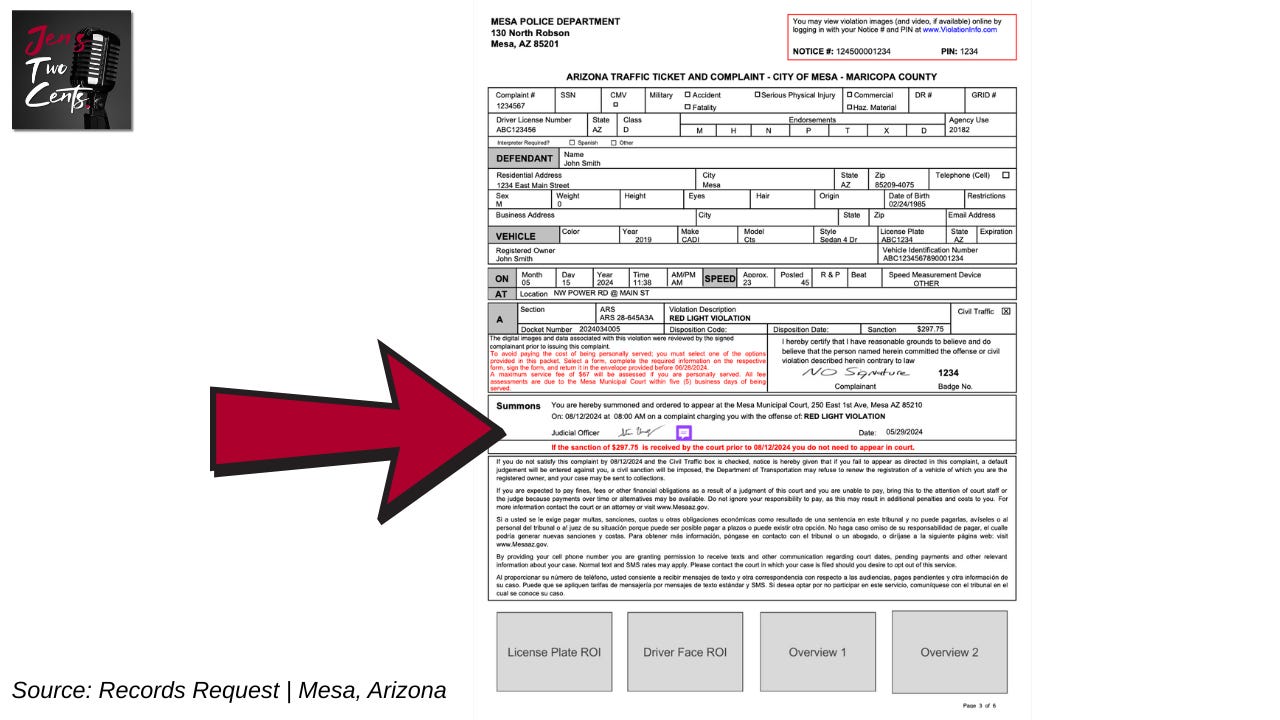
Here’s a look: in the “Summons” section of each citation, a purple icon appears beside a digital signature — the mark that’s meant to certify judicial approval. But records show — and the City of Mesa has confirmed — that for months, the wrong judge’s name continued to appear here.
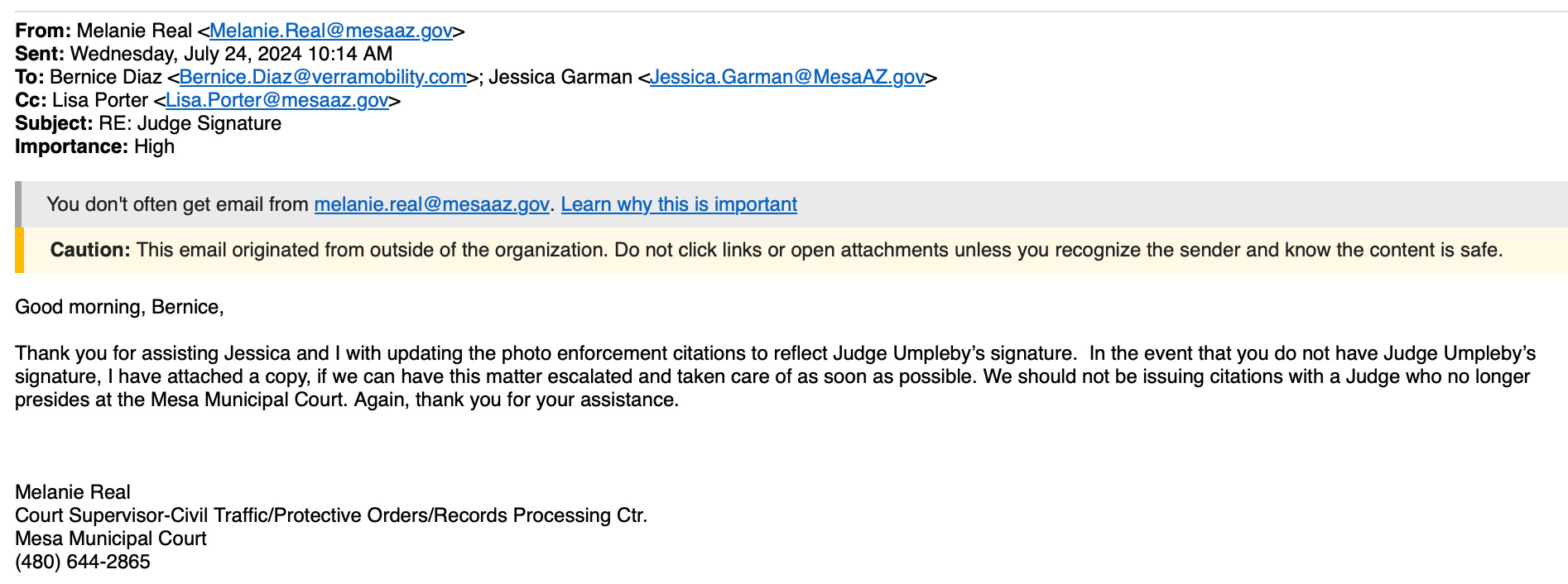
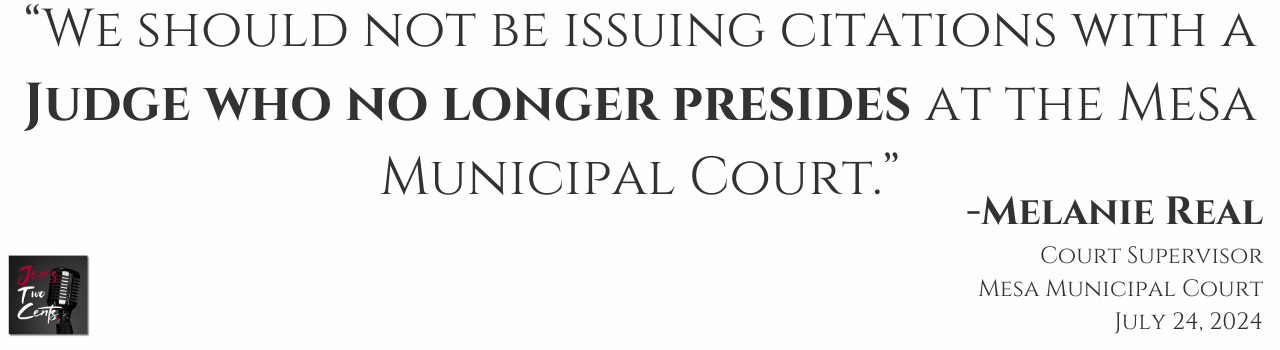
In July 2024, Mesa’s Traffic Program Coordinator flagged the problem to vendor Verra Mobility, citing examples. Verra Mobility emails admit citations were showing “two different judges, neither appear to be Judge Umpleby’s signature,” and asked the city to send over the correct version. Mesa’s court supervisor pressed to resolve the issue quickly, warning:
The exchange underscores how even the most basic legal detail — a judge’s authorization — relies on coordination between city staff and the private vendor running the system.
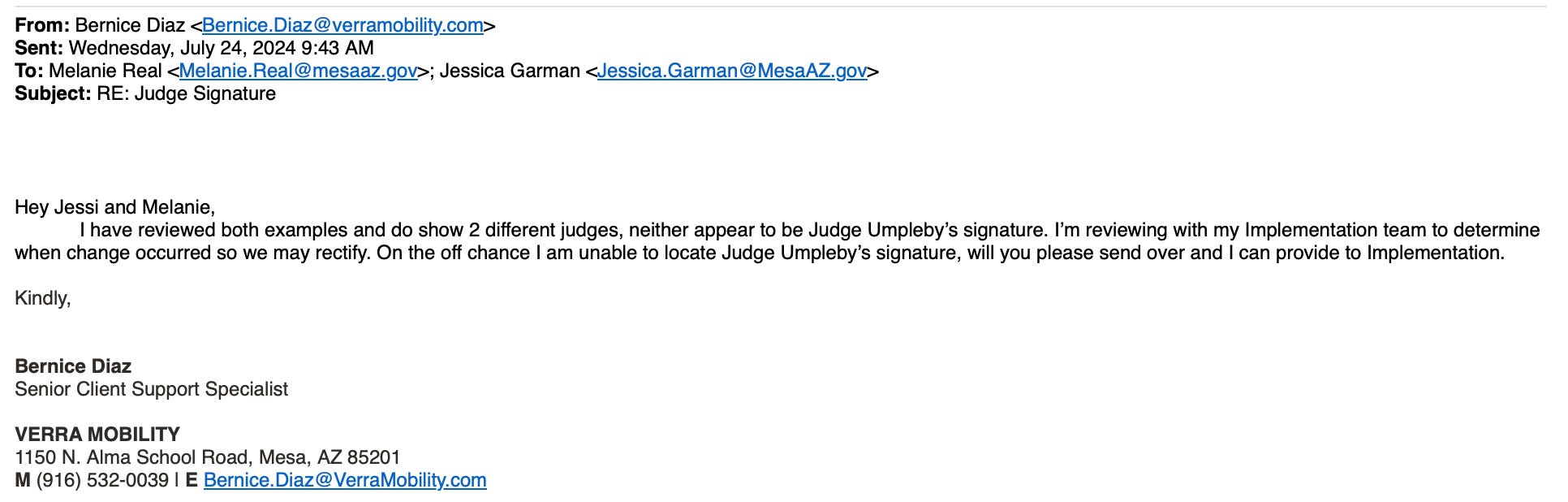
Verra Mobility admitted it could not locate a formal request to update the judge’s signature and, five days later, was still scrambling to finalize the change.
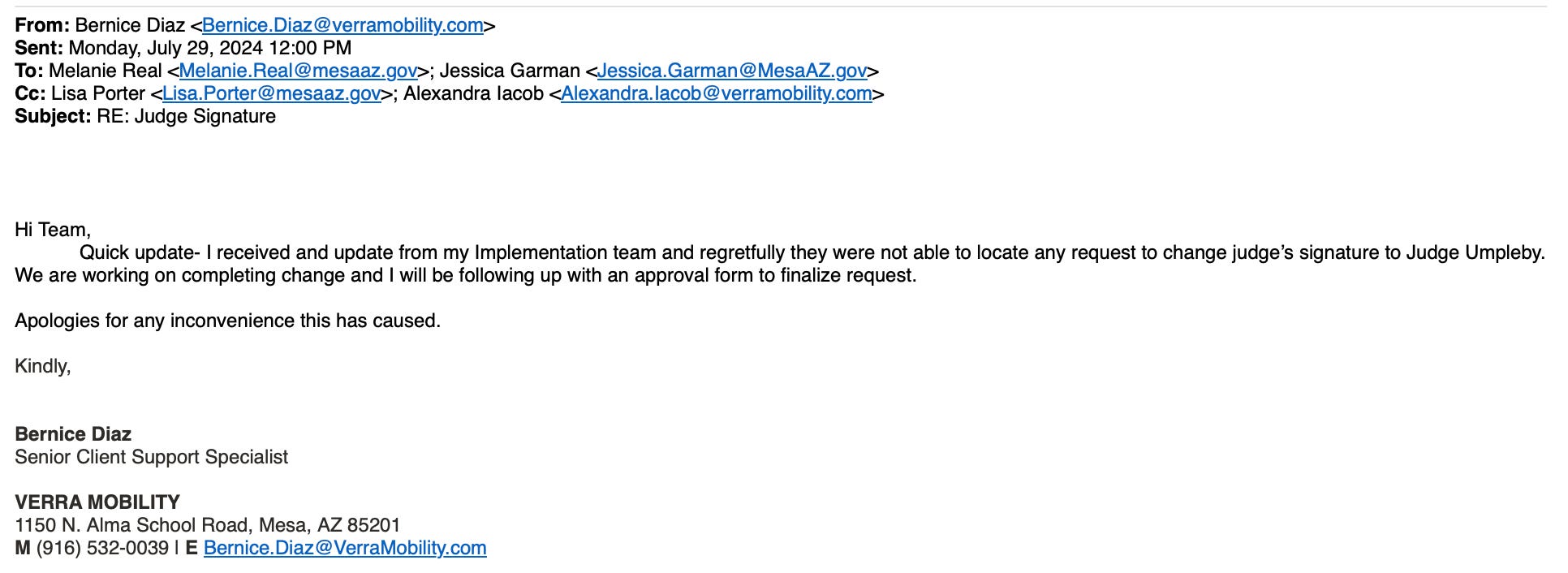
“Apologies for any inconvenience this has caused,” writes a Verra Mobility client support specialist.
I pressed Mesa officials to clarify how long the wrong judge’s signature appeared on photo enforcement citations, how many drivers were affected, and whether the city or court system relies on an autopen or other automated method to apply judicial signatures.
Here is the response I received:
“Mesa City employees identified incorrect judge signatures on photo enforcement citations within three months of Judge Umpleby's swearing-in. As documented in our correspondence, police and court staff immediately contacted our vendor to update the system and worked to determine appropriate remedial actions. This issue was proactively identified by City employees and the City have received no public complaints regarding judge signatures on citations. We are conducting a review to identify citations that may have been affected.”
September 8, 2025 | City of Mesa | Response to Records Request Questions
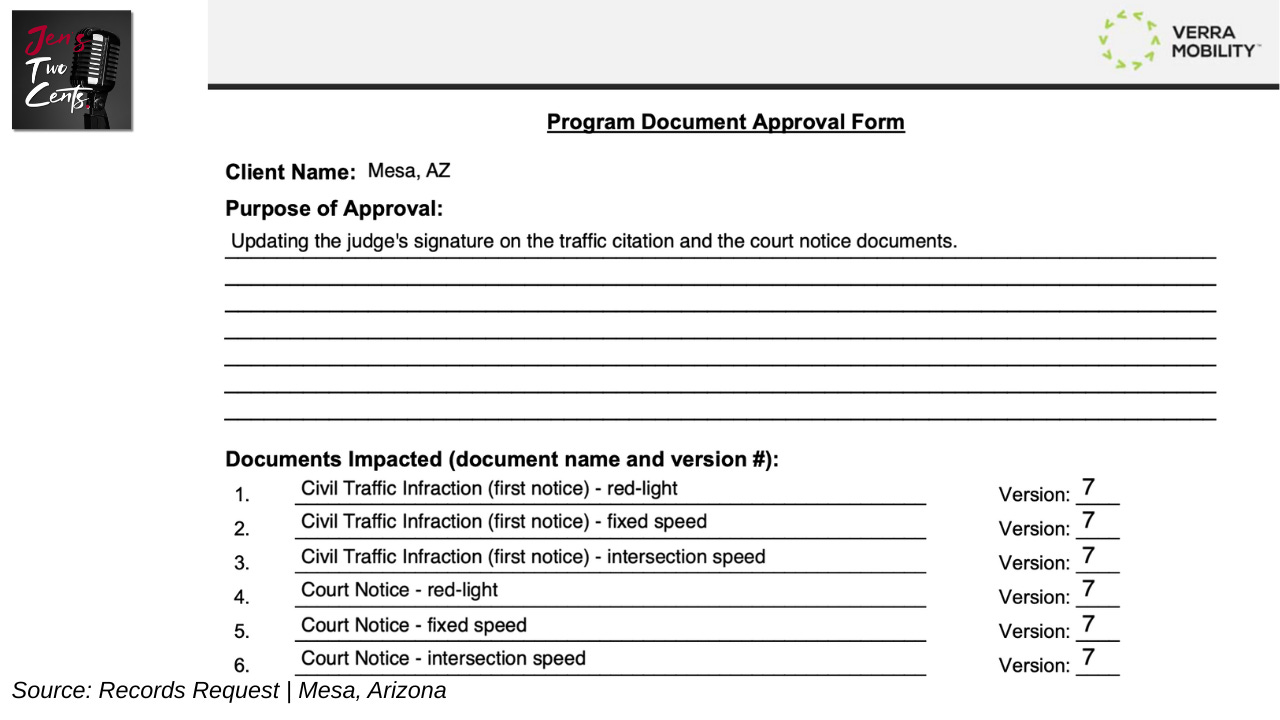
Program records show the judge’s signature update applied to six documents within Mesa’s photo enforcement program. These included the first notice of civil traffic infractions for red-light, fixed speed, and intersection speed violations, as well as the related court notices for each type of offense. All were listed as Version 7 and revised to incorporate the updated judicial signature.
The question: could these citations be invalid?
Arizona’s court rules say a traffic case doesn’t officially begin with just a ticket — it begins when the ticket and complaint are filed with the court, and the form must meet standards set by state law. That includes being properly written and signed on a form approved by the Supreme Court.
The city explains:
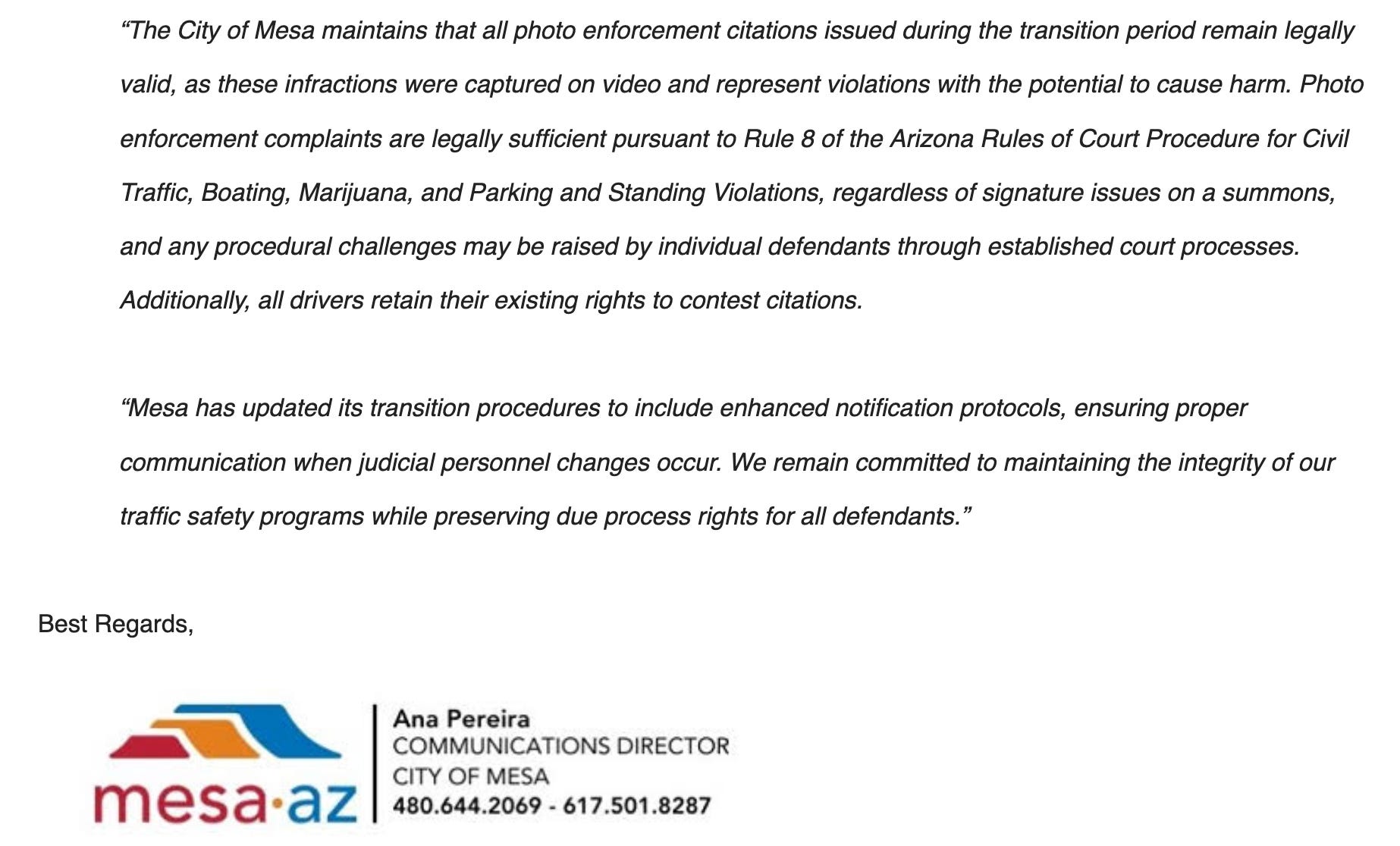
City officials insist the citations remain legally valid, even those issued with the wrong judge’s name. They argue the violations were captured on video, making them enforceable under Arizona court rules despite signature flaws on summonses. In other words, the burden shifts back to individual drivers to challenge errors — what appears to be a due process safeguard leaving the city free to keep collecting.
At the same time, officials admit the system needed fixing. They’ve now “enhanced notification protocols” to prevent future mistakes when judges rotate. The response underscores the larger problem: errors can persist for weeks or months before anyone notices, raising real questions about oversight and accountability.
UPDATE: SEPTEMBER 23, 2025
CITY OF MESA CLARIFIES JUDGE’S SIGNATURE IS DIGITALLY ATTACHED
“Also, there is no Auto Pen used for citations. It is a digital copy of the judge’s signature that is digitally attached to the citations issued by the Mesa Police Department.”
Kevin Christopher | Senior Public Information Specialist | City of Mesa
Same Vendor, Different Municipality: Paradise Valley Police Chief Calls Out Six Months of Photo Enforcement Failures
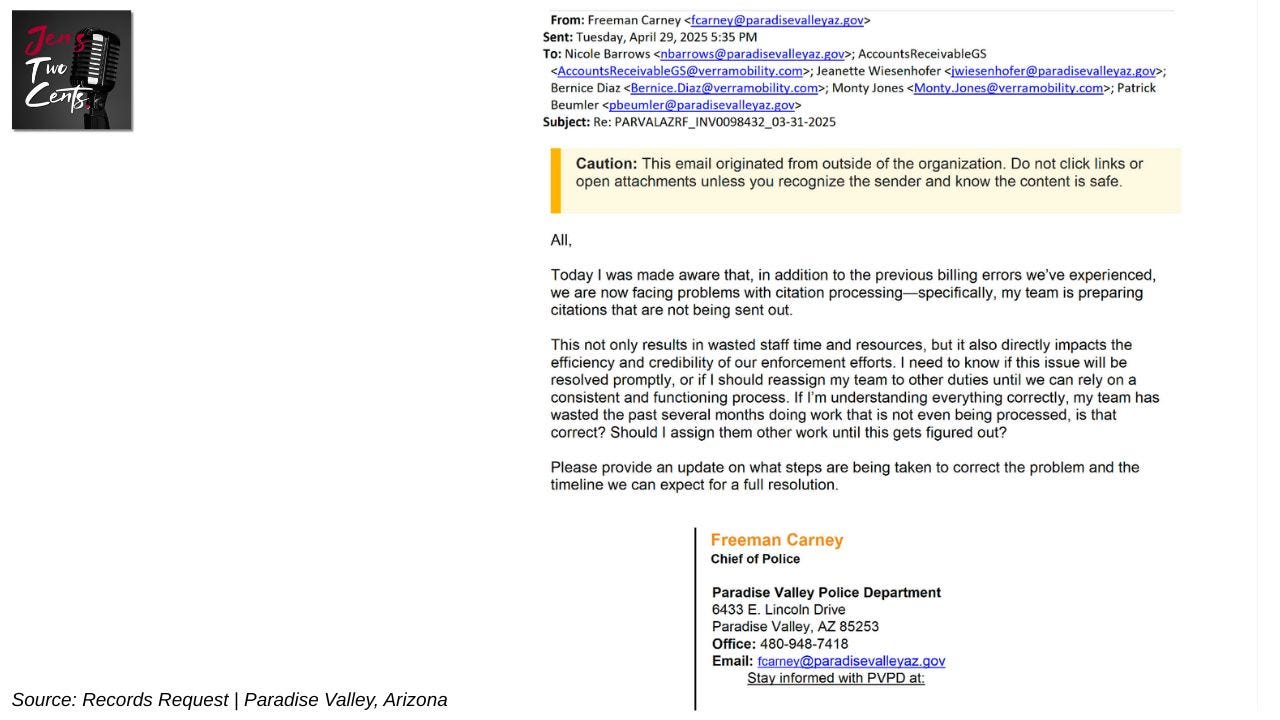
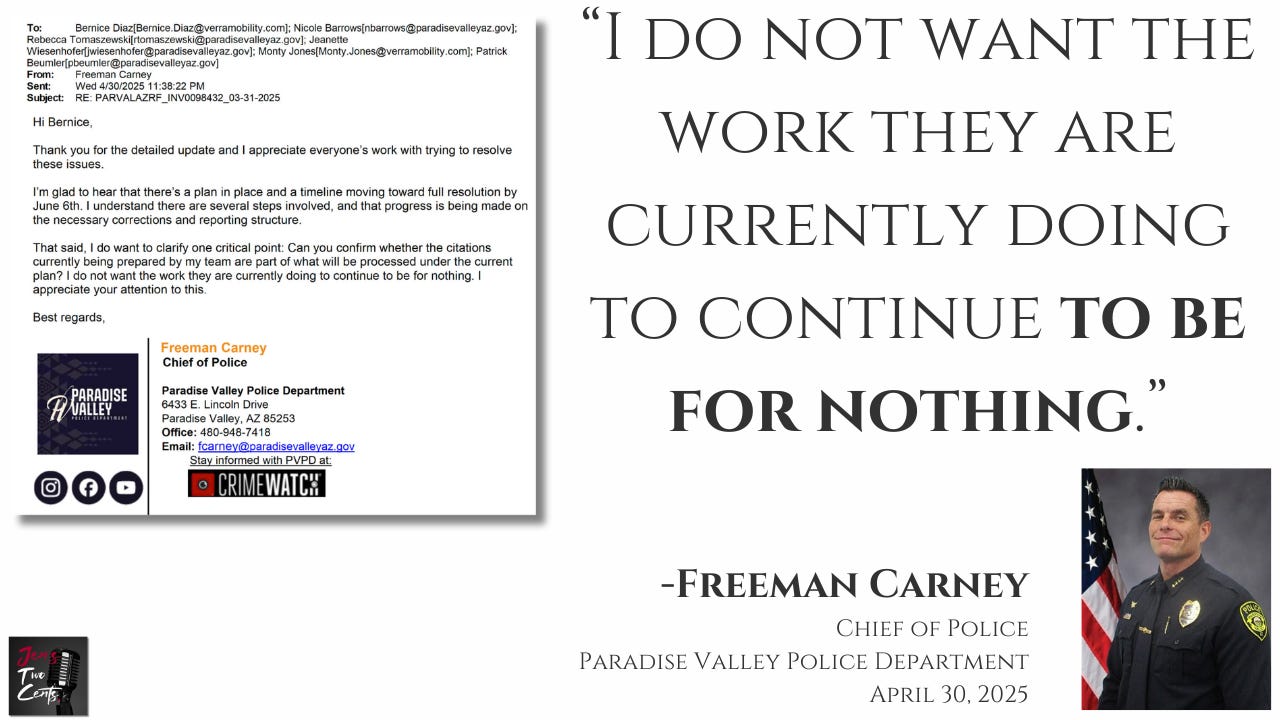
This spring in Paradise Valley, strong words from Police Chief Freeman Carney underscored frustration over ongoing problems with photo enforcement citation processing. In emails to vendor Verra Mobility and town staff, Chief Carney questioned whether months of work by his team had gone to waste, noting that citations prepared by his officers were not being sent out. He pressed for assurances that the errors would be corrected and asked if his team’s efforts should be redirected until the process was fixed, warning the situation undermined both efficiency and credibility of enforcement.
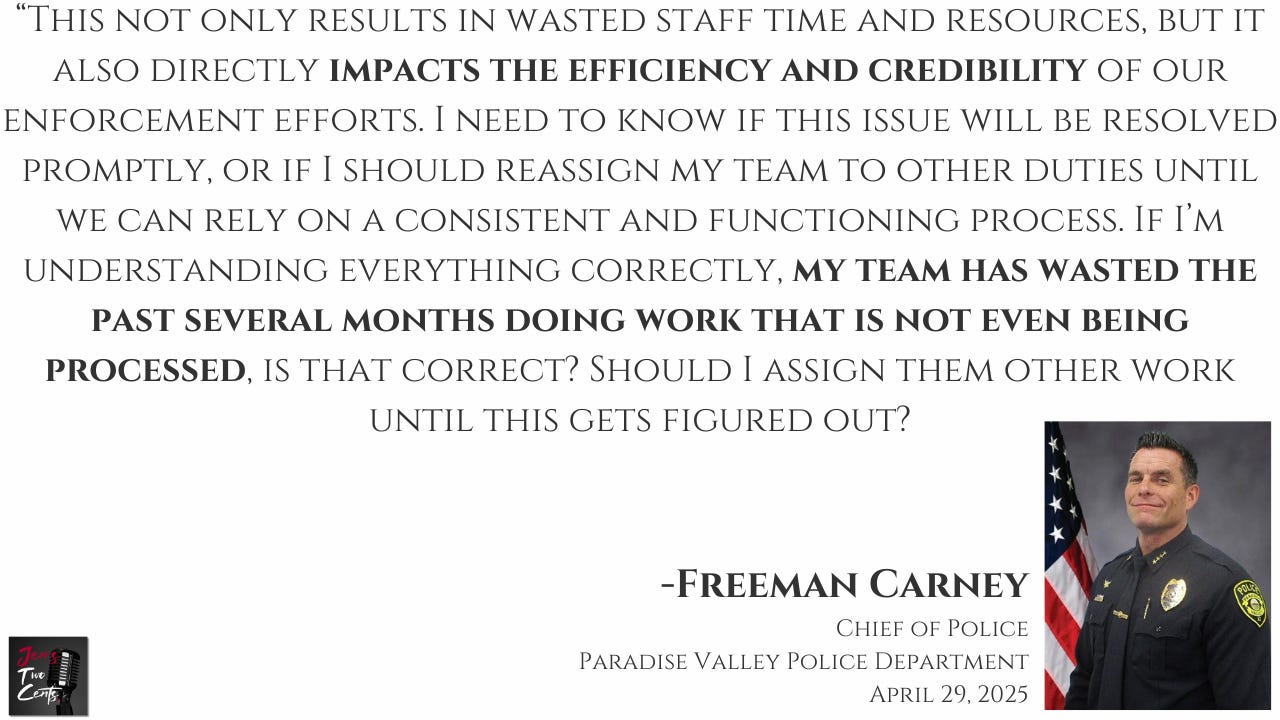
Here is the April 29, 2025 document provided through a records request.
What led up to this?
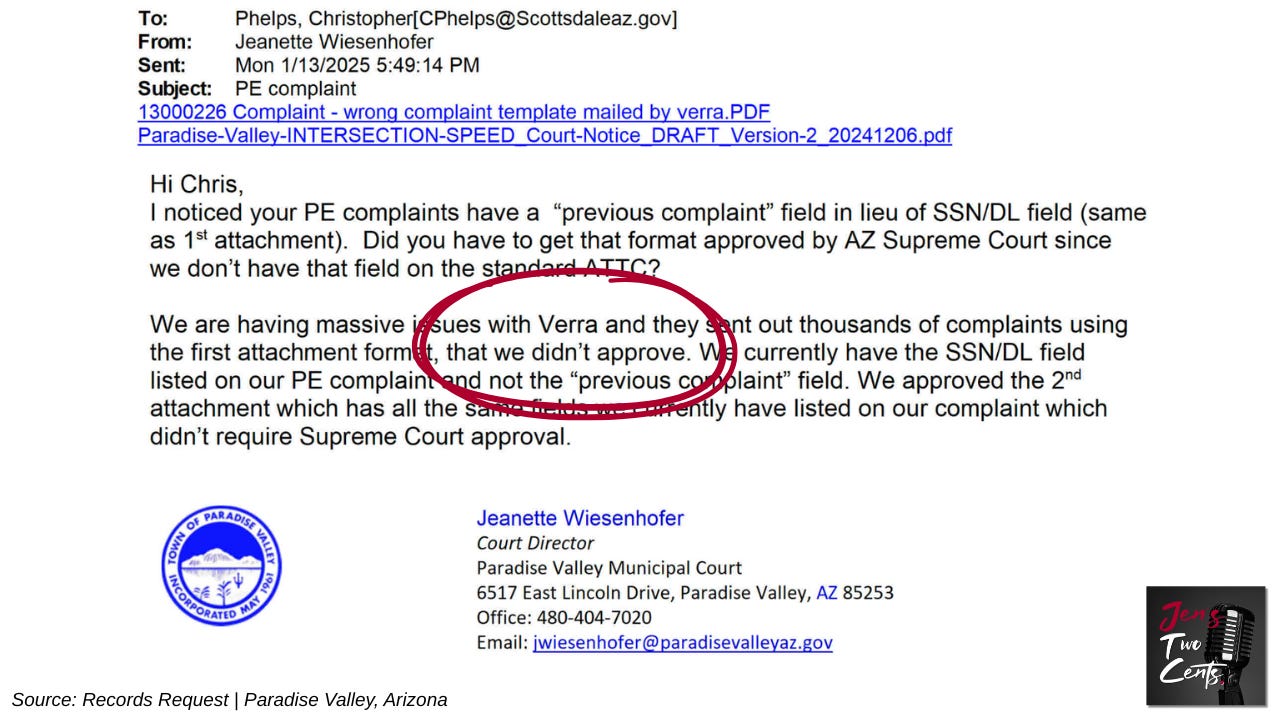
Records dating back to January from Paradise Valley show what the courts described as “massive issues” with Verra Mobility sending out thousands of citations using the wrong forms, including templates with fields the court never approved.
Two court officials used the same word for it: “nightmare.”
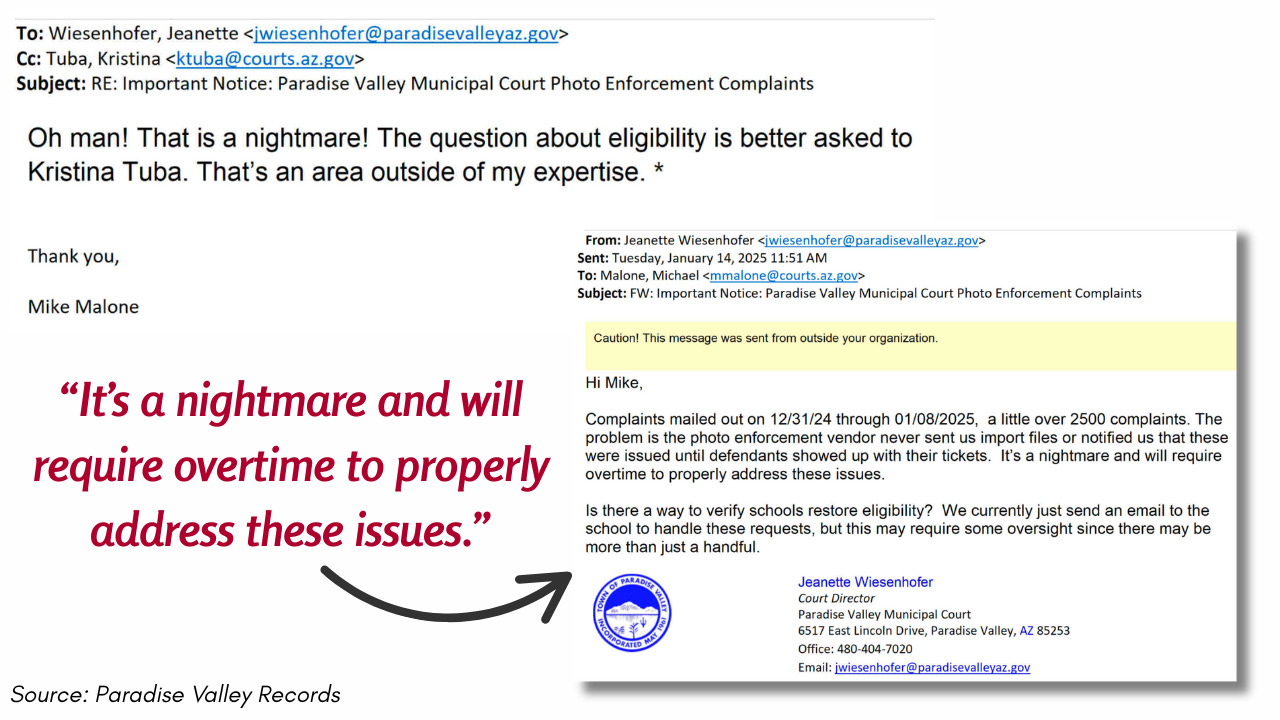
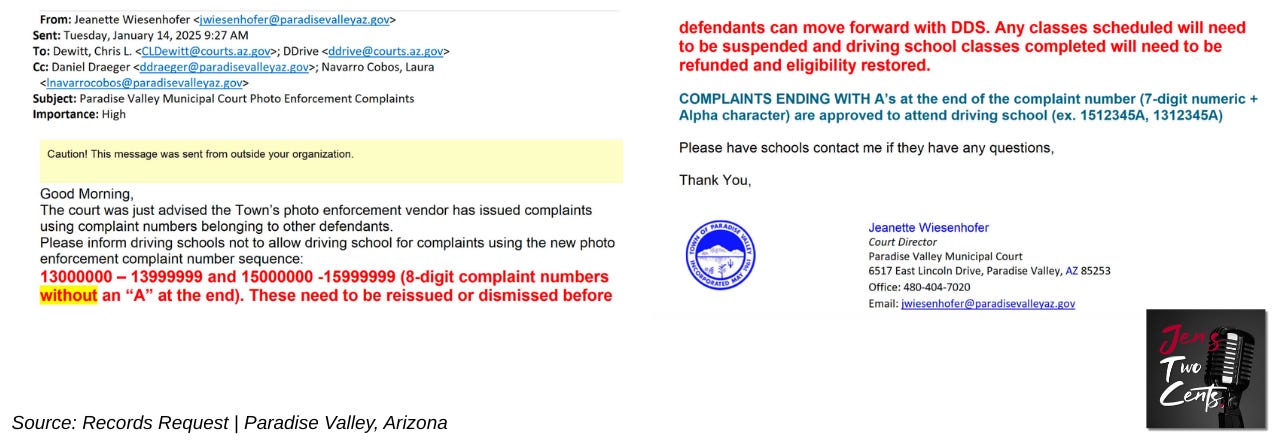
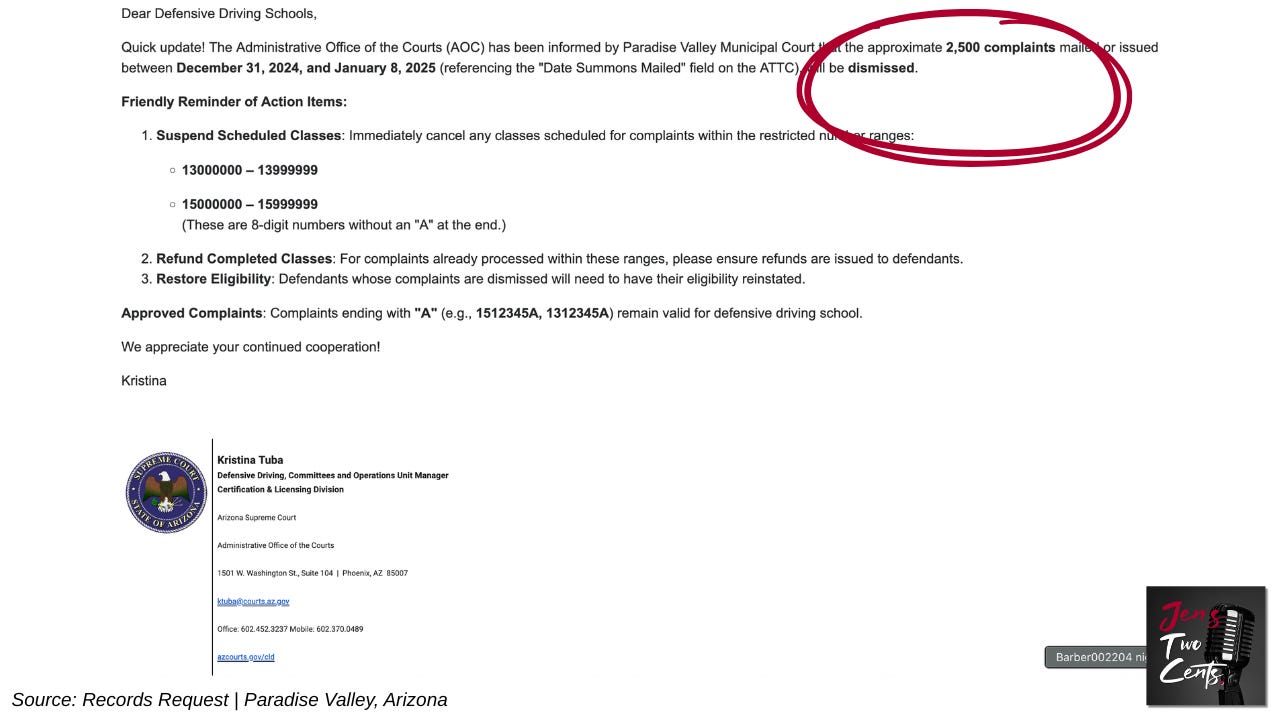
It appears from internal documents, some citations were mailed under complaint numbers that actually belonged to other defendants, forcing officials to order dismissals and refunds. At one point, roughly 2,500 complaints went out during a single weeklong period with these errors.
“We currently just send an email to the school to handle these requests, but this may require some oversight since there may be more than a handful.”
Jeanette Wiesenhofer | Court Director | Paradise Valley Municipal Court | January 14, 2025 to Michael Malone
Four minutes later, an email went to Chris DeWitt, Defensive Driving, Committees & Operations Unit, Certification & Licensing Division, Arizona Supreme Court, notifying him that 2,500 civil traffic complaints would be dismissed.
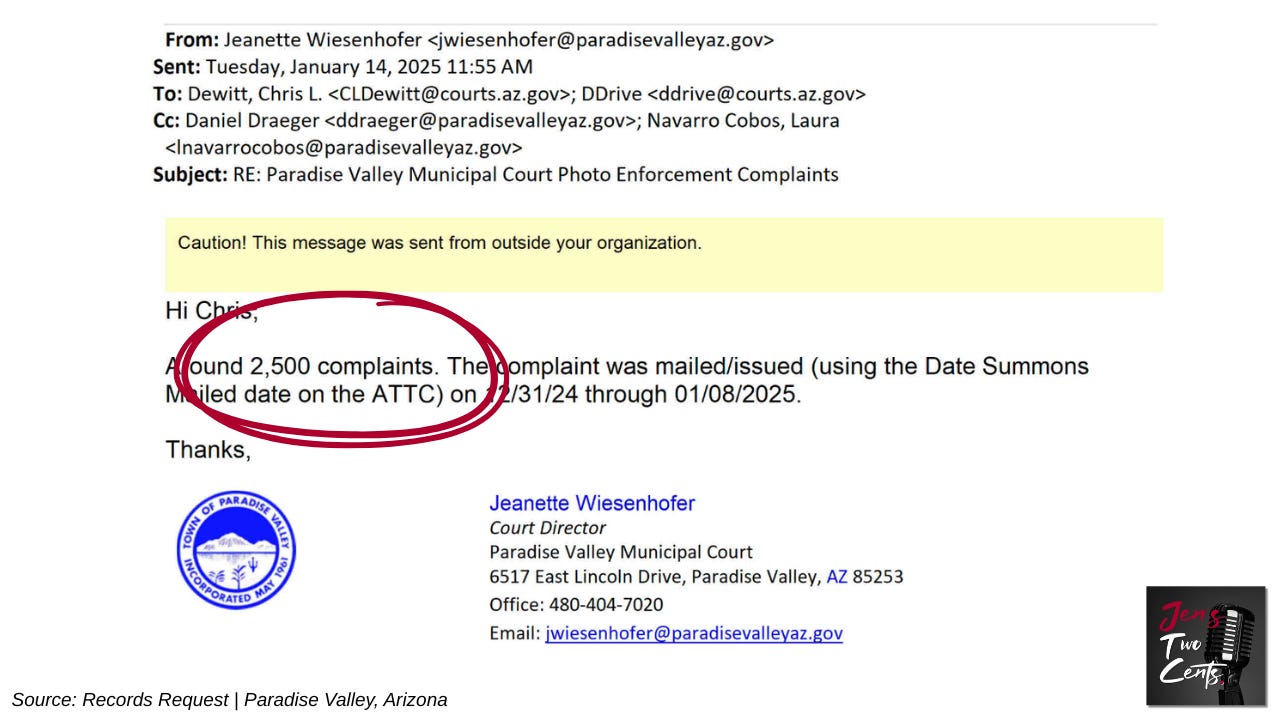
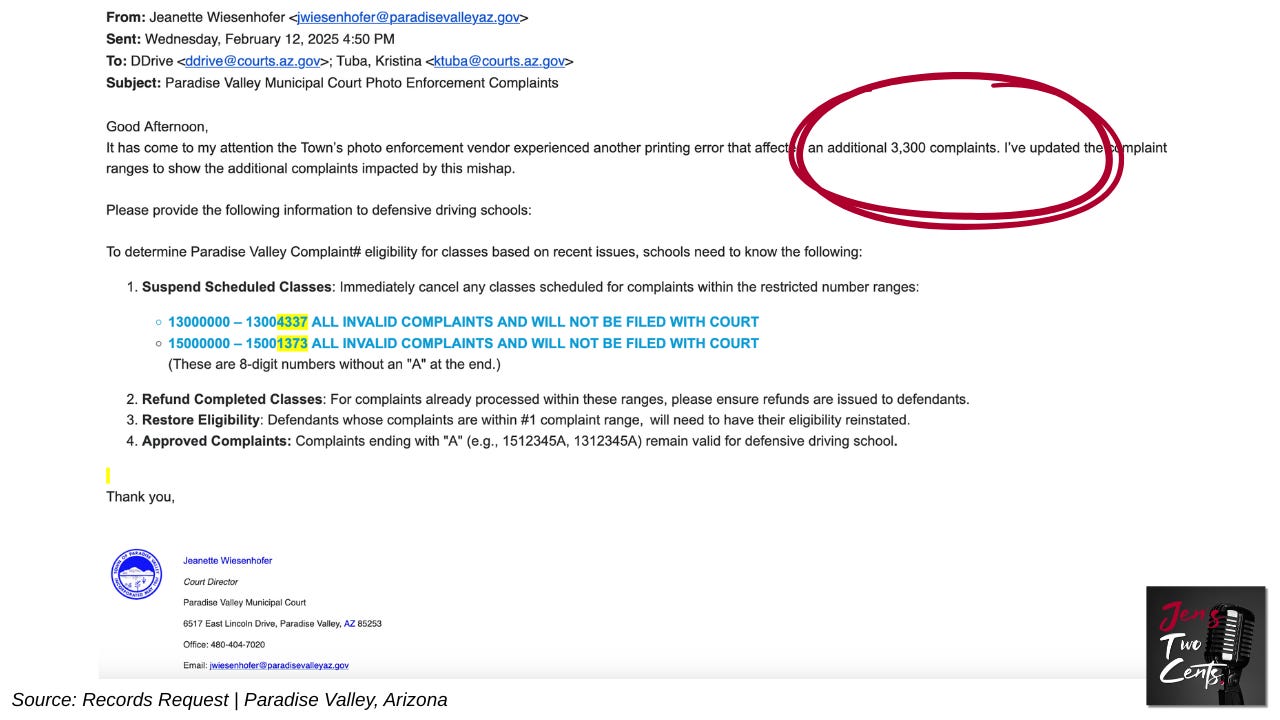
On February 12, 2025, Paradise Valley’s municipal court director sends out a warning for defensive driving schools that another 3,300 tickets were reportedly affected by a vendor printing error, called a “mishap.”
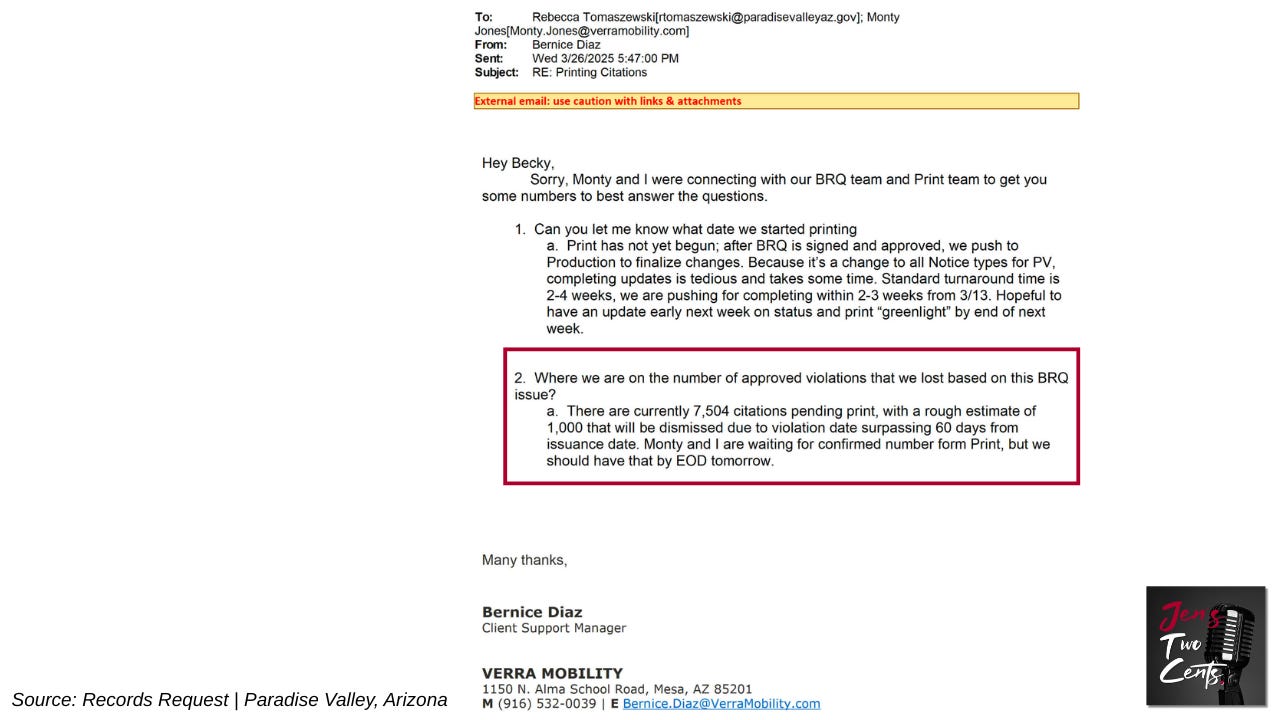
In late March, the vendor addressed delays in printing and mailing citations, with more than 7,500 tickets sitting in limbo, some of which became invalid.
“There are currently 7,504 citations pending print, with a rough estimate of 1,000 that will be dismissed due to violation date surpassing 60 days from issuance date.”
Bernice Diaz | Client Support Manager | Verra Mobility | March 26, 2025
April 30th, Verra Mobility told Paradise Valley’s police chief it wold fix problems with citation processing and expected everything to be resolved by June 6th. Records show the company said it would update files, clear out old or expired tickets, start sending about 1,000 citations a week to the court, and put in new reporting to prevent future errors.
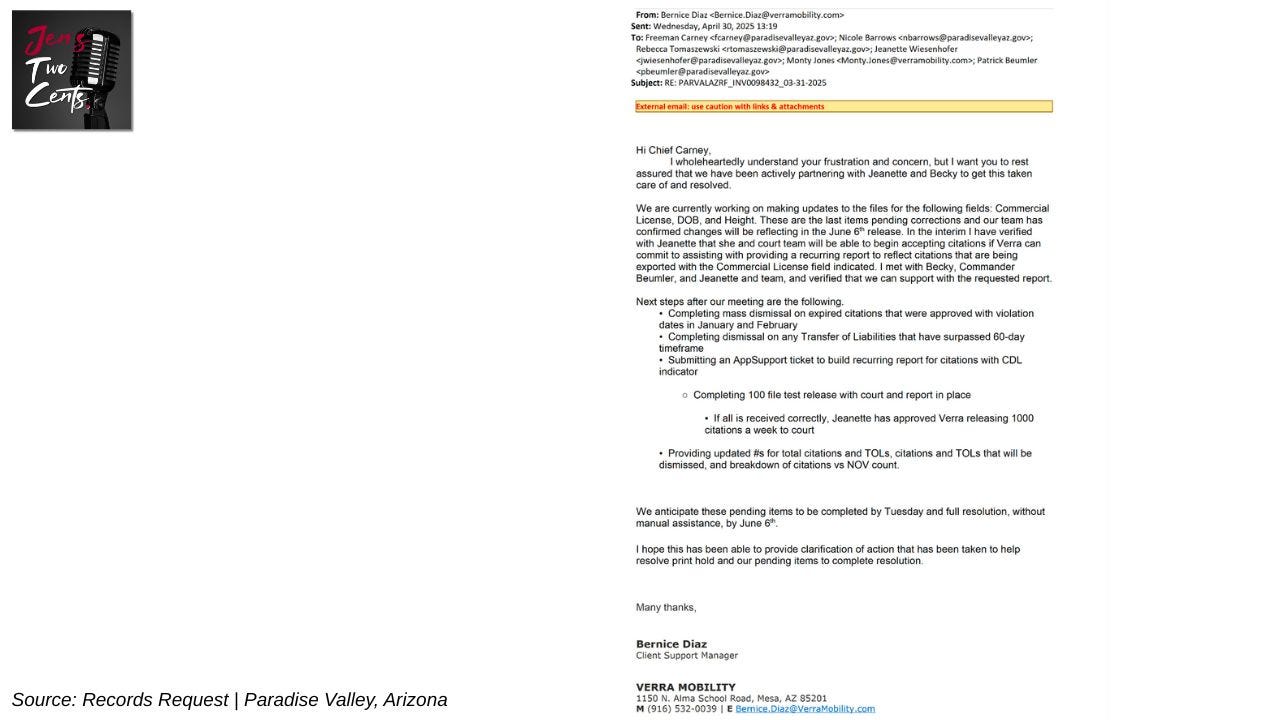
Police Chief Carney thanked the vendor saying, “I’m glad to hear that there’s a plan in place and a timeline moving toward full resolution by June 6th.” He then asked for clarification on “one critical point” — whether the citations currently being process by his team would be processed under the current plan.
In FY24, Paradise Valley taxpayers paid nearly $800,000 to the private photo enforcement vendor Verra Mobility — $782,922.84 to be exact. Records show the vendor’s cut was one of the single largest expenses in the entire program, second only to court and prosecutor costs. That means a significant share of every ticket paid in Paradise Valley doesn’t stay in the community at all.
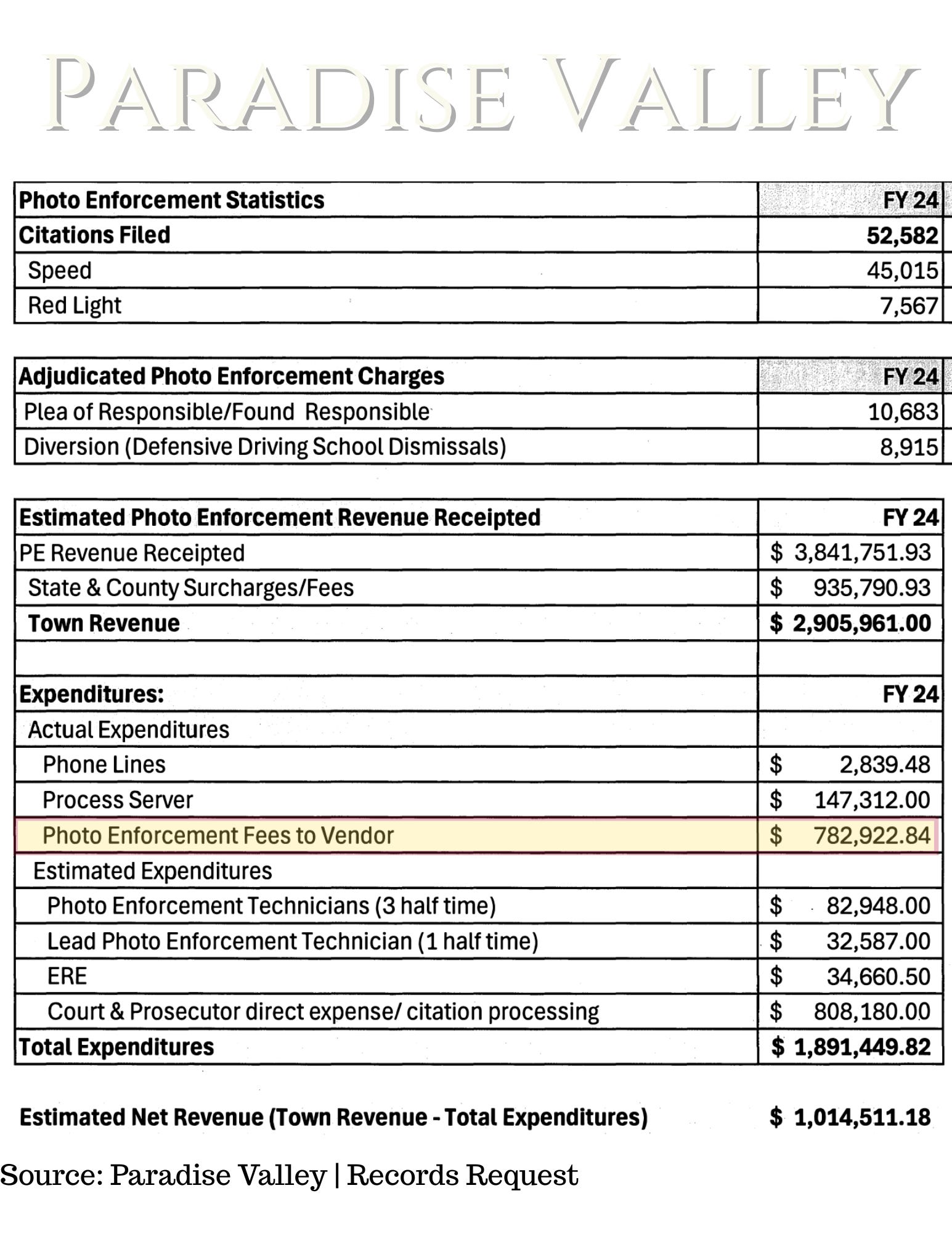
I requested FY25 records from Paradise Valley to find out how many citations were issued and adjudicated while the city was wrestling with vendor errors, along with itemized expenditures. The town responded that no FY25 statistical report exists — policymakers only asked for FY24 data — and the FY25 spending numbers are tied up in the ongoing audit.
“Expenditure data will not be available for a couple of months. The Town’s Finance Department and outside auditing firm are currently working on the FY 2025 Annual Comprehensive Financial Audit. Once completed, the audited revenue and expenditure report will be available.”
I’m told more legislation will be filed to ban photo radar in 2026, which may push the town back to the Capitol to argue for local control — and if history is a guide, they may come armed with new stats, just as they did this past session.
The implications of citation errors go far beyond clerical mistakes. I sat down with longtime photo radar opponent Shawn Dow, who argues the entire system rests on shaky legal ground. “The police chief found out 2,000 tickets were illegally issued. Wait till he finds out every ticket is illegally issued,” Dow said. He claims he’s helped shut down photo radar programs across the U.S. because they violated state law — and warns against lawmakers who try to rewrite the rules after the fact. “With a stroke of a pen they say, ‘We’ll just make it legal.’ You can’t do that,” Dow tells me.
Public Praise, Private Problems: Paradise Valley & Mesa Defend Photo Radar Despite Mounting Errors
This legislative season, lawmakers considered a resolution that would have let Arizona voters decide the fate of photo radar. City officials insist the cameras save lives and slow traffic — but as the records show, they also generate significant income. And while the program is wildly unpopular with drivers, municipalities continue to defend it on all three fronts.
Yesterday, I uncovered documents showing that fewer than a third of surveyed Mesa residents (29%) support broader use of photo radar. By contrast, 83% favor engineering fixes and 71% want more crosswalks — clear evidence that the public’s appetite leans heavily toward safer road design, not expanded surveillance.

But the data presented to state lawmakers emphasized school zone impacts. A Mesa Commander cited the same ASU survey of 850 residents showing 77% support for photo safety in school zones. “For us, it’s important,” the Commander said.
While internal emails detailed mounting errors and dismissed tickets, Paradise Valley officials were simultaneously standing before state lawmakers defending photo radar — and pleading to keep local control over it. In legislative testimony, they argued for their municipalities’ authority to use the technology, even as records showed its reliability was unraveling behind the scenes.
Paradise Valley Mayor Mark Stanton is a vocal defender of photo radar, making multiple appearances at the Arizona Legislature this spring to advocate for keeping control in local hands.
Lawmakers were weighing bills to expand photo radar, ban photo radar, and a resolution that would have allowed voters statewide to decide the fate of photo enforcement. “It should be a decision made by local communities, councils, and supported by the residents — which, in our case in Paradise Valley, is fully supported by our residents,” Stanton told the Senate Public Safety Committee on February 5th. A month later, on March 12th, he delivered a similar message to the House Transportation and Infrastructure Committee: “We feel that it should be the rights of a municipality. We’re asking just for that.”
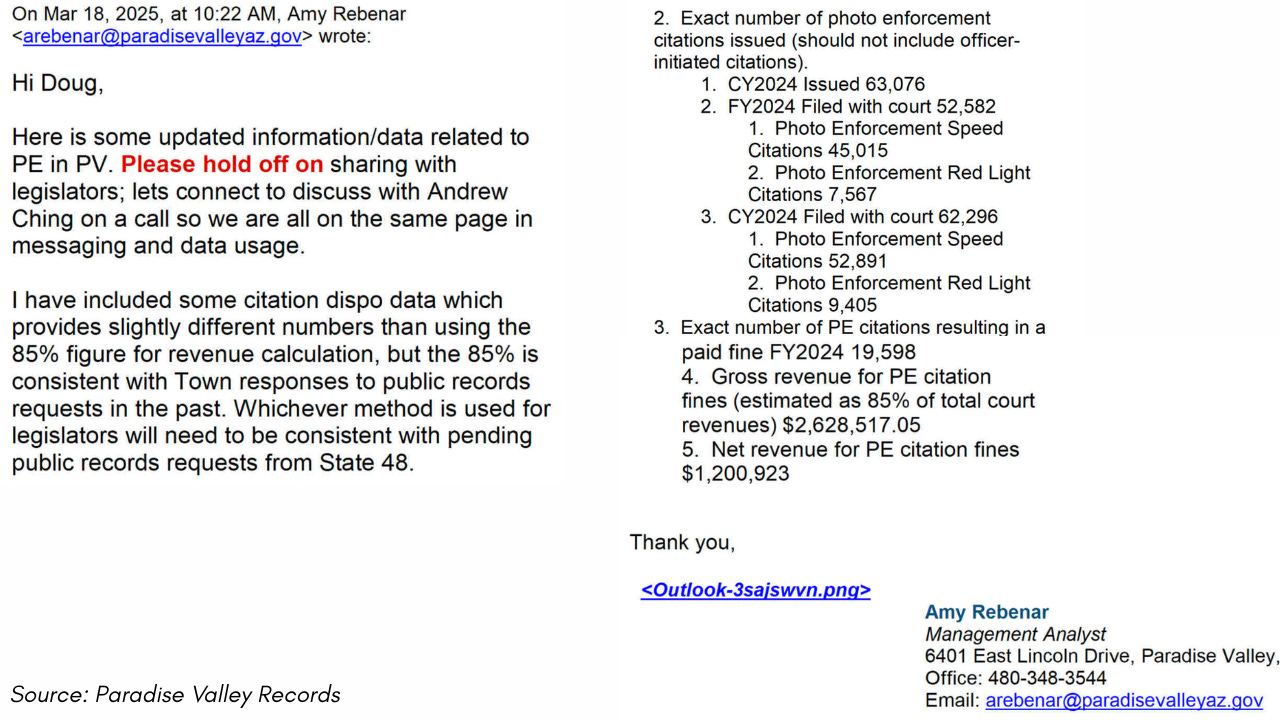
During the time of Mayor Stanton’s testimony, FOIA records show 5,800 citations had already been affected by vendor errors — with thousands more soon to be dismissed. From the records I obtained, it does not appear he was aware of the vendor issues. The documents also do not show where his figure of 100,000 tickets came from, as the official records put citations around the 63,000 mark.
Here are video highlights of Mayor Stanton answering questions from Arizona Senator Brian Fernandez (D-LD23) in 2025 about the Town of Paradise Valley issuing 100,000 tickets — using the figure to underscore the behavior modification he said photo radar introduces. A month later, he acknowledged he had personally received a ticket and that his own behavior was changed by paying the fine.
Paradise Valley’s Town Manager and Mayor Mark Stanton have not responded to my requests for comment and/or interview. And it’s unclear from the records I reviewed whether Mayor Stanton or members of the council knew about the issues between Verra Mobility, the police, and the courts.
The third-party vendor, Verra Mobility, acknowledged my questions on Friday, September 19, but has not yet provided a response.
The resolution to let Arizona voters decide ultimately failed, not because of debate on the merits, but because there weren’t enough Republicans present to carry the vote. State Representative Alex Kolodin later pointed out the maneuver, saying the absence was no accident — and exposed what he called a procedural trick that doomed the measure before it had a real chance.
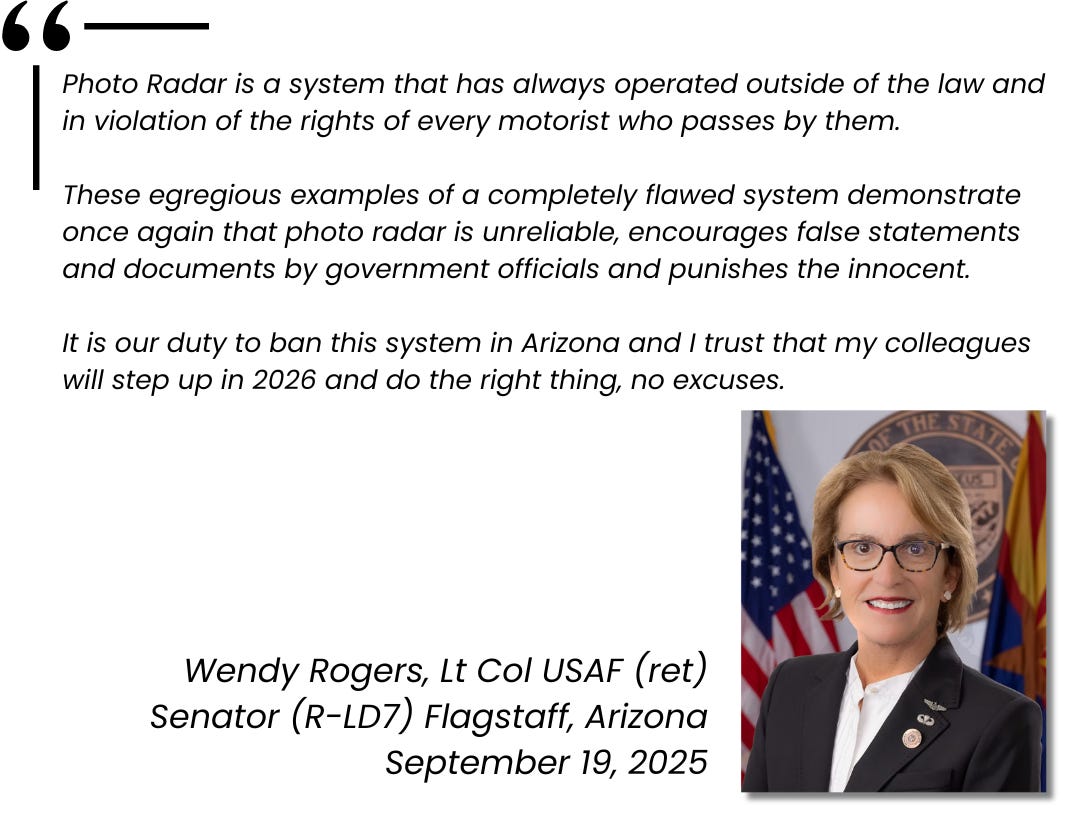
Arizona State Senator Wendy Rogers (R-LD7) sponsored both the bill to ban photo radar outright and the resolution that would have let voters decide the technology’s future. We reached out to her office for comment on our findings — obtained through FOIA records in Paradise Valley and Mesa — which revealed the thousands of tickets dismissed for printing errors, and summons issued with the wrong judge’s signature.
Limited Recourse for Drivers After Error Tickets
Drivers who had already completed defensive driving courses before notification of the error found themselves with no refund and no remedy. As questions mounted over who should bear responsibility for Paradise Valley’s photo enforcement mishaps, I pressed state court officials for clarity.
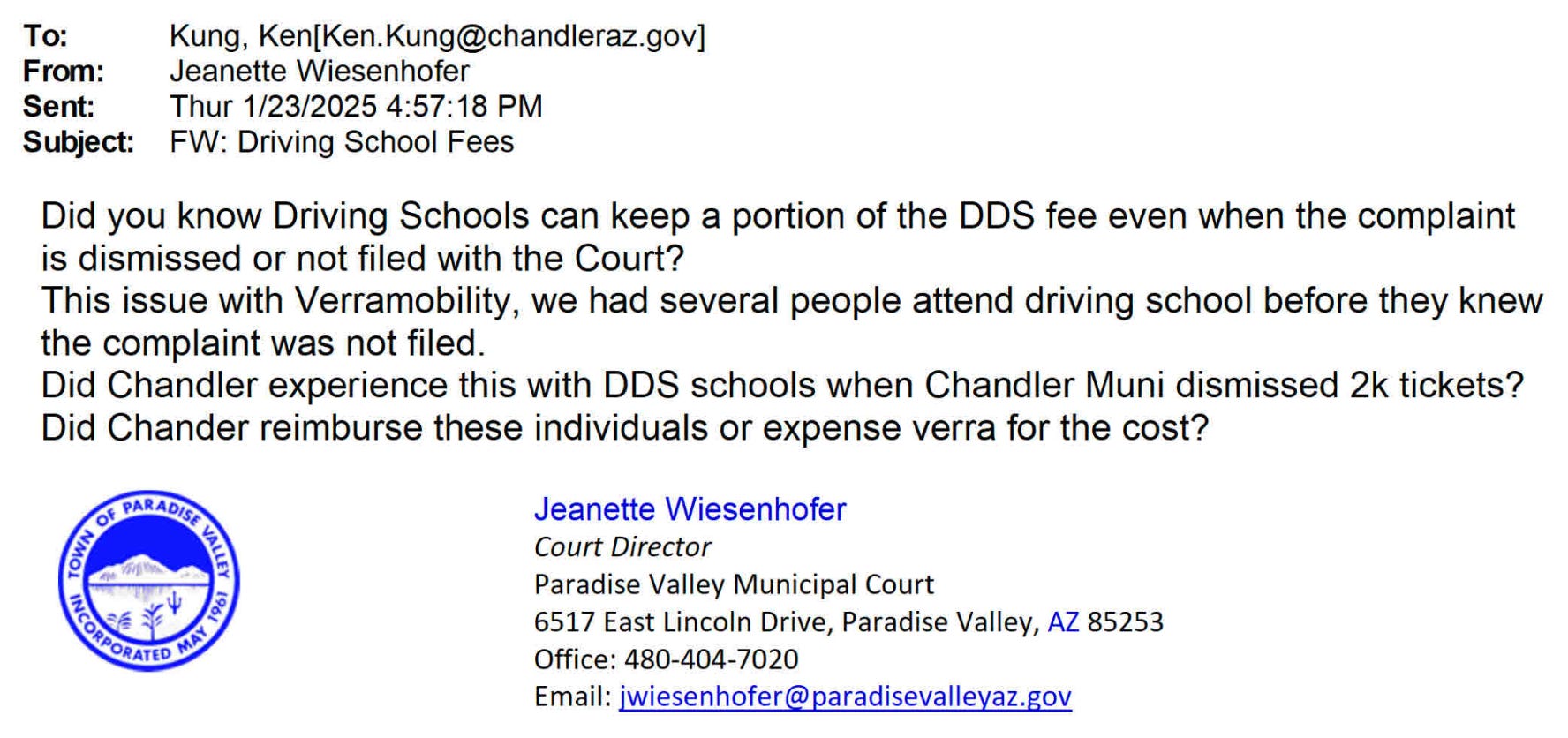
Internal emails show Paradise Valley’s court director asked Chandler how it handled the dismissal of ~2,000 Verra Mobility–related tickets—specifically whether motorists who already took Defensive Driving School were reimbursed and whether Chandler billed Verra for the cost. One case notes a driver was denied a full refund because the school kept a $29.95 course fee even though the complaint was never filed.
Refunds and Driving Schools
When defective or invalid complaints were never filed with the court, should driving schools be expected to refund defendants who had already taken classes? The Arizona Supreme Court’s communications team confirmed to me that schools were not required to return their portion of fees because they had already provided the service — the classroom instruction. However, schools were encouraged to help ensure refunds came through Paradise Valley Municipal Court, and that defendants had their defensive driving eligibility reinstated.
“While the Administrative Office of the Courts’ (AOC) Certification and Licensing Division (CLD) oversees the Defensive Driving Program, and certifies schools and instructors, it does not set refund policies for individual defensive driving schools. Each school is responsible for communicating their policies with students at the time of registration. You can review Code Section 7-205 (F)(28) of the Arizona Judicial Code of Administration regarding refunds for the Defensive Driving Program here.”
Alberto Rodriguez | Communications Office of the Arizona Supreme Court
Supreme Court Guidance
What about statewide policy? I asked whether the Arizona Supreme Court had issued formal guidance on how to handle refunds in situations like this. The answer: yes, but indirectly. Kristina Tuba, who manages the Court’s Defensive Driving Unit, sent a series of emails to schools outlining which complaints were valid, which were invalid, and what refund and eligibility steps should follow.
Responsibility Beyond the Courts
Finally, I asked whether municipalities themselves — or vendors like Verra Mobility, which prints and mails the citations — are ever expected to cover reimbursements when errors occur. The response was more cautious: each case would have to be evaluated on its own facts.
Jen’s Two Cents.
What’s most revealing is how error citations intersect with defensive driving schools. Drivers who already completed a course were typically ineligible for refunds, because the service had been delivered. Only those who signed up but had not yet taken the class were able to get their money back. In other words, even when tickets were issued in error, many drivers still bore the financial burden.
And here’s the unanswered question: if drivers completed defensive driving courses tied to citations that may not have been valid in the first place, did their insurance rates rise as a result?
When Jay Kaprosy of Veridus — the lobbying firm for Verra Mobility — testified before an Arizona House committee this spring, he acknowledged the company operates photo enforcement programs in eight Arizona municipalities and across 30 states nationwide. That reach raises urgent questions: how many drivers could be affected by citation errors outside of Paradise Valley and Mesa? Hundreds? Thousands? Hundreds of thousands?
In council chambers statewide, the refrain is familiar: courts are swamped, recruiting officers is hard, and photo radar is a “force multiplier.” The records tell a harder truth: more than ten thousand citations tangled in vendor errors, summonses issued with the wrong judge, and no FY25 scorecard unless officials ask for one. If taxpayers are underwriting this tool, they deserve simple metrics: error rate, dismissal rate, cost per valid adjudication, time to disposition—and clarity on who pays when contractors fail. Until cities publish full-year costs, retention policies, and appeal data in the open, lawmakers are being asked to protect a system which records show they can’t reliably oversee.
Paid by you. Tracking you. Statewide.