

A First-of-Its-Kind Government Mass Surveillance Proposal Gets First Hearing in Arizona
One of the more restrictive statutory frameworks governing government surveillance in Arizona gets its first hearing Wednesday.
Arizona’s so-called “Wild West” of mass vehicle surveillance could soon face its first meaningful limits.
State Senator Jake Hoffman has introduced a striker to HB2917 that would fundamentally change how license plate reader systems are used across the state.

At its core, the proposal sets a clear threshold: no local government or state agency may operate or establish a government mass surveillance network without notification and approval by a majority of voters.
That approach stands in stark contrast to SB1111, a competing proposal that would formalize and standardize the use of automated license plate readers (ALPR) under existing law enforcement frameworks.
While SB1111 focuses on access, training, and data use across agencies, HB2917 takes a different path by limiting deployment, restricting data flow, and placing decision-making authority directly with voters.
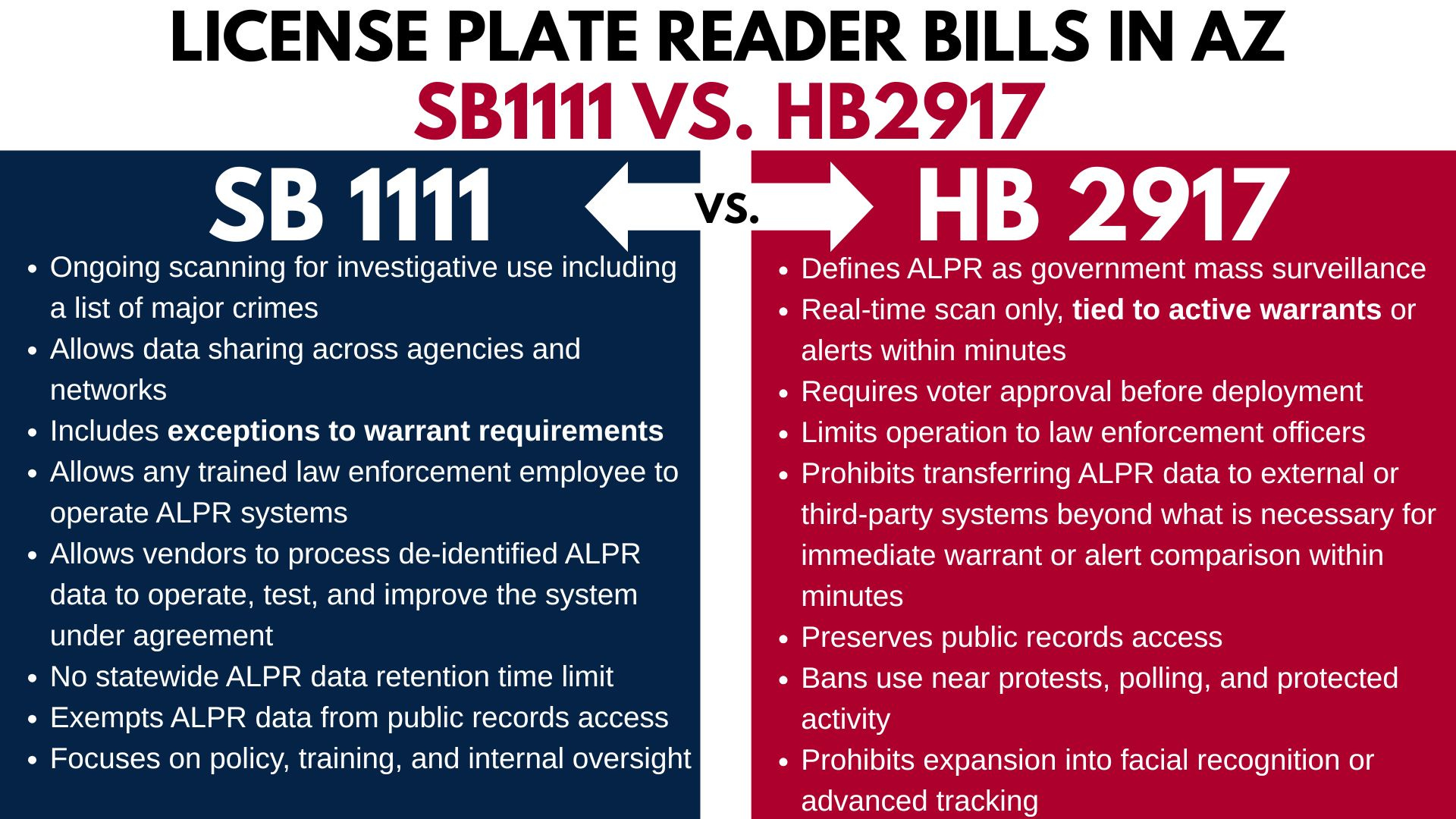
The result is a clear policy divide.
One bill regulates surveillance. The other places strict boundaries around whether it can exist at all.
Deployment Without Public Approval
Years of reporting point to a consistent pattern across Arizona.
License plate reader systems are often introduced as “pilot programs” without a public vote and, in some cases, without clear council approval.
Public visibility comes later, often incidentally. Residents notice cameras already installed. Questions follow.
Formal acknowledgment typically occurs when law enforcement returns to town and city councils to request additional funding.
More cameras. Broader coverage. Deeper integration. By then, the system is already operational.
HB2917 reverses that sequence. It requires approval before deployment, not after expansion.
Restrictions on Surveillance of Protected Activity
Senator Hoffman’s new striker bill places explicit limits on where surveillance can occur.
It prohibits the use of these systems to monitor or identify individuals engaged in constitutionally protected activity, including:
Political protests, marches, and demonstrations
Religious services and institutions
Reproductive health visits
Meetings with legal counsel
Interactions with news media
Any activity primarily protected under the First Amendment
It also establishes 500-foot exclusion zones around:
Polling locations during elections
Active protests or demonstrations
Registered nonprofit organizations under 501(c)(3) and 501(c)(4)
Why the Buffer Zones Matter
The question is whether those protections are necessary.
Public records suggest they may be.
In an exclusive Jen’s Two Cents investigation, records obtained from the Avondale Police Department show more than 33,000 license plate reader searches conducted by Arizona agencies within this dataset.
Among the listed reasons by one Arizona agency: “protest.”
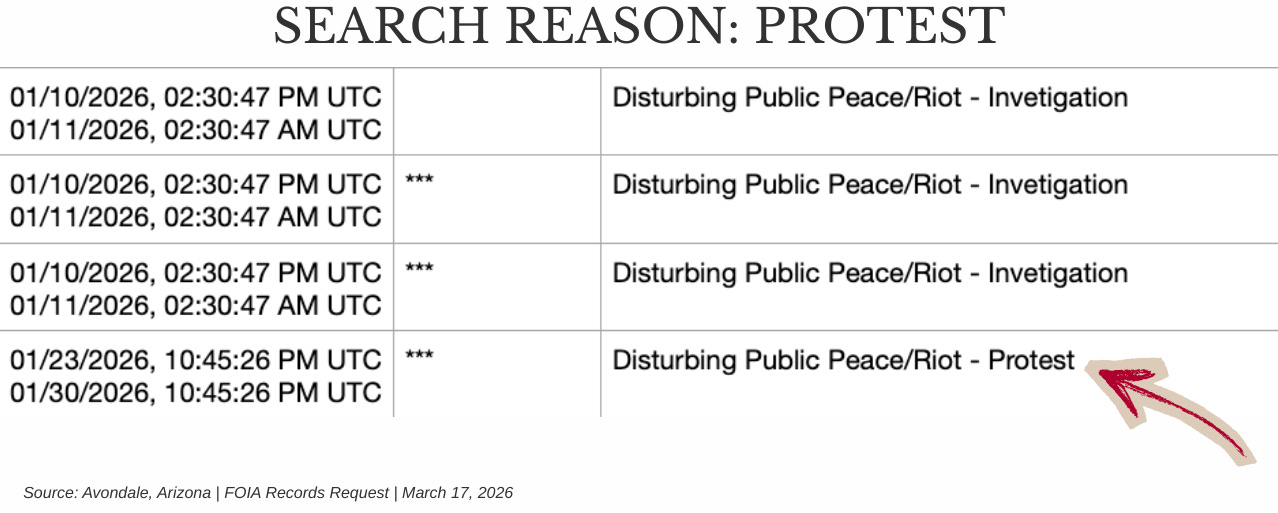
Additional public records have been requested to better understand and clarify the circumstances surrounding the “protest” search.
Records reviewed show system use in this dataset that is not limited to warrant-based investigations, including contexts tied to constitutionally protected activity.
HB2917 addresses that directly, drawing a clear line between public safety tools and the monitoring of First Amendment activity.
The public records obtained through that request are provided below for review.
The data show a single search can reach tens of thousands of cameras across thousands of networks.
Core Legal Framework of HB2917
Classification
Defines ALPR systems as part of a government mass surveillance network
Warrant Requirement
Requires a warrant for law enforcement access to data
Data Retention
Requires comparison to active warrant or alert lists within minutes of capture
If no match is found, data must be automatically and irreversibly deleted
Data Use Limitations
Limits systems to capturing license plate data only
Prohibits imaging or analysis of vehicle occupants or contents
Prohibits retroactive searches of archived license plate data
Technology Restrictions
Prohibits integration with facial recognition technology
Prohibits occupant counting, behavioral analysis, or expanded vehicle profiling beyond plate identification
Data Sharing Limits
Restricts sharing across agencies, jurisdictions, and networks
This framework draws a clear line: surveillance is permitted for active cases, not continuous tracking.
System Access and Accountability
Public records show Arizona agencies allow a range of personnel to access license plate reader systems.
In Avondale, 58 unique users including officers, detectives, community service officers, and dispatchers conducted searches within a one-month period, according to the police department.
HB2917 narrows that access.
Only trained law enforcement officers would be authorized to operate the system, request warrants, and access data. Each search would be logged with officer identity, time, plate queried, and purpose, with audit records retained and subject to court review.
Data Retention and Pattern-of-Life Tracking
Arizona agencies currently set their own data retention policies.
In one case, a public records request for resident Pam Kirby returned a year of location data, including more than 700 images of her vehicle. Due to privacy concerns, Jen’s Two Cents is not publishing those images.
Below are representative snapshots of 635 detections captured by two different license plate reader systems reportedly operating in Paradise Valley, Arizona — illustrating the volume and frequency of data collection over time.
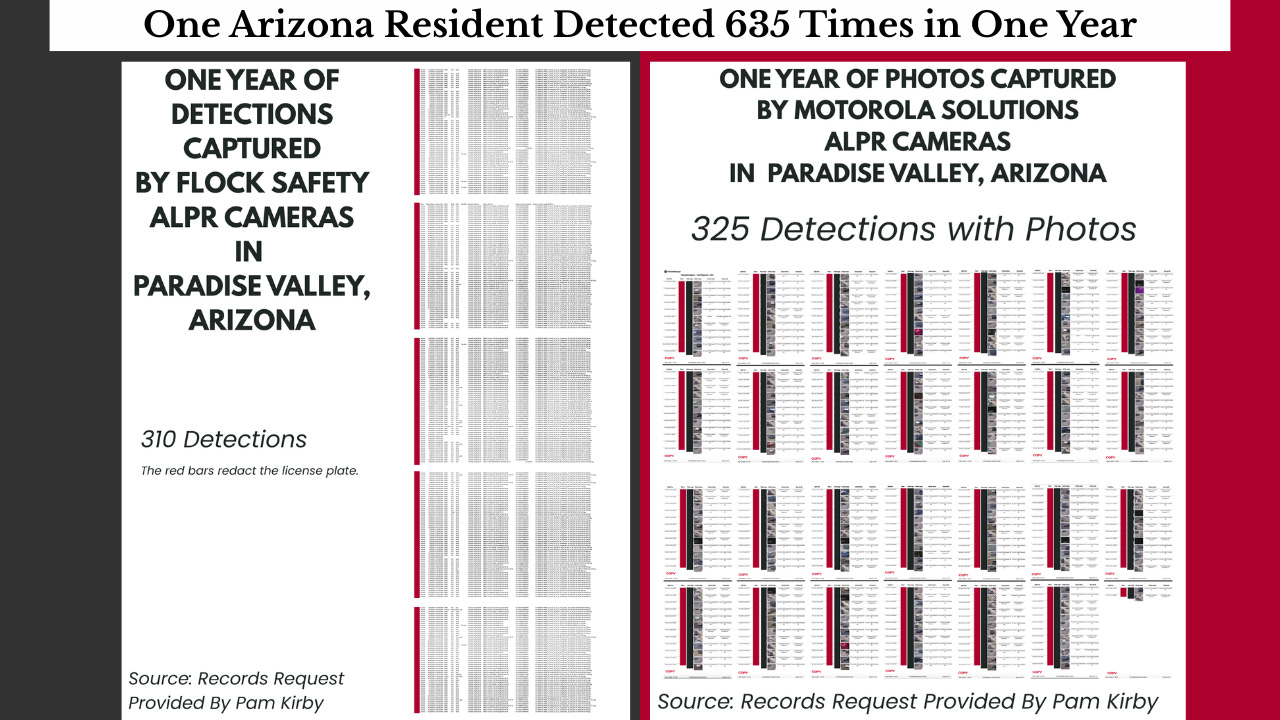
HB2917 addresses this by prohibiting the use of license plate reader data to build a person’s pattern of life, including travel history or routine, whether analyzed manually or through AI.
Data Access, Correction, and Accountability
One of the most consequential sections of HB2917 addresses a rarely examined issue: what happens when license plate reader data is wrong.
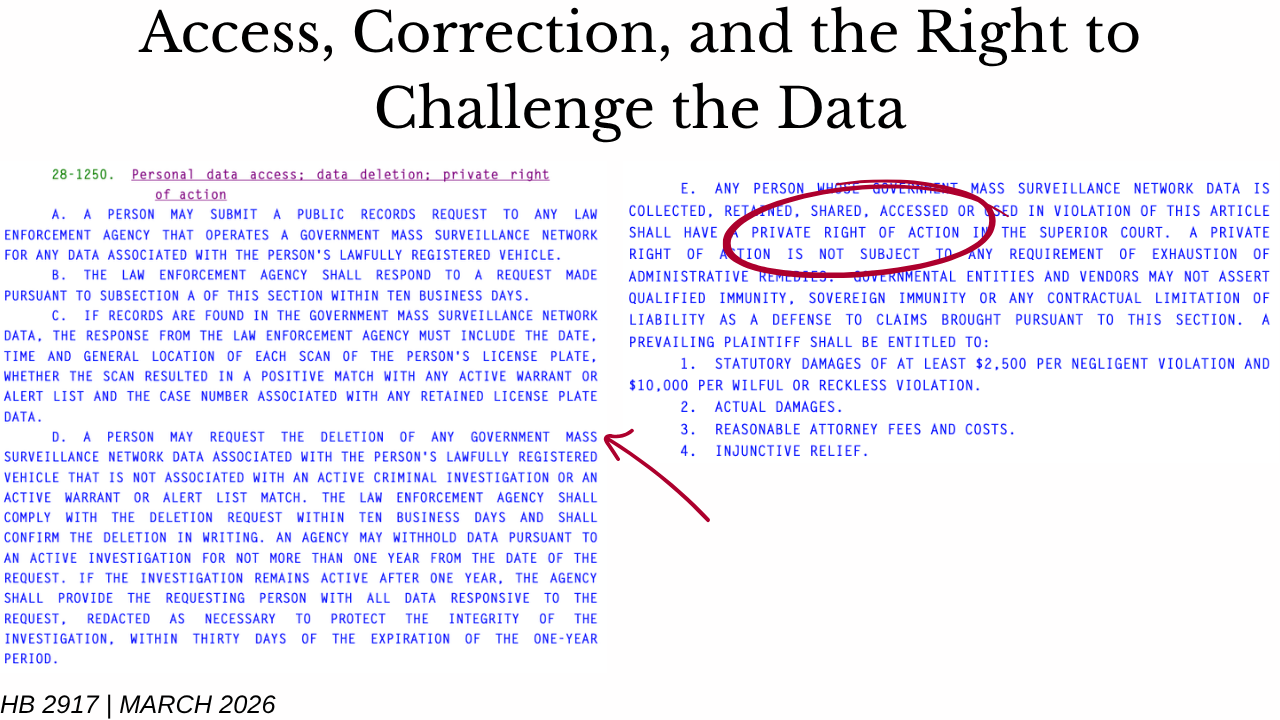
Under Sen. Hoffman’s striker legislation, individuals would have a clear, enforceable right to:
Request all surveillance data associated with their lawfully registered vehicle
Receive a response within a defined timeframe
Review when and where their plate was scanned, including any associated alerts or investigations
Request deletion of data not tied to an active case
Receive confirmation when that data is removed
The bill goes further.
If data is collected, used, or shared in violation of the law, it establishes a private right of action, allowing individuals to pursue legal claims directly. Agencies and vendors would be subject to damages, attorney fees, and injunctive relief.
This is not theoretical.
In my own case, a public records request for my license plate data returned results tied to vehicles and plates that were not mine.
When I attempted to correct the record, I was told it could not be done.
Shortly after, the city changed its policy, cutting off access for individuals to request their own vehicle data. That same approach later appeared in proposed language within SB1111.
HB2917 takes the opposite approach.
It affirms the public’s right to access their data, correct inaccuracies, and hold agencies accountable when the system gets it wrong.
A Shift in Law Enforcement Tone?
When SB1111 was heard earlier this session, the committee room was filled with police chiefs from across Arizona. A clear signal of how closely law enforcement is watching the issue.
The debate that followed on the Senate floor was contentious, highlighting an ongoing divide over how license plate reader systems should be governed.
After that debate, the Arizona Police Association issued a public statement acknowledging both sides of the issue.
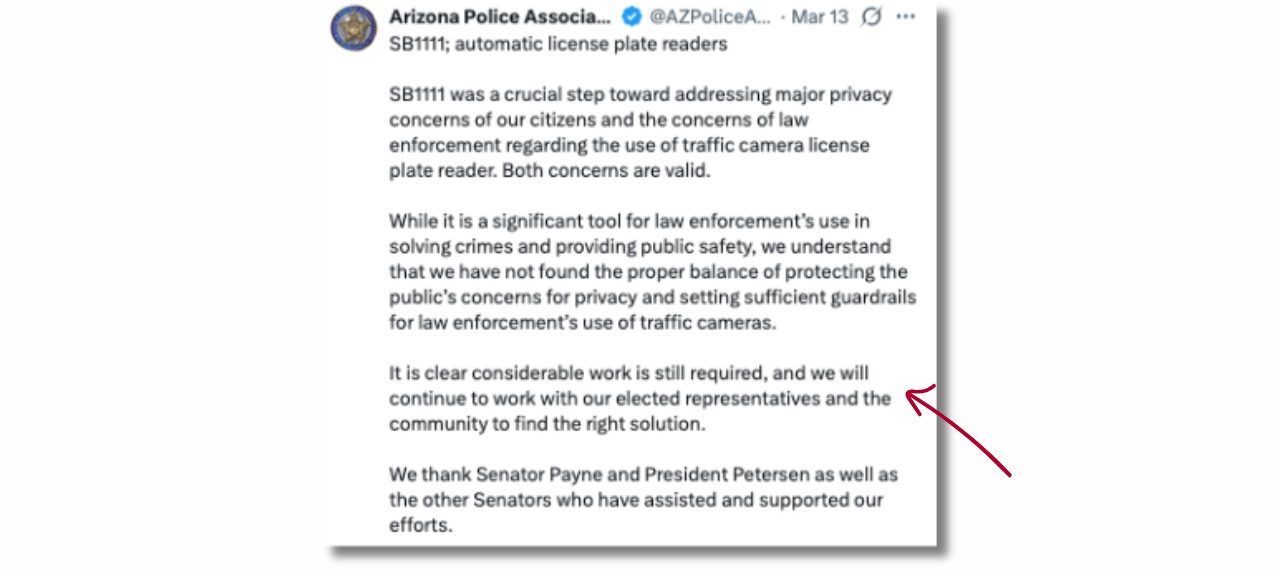
The organization described ALPR technology as a valuable tool for solving crimes and supporting public safety, while also recognizing “major privacy concerns” raised by the public.
It also stated that the “proper balance” between privacy protections and law enforcement use had not yet been found.
That framing reflects the current policy debate.
HB2917 enters the conversation at a moment when even law enforcement groups are publicly acknowledging the need for clearer guardrails.
Gaps Between Policy and Practice
Last week, the Arizona Capitol Times published a Q&A with Navajo County Sheriff David Clouse regarding SB1111.
In the interview, Sheriff Clouse addressed concerns about license plate reader use, stating:
“There are some groups I think are spreading misinformation or bad information about the use of license plate readers.”
He also described what he characterized as built-in safeguards:
“We have to put in an officer’s name. We have to put in the case number, and we have to put in the reason for the search.”

Sheriff Clouse described case numbers as part of standard procedure. Public records reviewed by Jen’s Two Cents show that many queries in the dataset do not include an associated case number, reflecting how those fields appear within the records reviewed.
In Navajo County Sheriff’s Office data, numerous entries among the 680 searches have blank case number fields. Each query does include a stated reason, including non-DUI alcohol offenses, burglary, stolen vehicles, homicide investigations, and “wanted person (arrest warrant/fugitive).”
The public records also show that access to the ALPR system is not limited to patrol-level personnel.
The dataset shows both the Pinal County Sheriff’s Office and the Pinal County Attorney’s Office as users of the Flock Safety system, with the County Attorney’s Office as the only prosecutorial agency identified among Arizona agencies.
In a statement, the Pinal County Attorney’s Office said:
“Public records show that Pinal County approved its broader Flock agreement on August 3, 2022. County financial records further show Flock-related expenditures charged to an Attorney-designated fund by August 2023, indicating that the County Attorney’s Office is participating in, or helping fund, use of the platform.
The technology serves a legitimate investigative purpose. It helps law enforcement identify suspect vehicles, generate leads, corroborate witness accounts, and connect incidents across jurisdictions, particularly after a crime has been committed. The existence of separate networks is not unusual where different agencies operate within the same technology environment while maintaining distinct access controls.
It is the duty of a prosecutor to use every lawful tool available in pursuit of justice and the safety of the communities we serve. That duty does not exist in isolation. The Pinal County Attorney’s Office is also a guardian of civil liberties, and powerful technology requires clear, principled guardrails that protect both public safety and the rights of the people we serve.”
-Christy Kelly | Public Information Officer for Pinal County Attorney Brad Miller | March 23, 2026
That statement reflects the office’s current position on the use of the technology.
Separate public testimony provides additional context.
In a March 19, 2025 hearing before the Arizona House Transportation and Infrastructure Committee on traffic photo enforcement, County Attorney Brad Miller stated:
"So this goes back to one main thing. And the whole reason we're here. We're talking about data and science and money. But in the end, this whole issue comes down to one thing. And that's putting it back to the people. The people gave us this power. The people that created this legislature. The people that created the executive branch of where I work in. And the people who created the judicial branch. Should we give the power to the people to decide how they want to be governed? What their standard of due process is. Because they're screaming from the top of their lungs saying process - the due process rights that we believe we're owed are not being had with these photo radar tickets. These photo radar cameras. It feels unconstitutional. It feels unsafe. It feels wrong."
-Brad Miller | March 19, 2025 | Arizona House Transportation and Infrastructure Committee
Those comments were made in the context of license plate traffic photo enforcement cameras.
The records reviewed for this report relate to license plate reader system use.
ALPR audit logs show queries conducted by the Pinal County Attorney’s Office between January 5 and January 29, 2026.
Within that period:
99 total queries, all labeled “lookup”
The largest single query included 90,828 devices (cameras)
A single network query extended across 5,750 networks
The primary listed purpose was “Wanted Person (Arrest Warrant/Fugitive)” in 95 searches.
That distinction goes to the core of the debate now unfolding in Arizona, where questions around the Fourth Amendment and warrant standards remain central.
Arizona and the Fourth Amendment
Earlier this month, during floor debate on SB1111, Arizona Senator Jake Hoffman introduced an amendment aimed at significantly narrowing the scope of license plate reader surveillance.
Sen. Hoffman, who is the sponsor of the HB2917 striker, framed his amendment around constitutional limits, “The Fourth Amendment is not a suggestion. It is a command to government. You do not search people without probable cause and without a warrant,” Hoffman said on the Senate floor.
“A government that watches everything controls everything.”

Unlike Senator Payne’s SB1111, which reflects input from law enforcement and agency stakeholders, Sen. Hoffman’s striker HB2917 incorporates feedback from Arizona residents, including members of the What the Flock coalition, of which I am a participant.
The distinction between the two bills reflects growing public concern about how these systems operate in practice.
HB2917 would establish one of the more restrictive statutory frameworks governing government surveillance in the United States by requiring voter approval, limiting how systems operate, and defining clear legal boundaries.
It does not eliminate law enforcement use.
It defines it.
“No person shall be disturbed in his private affairs, or his home invaded, without authority of law.”
Article 2 Section 8 Arizona Constitution
How to Watch the Wednesday Hearing
The hearing will take place:
📍 Arizona State Senate Government Committee
🗓 Wednesday, March 25, 2026 at 7am
🎥 Watch live:
https://www.azleg.gov/videoplayer/?eventID=2026031122
📣 How to Take Action
Public input is part of the legislative process in Arizona.
Residents can use the Request to Speak (RTS) system to register their position on the bill ahead of the hearing.