

Teamwork and Communication Move ALPR Proposal Into Public Discussion
Something pretty incredible happened yesterday, and it shows the power of social media and an engaged community.
Jen’s Two Cents was tipped that an ALPR technology item was sitting on the Yavapai County Board of Supervisors’ consent agenda.
I posted the agenda item to X, and the folks at Prescott Pulse and Eye on Prescott shared it with their Facebook audience.

Within a couple of hours, Supervisor Chris Kuknyo confirmed the items had been pulled from the consent agenda for discussion.
Consent agenda items are generally approved together without individual discussion. Now, the public gets to hear this one discussed.

The Yavapai County Board of Supervisors meeting begins today at 9 a.m.
UPDATE AUGUST 19, 2026 : 9:10AM
BREAKING: Yavapai County Supervisors Reject Two Sheriff’s Office Technology Contracts
It took just 1 minute and 28 seconds.
The Yavapai County Board of Supervisors removed two Sheriff’s Office items from today’s consent agenda and denied both.
Item #20: A $39,348 contract with Ekin Traffic Solutions for three mobile ALPR and video units.
Item #22: A $13,847.88 LeadsOnline NightHawk subscription providing investigative intelligence tools to the Criminal Investigations Bureau.
Board Chair Brooks Compton acknowledged the community response: “For the public, thank you so much for your input. It has been welcomed.”
Yesterday, these were consent agenda items. The community spoke up. Today, they were pulled for discussion and denied.
This is the power of community.
Arizona Agencies Moving Away From Flock Still Appear in Data-Sharing Networks
Earlier this week, I published a report examining the City of Avondale’s use of the Flock Safety system.
While researching that story, I came across something worth a closer look: Flock’s public transparency portals and who’s in the system.
The portals can show an agency’s network relationships, including which organizations have been granted access to its Flock data and which organizations are sharing data back.
And when I started looking through those lists, some familiar Arizona agencies were still there.
Including agencies that have recently suspended, discontinued or announced plans to move away from Flock.
So I started checking more portals.
60 law enforcement, public agencies HOA’s and private organizations are sharing data with the University of Arizona Campus Police Flock network, including the Arizona Department of Public Safety, Northern Arizona University Campus Police, Home Depot and Lowe’s.
But something else caught my eye.
Also notable are agencies that have announced plans to either suspend their Flock programs or leave altogether.
Tempe Police announced August 11th that it had stopped all sharing of data from its own Flock cameras. Yet Tempe still appears as an agency granted access to data in both the University of Arizona Campus Police and the Payson Police Department’s Flock Transparency Portal.
A Tempe Police Department spokesperson clarifies:
“While Tempe Police is no longer sharing its Flock data with any agencies, the Flock Transparency Portal on our website shows that some agencies continue to share their data with Tempe, which the department accesses only for law enforcement purposes, including helping solve crimes, recover stolen property, locate missing persons and identify vehicles associated with crimes in progress.”
Tempe Police Department | Public Relations Unit | August 17, 2026
Here is Tempe’s Flock Safety Transparency Portal: Police Data Transparency | City of Tempe, AZ.
In an August 11th press release, Tempe Police stated it, “stopped all data sharing from its Flock Automated License Plate Readers (ALPRs.) This was in response to privacy concerns expressed by the community and the recent misuse of the system by two local law enforcement agencies.”
“The Tempe Police Department will remain cooperative with other law enforcement agencies throughout the state. Agencies that need information may request it through the appropriate process.”
“Every month, Tempe Police audits the searches made using the Flock Safety system. To access the system’s data, officers are required to input report numbers. Each entry to the system is reviewed to confirm that all data access was strictly necessary for law enforcement. The most recent audit was conducted on Friday, Aug. 7. No misuse was found in that audit – or in any previous audits.”
Surprise Says All ALPR Access Is Suspended
Surprise Police suspended use of its ALPR system on August 12 after an audit identified an anomaly and an officer was placed on administrative leave.
A day later, the city took another step.
“On August 13, 2026, the City of Surprise sent notice to Flock Safety that the City was canceling its contract and requested removal of all related equipment.”
After multiple attempts by Jen’s Two Cents to reach the city for clarification, a spokesperson confirmed the cancellation.
Surprise Police suspended use of its ALPR system a day earlier after an audit identified an anomaly and an officer was placed on administrative leave. But Surprise still appears as an agency granted access to Flock data in the University of Arizona’s transparency portal, as well as in the Flock transparency portal in Pittsboro, Indiana.
That does not mean Surprise Police is still accessing those systems.
In fact, the city spokesperson told Jen’s Two Cents:
“Surprise Police Department has suspended access to all ALPR systems.”
The portal listings, however, remain. That raises a question about how quickly Flock transparency portals reflect changes when an agency suspends access or cancels its contract.
Jen’s Two Cents also asked whether Surprise plans to seek another ALPR vendor. The city did not respond to that question.
Pinal County’s Contract Remains Active Until September
Pinal County Sheriff Ross Teeple has announced he will not renew the Sheriff’s Office contract with Flock Safety when it expires September 28th.
For now, however, the agency still appears in several Flock transparency portals.
The University of Arizona’s portal lists the Pinal County Sheriff’s Office on both sides of its network: as an organization granted access to university data and as an organization sharing data with University of Arizona Campus Police.
Jen’s Two Cents also found the Sheriff’s Office listed in the Payson Police Department portal and a Flock transparency portal in Pittsboro, Indiana.
Jen’s Two Cents reached out for clarification and was told:
“Pinal County Sheriff Ross Teeple has decided against renewing his agency’s contract with Flock Safety, which expires on September 28. This was communicated to the Board Of Supervisors on August 5. This only affects unincorporated Pinal County and the city of San Tan Valley.”
The department also noted that the San Tan Valley City Council may decide to use automatic license plate readers in the future.
Pinal County Sheriff Teeple has said his decision came down to balancing the investigative value of ALPR technology against constitutional concerns.
Pinal County Sheriff Ross Teeple:
“Automatic license plate readers help solve crimes, catch criminals and find missing people. Technology that is limited to reading license plates is a great tool.
I swore an oath to defend the Constitution, and I believe the latest cameras may be capable of violating citizens’ Fourth Amendment rights.
In order to put a GPS tracker on a vehicle, my deputies need a warrant. AI pattern recognition technology and facial recognition technology are pushing that boundary.Protecting public safety and defending constitutional rights are my most important jobs. We can use technology while still achieving those goals.”
Chandler Ends Flock Use and Disappears From Reviewed Sharing Networks
Chandler Police no longer appears on the university’s sharing or access lists. On August 7th, Chandler announced it was discontinuing its use of Flock after an audit identified an unexplained anomaly. The city said Chandler’s access to the Flock system would be terminated and its 40 Flock cameras removed.
In January 2026, Chandler appeared as a partner in Payson’s Flock transparency portal. Today, Chandler does not appear in any of the Flock transparency portals reviewed by Jen’s Two Cents.
Sierra Vista Ended Its Flock Contract in April. It Still Appears in Sharing Networks.
The City of Sierra Vista is no longer contracted with Flock Safety for license plate readers. The contract was reportedly terminated on April 2, 2026.
More than four months later, however, Sierra Vista still appears as an agency granted access to Flock data in transparency portals reviewed by Jen’s Two Cents, including those published by Payson Police and University of Arizona Campus Police. We also see the City of Sierra Vista in the Tempe Flock Transparency Portal.
But Sierra Vista Police says those portal listings do not reflect its actual access.
Corporal Jené Seage confirmed to Jen’s Two Cents that the department is no longer using the Flock system in any way.
“We don’t have any access. That was revoked when we cancelled our contract. At least as far as the line officers were told. We don’t go onto the website anymore. All that has been revoked.”
Sierra Vista’s Flock transparency portal can still be found in search results, but as of publication, the portal itself no longer appears to be publicly accessible.
Jen’s Two Cents also contacted Flock Safety for clarification about the portal listings and has not received a response.
Seage said any active Flock cameras currently operating in the Sierra Vista area are privately owned.
So, in Sierra Vista’s case, appearing in another agency’s Flock transparency portal does not mean the department still has access to that data.
Another Transparency Portal Detail Worth Noting
Here’s something else I noticed while reviewing Flock transparency portals: agencies can choose which usage statistics they display publicly.
Many portals appear to show “Unique Vehicles Detected” while not displaying Total Vehicle Volume or Total Unique Vehicle Volume.
The University of Arizona portal is a good example, not because I’m singling it out, but because it illustrates the issue. Its portal shows 156,619 unique vehicles detected in the last 30 days. That means 156,619 distinct license plates, each counted once across the entire 30-day period.
It does not tell us how many total vehicle detections the cameras recorded.

That number could be much higher. From the public-facing portal alone, we simply don’t know.
Not Every Portal Shows the Full Picture
Many Arizona agencies using Flock do not publish their public Flock transparency portal at all. And among the Arizona portals Jen’s Two Cents reviewed, we could not find one displaying all of the available usage metrics.
For comparison, public reports from Wheaton, Illinois, and Ellensburg, Washington, have disclosed both the number of vehicle detections and unique vehicles detected.
Why does this mean? A vehicle can be detected repeatedly, while the “Unique Vehicles Detected” figure counts each license plate only once during the reporting period.


Not all vehicle counts mean the same thing. Flock separates the data into different measurements. Total Vehicle Volume counts every detection, meaning the same vehicle can be counted over and over. Total Unique Vehicle Volume counts a plate once per day. Unique Vehicles Detected counts each plate only once during the entire 30-day period.
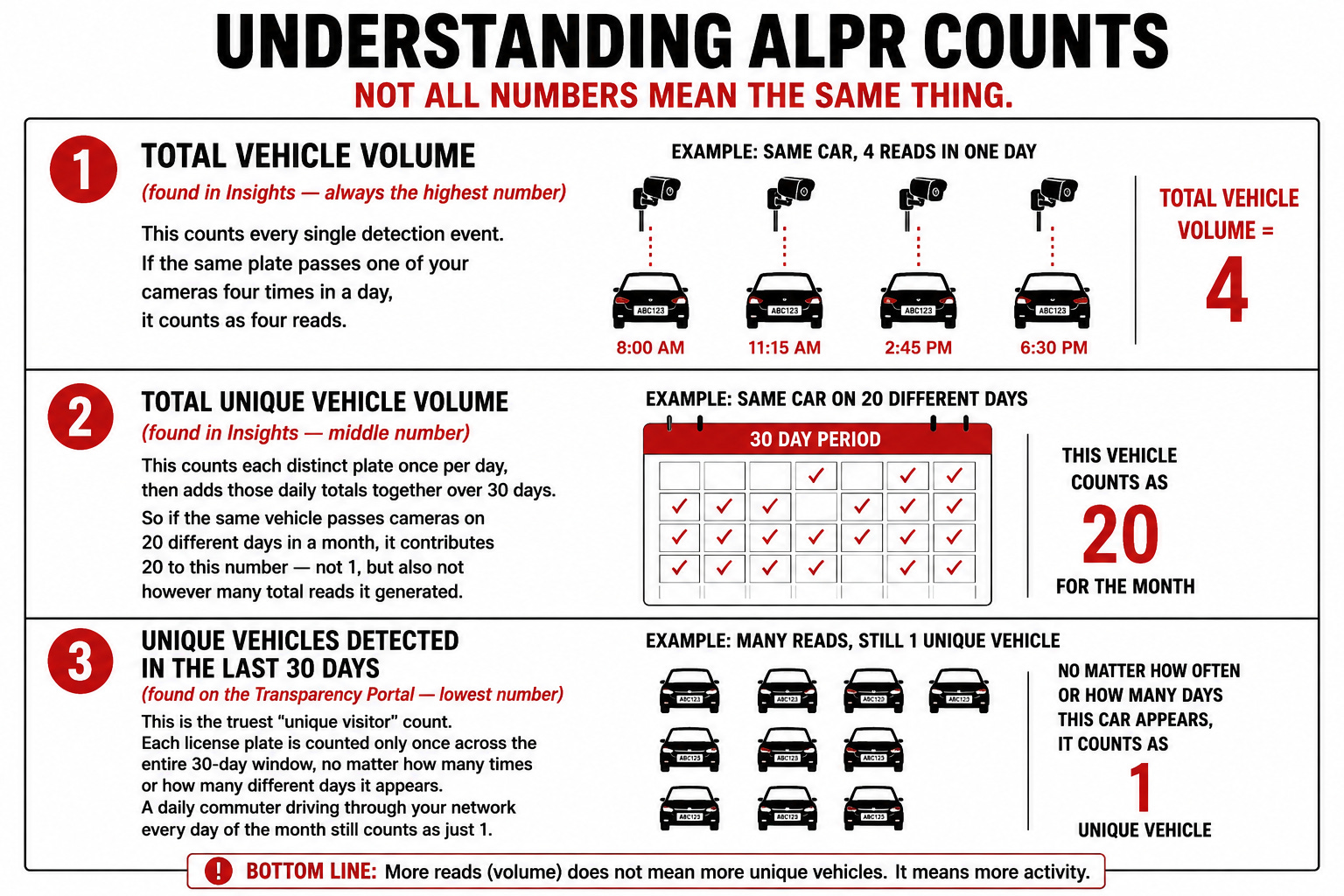
So when an Arizona portal reports only Unique Vehicles Detected, we still don’t know the total number of times those cameras captured vehicles.
Why does this matter? Our reporting has found continued confusion about what ALPRs actually collect: a vehicle can be detected and its location recorded each time it passes an ALPR camera, whether that camera is made by Flock or another manufacturer.
Jen’s Two Cents
Here’s a list Arizona didn’t make, but 2027 could change that.
A new 50-state ALPR policy scorecard evaluates states on privacy protections, data sharing, auditing, transparency, enforcement and other safeguards. Arizona is among the states without a statewide ALPR law on the books.
Arizona lawmakers tried in 2026. Multiple bills addressing ALPR use were introduced, including proposals dealing with law enforcement access, data management, auditing and surveillance networks.
They didn’t cross the finish line.
Will lawmakers try again in 2027? Will someone propose stronger limits, or even a ban?
In the meantime, Jen’s Two Cents will keep digging into how ALPR systems are actually being used across Arizona, who has access to the data and what communities can do when they want a say.
Finally, THANK YOU to everyone who stays connected, sends tips and supports my work.
I do this in my spare time, and after following this technology for several years, it’s been great to see more Arizonans taking an interest and asking questions in their own communities.
Keep the tips coming. I’m always listening.
Earlier this year, I took a deeper look at the scale of Arizona’s interconnected Flock network and just how far a single search can reach.
Read the full investigation: “Scale of the System: Records Indicate Arizona Vehicle Surveillance Networks Can Reach 95,000+ Cameras.”