

“Hypocrites.” Prescott’s Camera Debate Takes an Unexpected Turn
Police cameras vs. scenic cameras. Who's on the other side of the lens?
“Hypocrites.”
Prescott, Arizona, is no stranger to the debate over cameras.
But this time, it’s not just Flock license plate reader cameras in question.
The “eyes in the skies” camera debate has taken an unexpected turn. This time, it’s about the cameras that aren’t being used by the government.
Let’s take a step back. While investigating how Flock Safety cameras were approved and later presented to the public in Prescott, I gave city officials an opportunity to weigh in. If you read that investigation, you’ll see I published the records alongside detailed responses from Interim Police Chief Jon Brambila and Mayor Pro Tem Lois Fruhwirth about the program, the procurement process, and decisions made along the way.
But they weren’t the only city officials I heard from.
Prescott Mayor Cathey Rusing also responded.
Her response took the conversation somewhere else entirely.
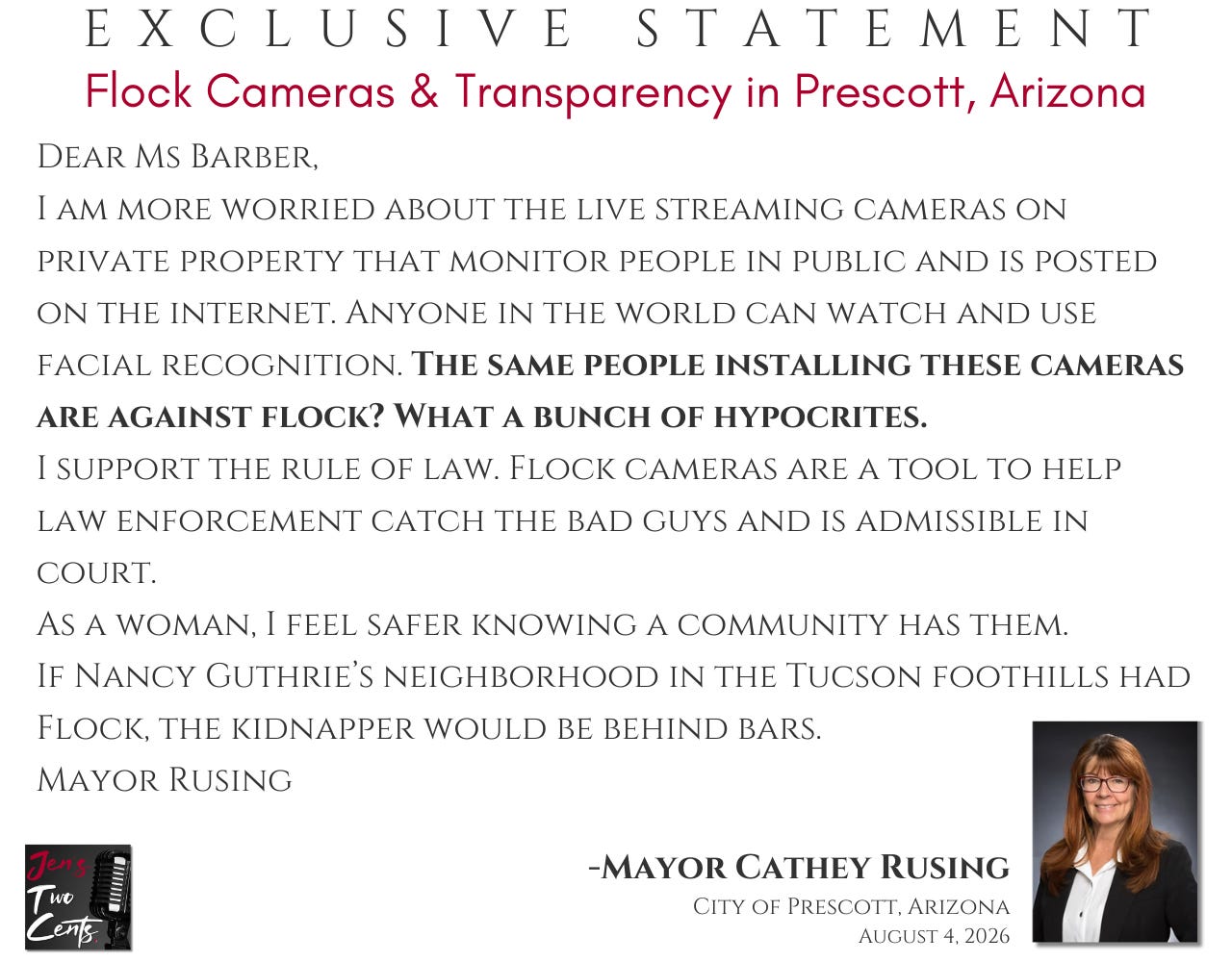
Mayor Rusing wasn’t just defending the city’s taxpayer-funded Flock cameras.
She addressed privately owned cameras livestreaming public spaces… and some of the people opposing Flock while operating their own private cameras.
Her word for the people?
“Hypocrites.”
Here’s what Mayor Rusing told me:
“I am more worried about the live streaming cameras on private property that monitor people in public and is posted on the internet. Anyone in the world can watch and use facial recognition. The same people installing these cameras are against flock? What a bunch of hypocrites.”
And with that, my investigation took an unexpected turn.
If we’re going to have a serious conversation about surveillance, privacy and cameras in Prescott, perhaps the question isn’t only whether government should be watching.
What happens when the cameras belong to your neighbors or private businesses?
And that’s where Part Two of this multi-part investigation into cameras in Prescott begins.
A View Worth Watching
Full disclosure. I love the Prescott area. It’s home away from home for me.
Prescott sits a mile high in the mountains of central Arizona, about 100 miles north of Phoenix. At roughly 5,200 feet, it’s a different Arizona than the desert landscape many outsiders picture.
Four seasons. Ponderosa pines. Mountain roads. Granite outcroppings. Sweeping views that stretch across the Prescott National Forest.
It’s beautiful backcountry. With a spirited downtown vibe.
And people want to see it.
So perhaps it’s no surprise that cameras have popped up across the landscape, offering live views from the surrounding hillsides to Prescott’s historic Courthouse Plaza.
What can the cameras see? Some capture weather. Some capture scenery. Some simply offer a window into life in one of Arizona’s most historic and recognizable mountain communities.
To be clear… these are not police cameras. Not paid for by taxpayers.
This is an important distinction.
A View From Prescott’s “Eyes in the Sky”
Let’s get perspective on the privately owned cameras looking down on Prescott.
Here’s one sitting above Prescott’s famous Whiskey Row, a bustling tourist destination steeped in Old West history, legendary saloons, and the city’s frontier past.
KYCA’s live camera at the Jersey Lilly on Whiskey Row streams a view of downtown Prescott on YouTube.

I peeked in on a rainy Tuesday morning. The streets were quiet, but I could watch vehicles passing through downtown in real time.
From my desktop with my own eyes, I can’t make out license plates or identify the faces of people walking across the street. Whether technology, including facial recognition, could extract more from that same livestream is a separate question.
Then I checked out SignalsAZ, which offers two publicly accessible live cameras. One provides a wide view across the Prescott area and another overlooks Courthouse Plaza. The cameras allow anyone with an internet connection to check local sky and weather conditions.

Again, I could not make out plates or faces with the naked eye. You should take a look at make your own conclusion.
And finally, the camera overlooking Courthouse Plaza with a story that extends well beyond the view.
Prescott’s First Downtown Live Cam
High above Courthouse Plaza, a camera at Bashford Courts streams downtown Prescott around the clock.
Prescott Live describes it as “Prescott’s First Downtown Live Cam.” The site says the camera provides a real-time view of the square from people gathering beneath the trees to events, live music and the everyday activity unfolding downtown.

It’s not just a camera feed. The site has sponsors and promotes a network of other 24/7 cameras in communities including Prescott Valley, Chino Valley, Jerome and Sedona.
According to Prescott Live, the purpose is simple: give locals, seasonal residents and prospective visitors a way to stay connected to downtown Prescott in real time.
Prescott Live cameras are operated by Eye on Prescott, a local media outlet and podcast hosted by Tony Hamer and Chad DeVries.

Around Prescott, these two are something of local celebrities. They cover city politics, community news, and local government. They’re certainly not afraid to tackle the big issues or tell you exactly what they think about them.
I’ve enjoyed getting to know Tony and Chad through my own reporting. And last November, they invited me into their gorgeous downtown studio to talk Flock, privacy, and surveillance.
Which brings me to something important: I’ve actually seen their camera overlooking the Plaza up close.
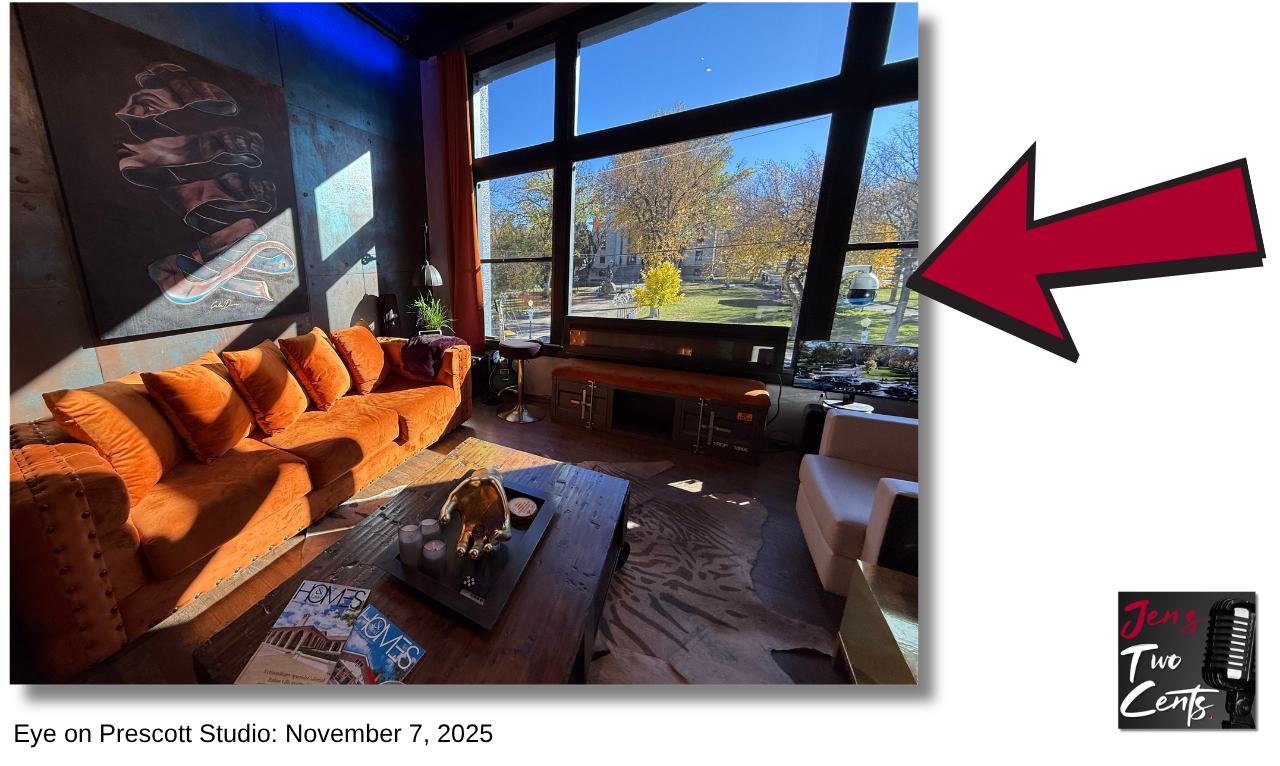
At the time, I had no idea that months later, a debate over that kind of camera would become the next chapter of my Flock investigation.
Which brings us back to the mayor.
One line in Rusing’s statement to me suddenly becomes especially noteworthy:
“The same people installing these cameras are against flock? What a bunch of hypocrites.”
Was the mayor referring to the people behind this camera?
I don’t know.
I reached back out to Mayor Rusing and asked her to clarify specifically whom she was referring to when she made that statement. As of publication, she has not responded.
So I won’t put names to her words for her.
But I did reach out to Chad and Tony, the duo behind the Prescott Live scenic cams.
I asked them about the comparison between privately operated scenic cameras and Flock’s automated license plate readers.
DeVries rejected the comparison.
“Eye on Prescott’s live scenic cameras are fundamentally different from Flock Safety license plate reader (LPR) cameras. Scenic cameras are privately owned, located on private property, and are designed exclusively to provide a live public view of a fixed location. They do not identify, track, or store digitized information about individuals, vehicles, license plates, or personal property, nor do they create searchable databases or historical movement records.
For more than 30 years, scenic cameras have been widely used by communities throughout the United States to promote tourism, showcase local attractions, and provide a free public service by displaying real-time weather conditions, traffic flow, parking availability, community events, wildlife activity, and emergencies occurring within the camera’s fixed field of view. Each month, thousands of viewers tune in to our cameras and appreciate being able to experience the beauty of Prescott from anywhere in the world. Whether they are former residents, prospective visitors, family members, or tourists planning a trip, these cameras help connect people with our community while supporting local businesses and tourism.
By contrast, Flock Safety cameras are automated license plate reader systems deployed for law enforcement and public safety purposes. They are typically installed by or in partnership with government agencies and are often funded with taxpayer dollars. Because they collect and retain searchable vehicle information for investigative use, it is appropriate that government agencies be transparent with the public about where these systems are installed, how the data is used, how long it is retained, and what privacy safeguards are in place.
Equating a privately owned scenic camera with a law enforcement license plate reader is inaccurate. While both may observe public spaces, they serve entirely different purposes, use fundamentally different technology, and have very different privacy implications.”
Chad DeVries | Eye on Prescott
DeVries tells me Eye on Prescott does not save or archive the livestream footage and has never provided footage from the camera to law enforcement.
“We have no reason to save it. It’s scenic only and for my advertisers.”
DeVries said people have contacted him in the past hoping to obtain footage after accidents near the camera’s field of view. His answer, he said, has been the same: there is no recording to give them.
Eye on Prescott has a thriving Facebook community, where it has publicly pushed back on comparisons between its scenic livestream cameras and Flock’s automated license plate readers.
In a graphic shared with followers, Eye on Prescott put its position in bold letters: “SCENIC CAMERAS ARE NOT FLOCK CAMERAS.”

The graphic contrasts what Eye on Prescott describes as privately owned cameras intended for public viewing and tourism with Flock cameras designed for law enforcement use and the collection of searchable vehicle information.
Its bottom line is equally direct:
“SCENIC CAMERAS SHOW THE VIEW. FLOCK CAMERAS COLLECT DATA.”
That’s Eye on Prescott’s argument.
While KYCA Radio has not responded to my questions by publication, SignalsAZ did:
“Our live streaming cameras view public property and can be viewed on the home page of SignalsAZ.com . The purpose of the cameras is for residents to view weather, traffic, and the events that may be occurring (ie downtown Prescott). That’s it!”
Guy Roginson | Executive Director | Talking Glass Media
“That’s it!”
Mayor Rusing sees the privacy question differently.
Within her statement is another issue worth examining: facial recognition.
I’m no technology expert. Can facial-recognition technology be used to identify people captured by these publicly available scenic livestreams? An internet search tells me that question opens up an entirely different rabbit hole. One I’ll save for another day.
What we do know is that facial recognition from video depends heavily on things like image quality, face size, camera angle, lighting and other conditions.
So, for now, I’m sticking to what I can document.
Watching vs. Tracking
A camera livestreaming a public space can raise legitimate privacy questions of its own.
Who is watching?
Is the footage recorded?
Could emerging technology someday extract more information from those images than we can see with our own eyes?
Is watching a public place the same thing as systematically capturing vehicle information and turning it into searchable database for law enforcement?
Should those two kinds of cameras be treated as equivalent simply because both can see what happens in public?
I’ll let you decide.
Jen’s Two Cents.
In towns, cities, counties and universities across Arizona, taxpayers are funding automated license plate reader systems designed to capture vehicle information and create searchable records that can be used by law enforcement.
As the records I reviewed in Prescott showed, those systems can be purchased and put into operation without first being presented to the public in a standalone City Council discussion or vote. A system supported by Prescott’s mayor.
“I support the rule of law. Flock cameras are a tool to help law enforcement catch the bad guys and is admissible in court.
As a woman, I feel safer knowing a community has them.
If Nancy Guthrie’s neighborhood in the Tucson foothills had Flock, the kidnapper would be behind bars.”
Mayor Rusing
The mayor’s reference to a neighborhood raises another question:
How deep into our neighborhoods should vehicle surveillance cameras go?
While reporting this story, I also came across a discussion involving another Arizona mayor and police chief about using Flock cameras at the neighborhood level. That conversation raises a new set of questions about where these systems belong.
This debate no longer stops at major intersections or busy city streets. It’s moving deeper into Arizona communities. And that’s where Part Three of this investigation is headed.
As for the privately owned cameras in Prescott, they offer an invitation... No matter how far away you are, you can still peek in on this beautiful little corner of Arizona:
“Wherever you are, the square is always just one click away.”
One camera invites you to watch. Another uses your tax dollars to give government the ability to collect and search your location data.
This chapter isn’t about whether cameras exist. It’s whether we understand what happens on the other side of the lens.