

For the past handful of years, I’ve watched artificial intelligence slowly creep into policing where I live and throughout the state of Arizona.
It has been a fascinating topic to follow and report on.
This week, all of that reporting converges in one place. Right in my own backyard.
This week, the National Real Time Crime Center Association is bringing what it calls its “largest, most ambitious NRTCCA Conference to date” to the Phoenix Convention Center.
“Phoenix marks a milestone moment where real time crime centers, public safety leaders, technologies, and innovators come together at a scale we have never done before.”

The sponsors range from some of the biggest names we commonly hear about in law enforcement technology… like Flock Safety, Axon, Motorola Solutions, Skydio and Peregrine… to dozens of companies most members of the public have probably never heard of.

Take a closer look at what many of them sell: artificial intelligence, facial recognition, drones, video analytics, automated license plate readers, data integration, investigative tools and technology designed to help law enforcement collect, search and connect information faster than ever before.
Sold-Out Pre-Conference Tours
Before the conference sessions even begin, attendees have an opportunity to see some of this technology in action through a series of sold-out pre-conference bus tours.
The stops include both law enforcement real-time crime centers and some of the biggest companies operating in the public-safety technology space.
On the law enforcement side, attendees are scheduled to visit:
Grand Canyon University Police Department Real Time Center
Mesa Police Department
Peoria Police Department Real Time Center
Phoenix Police Department Citywide Real Time Center
Phoenix Police Department Desert Horizon Precinct
The technology-focused stops and events include:
AXIS Communications
Axon headquarters
Genetec event
Motorola Solutions
NRTCCA Training Facility
Verkada
For Arizona, this is a significant list.
Several of the police departments opening their doors to conference attendees are already part of the state’s expanding network of real-time policing technology.
The tours offer attendees a firsthand look at how those systems are being put to work here in Arizona.
But the tours are only the beginning.
Once attendees return to the Phoenix Convention Center, the focus shifts from seeing the technology in action to discussing where it goes next.
And the companies sponsoring the conference aren’t just exhibiting on the conference floor.
Several also appear throughout the agenda, alongside law enforcement officials, in sessions examining the technologies already changing policing…
And what comes next.
What’s on the Agenda?
The conference agenda is extensive, but some of the most consequential and controversial technologies in modern policing are front and center.
Artificial intelligence. Automated license plate readers. Facial recognition. Drones as first responders. Open-source intelligence. Expanding camera networks. And the ability to connect and share more of that information across jurisdictions.
The week begins with some of the infrastructure behind it.
A Samsung Electronics America presenter will lead a practical course on developing a Tactical Awareness Kit (TAK) program. The technology can integrate data from aircraft, 911 centers, officer locations, video surveillance and drones into a shared operational picture.
Another hands-on course teaches agencies how to build and configure cameras and communication systems, with the stated goal of helping them expand their camera networks.
Then there’s AI.
Amazon Web Services is sponsoring a session on bringing AI power into real-time crime centers, while Motorola Solutions will present a session on moving real-time operations beyond traditional video and license plate readers through built-in AI, Drone as First Responder capabilities and other integrations.
Drones as First Responders
The conference says Drone as First Responder programs have “exploded across the country in the past year.”
Skydio CEO Adam Bry will discuss the future and growth of DFR programs, while other sessions focus on building and scaling them.
One examines how drones could change officer-involved shootings and uses of force.
Another is titled “How to Explain DFR to Your Council and Community in 2026,” promising strategies for addressing concerns amid what the conference itself describes as the current controversy surrounding surveillance technology.
Facial Recognition, OSINT and Your Vehicle
Facial recognition also has a place on the agenda, including sessions on turning facial recognition results into investigative leads and establishing what organizers describe as a responsible and ethical facial recognition unit.
Open-source intelligence training will teach attendees how publicly available information can be used in real-time operations and investigations.
Another session goes further, examining how law enforcement can use publicly available information to identify potential threats before investigators have a name, address or even know which jurisdiction the threat belongs to.
Automated license plate readers and vehicle intelligence are part of the conversation as well, including regional information sharing and partnerships between law enforcement and private businesses.
And one session raises a question that may sum up the broader debate:
Should every agency have direct access to everything?
The discussion will include governance, auditing, accountability, data ownership, user management and public trust.
Arizona Takes Center Stage
Arizona isn’t simply hosting the conference.
One sponsored session is titled:
“How Arizona Deployed Peregrine to Every Jurisdiction.”
Phoenix Police will also be among the agencies discussing what happens after real-time technology goes live.
Federal money gets its own attention, with sessions examining DOJ and DHS grant programs and other funding available to help state and local law enforcement build and operate real-time crime centers.
And then there are two sessions that immediately caught my attention:
“The Collision of Drones, ALPRs, Public Records and Privacy.”
And:
“ALPR, Drones, and Data Privacy: Federal Policy and Legislation Affecting RTCCs.”
That second discussion will address data access, information sharing, privacy and federal policy that could shape how real-time crime centers operate.
Those are questions Arizona is already confronting.
Who’s Taking the Stage?
The speaker lineup is nearly as interesting as the technology.
It brings together federal officials, law enforcement leaders, technology executives and some nationally recognizable names.
Mike Fullerton, Assistant Secretary for the DHS Office for State and Local Law Enforcement, is scheduled to deliver welcoming remarks.
Former Pinal County Sheriff Mark Lamb will join an Ekin-sponsored session with a particularly timely title: “Innovation With Respect to Privacy.”
Adam Bry, CEO of Skydio, will take on the future of Drone as First Responder programs.
Former U.S. Marine Codey Gandy, now a leadership instructor and strategic adviser with Echelon Front, is a keynote speaker.
Aaron Cohen and recently retired NYPD Deputy Chief William Viscardi will present on using publicly available information to identify and attribute potential threats before investigators even know which jurisdiction they belong to.
Rosanna Tomiuk, a partner at Novus Global, is also scheduled for a keynote.
Former Fairfax County Police Major Christian Quinn will deliver another keynote later in the conference.
And one of the most recognizable names isn’t actually coming to Phoenix in person.
Leadership author Simon Sinek is scheduled to appear virtually for a Q&A with The Curve Executive Director Doug Shoemaker. Sinek founded The Curve in 2021, which the conference describes as a group of police chiefs and sheriffs working to reform policing from within.
While much of the agenda focuses on what these technologies can make possible, some of its most important sessions may ultimately be the ones asking where the limits should be.
Flock Takes the National Stage: Will Arizona’s Police Departments Be Part of the Conversation?
What will be interesting to see is whether anyone addresses what has happened right here in Arizona, where police departments have recently come forward with cases involving intentional misuse of Flock Safety’s license plate reader system.

Speaking of misuse, Flock Safety will take the national stage with a tool I reported on earlier this year: Audit Assistance.
The company is sponsoring a session on oversight and accountability, using its own auditing tool as an example.
Given what Arizona police departments have recently disclosed about intentional misuse of Flock’s system, the timing is hard to miss.
Jen’s Two Cents
Of all the sessions being offered at this week’s National Real Time Crime Center Association conference in Phoenix, two hit at the core of where I think we are as a society right now.
One is called “The Collision of Drones, ALPRs, Public Records and Privacy.”
The other: “ALPR, Drones, and Data Privacy: Federal Policy and Legislation Affecting RTCCs.”

Arizona has already been forced to confront these issues.
Last year, I filed a public records request with my local government in Goodyear asking for something pretty simple: Show me what your Flock license plate reader system has collected about my vehicles.
What came back stunned me.
My records spanned 185 days and contained 243 linked data points documenting my vehicles and 273 photographs in total. Some of those images included license plates and even a vehicle that did not belong to me.
I then asked what I thought was another fairly simple question: If information connected to me is wrong, can I have it corrected or deleted?
The answer was no.
Something else happened after I obtained those records.
Goodyear changed how it handled these requests.
During a January City Council work session, Goodyear Councilmember Trey Terry acknowledged that the city had honored the request at the time but had since been reviewing its policy.
Then he said something that immediately got my attention:
“We did honor that request at the time. My understanding is the City of Surprise does not create a ‘hit’ — uh — because when somebody would put in a public records request, it forces us to create a ‘hit’ — or put a plate on a hotlist to then be able to capture that data.”
A hotlist?
I emailed the city attorney asking for clarification.
The following afternoon, Goodyear Police Chief Brian Issitt responded and told me that wasn’t what happened with my request:
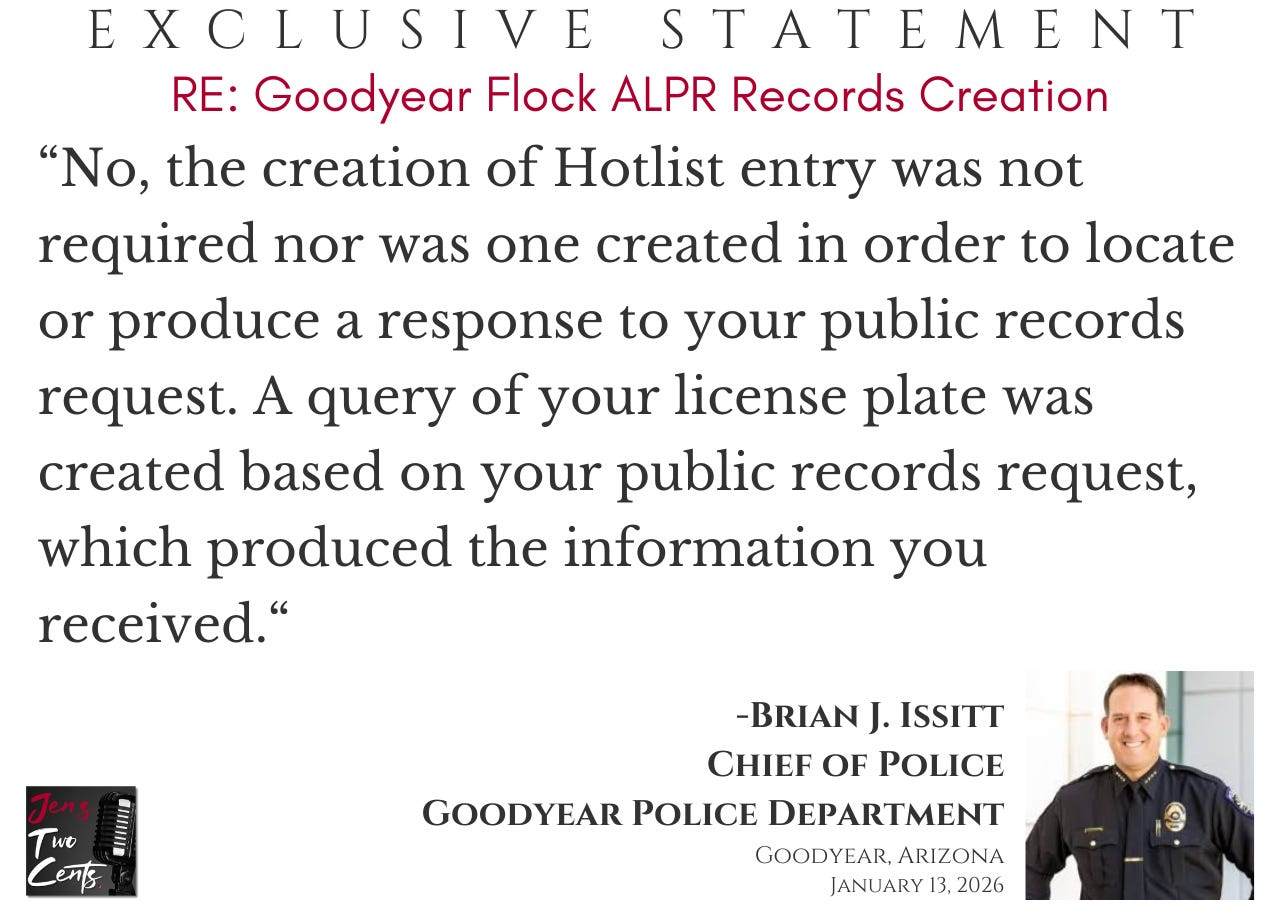
So, yes, there has been misinformation surrounding Flock cameras in Arizona. Some of it came from the very government officials defending them.
Goodyear developed a policy changing how it responds to ALPR public records requests. The result? Requests for that data will be denied going forward. And the debate didn’t stay in Goodyear.
It made its way to the Arizona Legislature.
Earlier this year, I took my own experience to the State Capitol as lawmakers considered legislation governing license plate readers that were already operating across Arizona. At issue were questions I had been asking for months: How long should police be allowed to retain the location history of people who aren’t suspected of crimes? How long should it be stored by the government? Who can it be shared with? And should I have the right to see what my own government has collected about me with the ability to correct errors?
Those questions became part of the fight over legislation including SB 1111 and SB 1138 and, later, proposed restrictions on ALPR use in a striker amendment to HB 2917.
At the time, much of the debate was about “guardrails.”
Fast forward to this summer.
Arizona police departments have started publicly acknowledging cases in which officers allegedly used Flock systems outside department policy, including to locate family members.
Suddenly, the possibility of misuse wasn’t hypothetical.
The political conversation appears to be moving again.
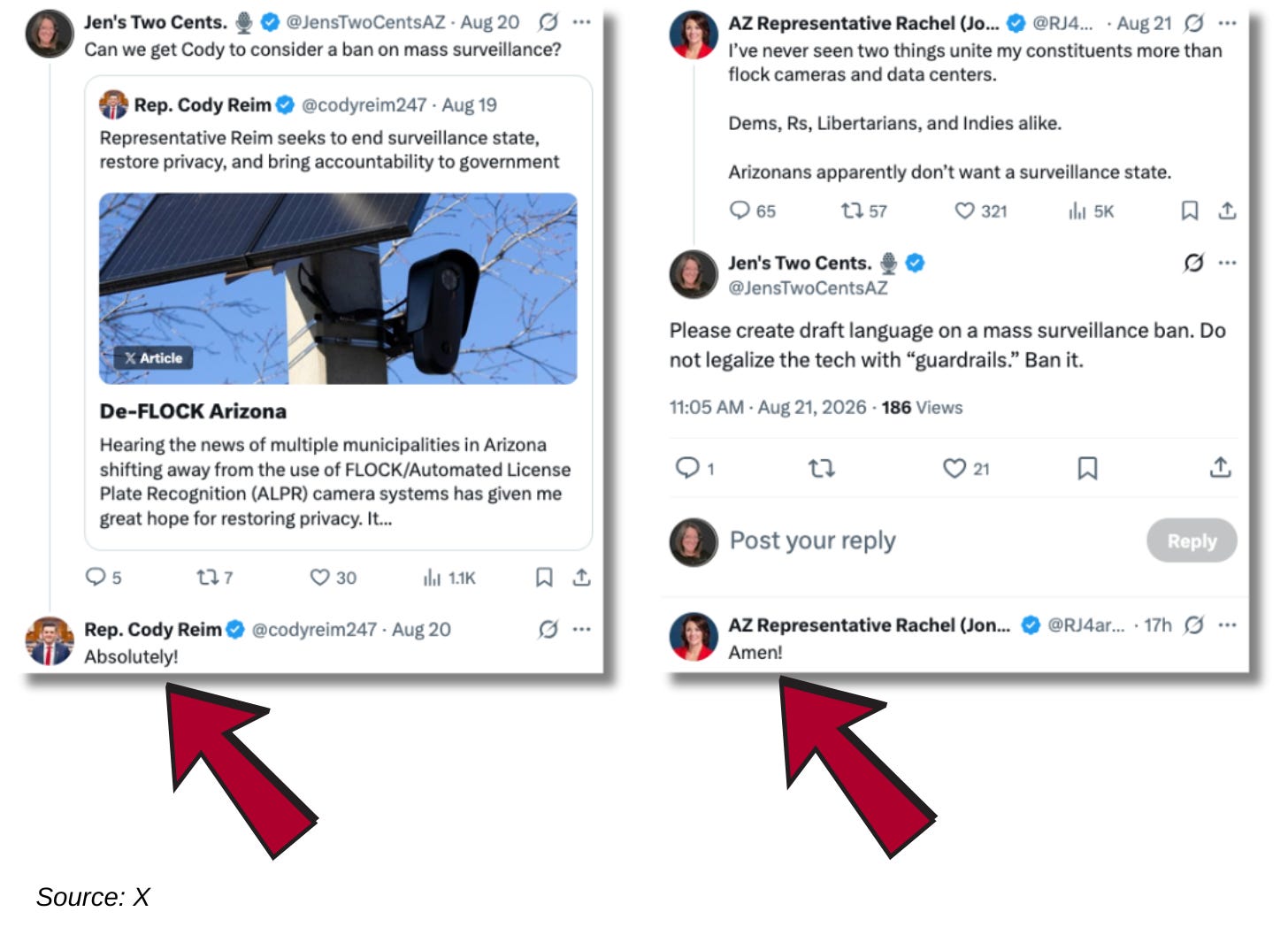
This week, Republican Rep. Cody Reim publicly agreed when I asked whether he would consider a ban on mass surveillance. Rep. Rachel Keshel, responding to my call for draft language banning mass surveillance rather than simply regulating it with “guardrails,” replied: “Amen!”
Keshel had already made a broader observation:
“I’ve never seen two things unite my constituents more than flock cameras and data centers. Dems, Rs, Libertarians, and Indies alike. Arizonans apparently don’t want a surveillance state.”
This week… polling behind that sentiment. A statewide NextGen Polling survey found a majority of respondents opposed police use of Flock cameras, while an even larger share expressed concern about potential misuse.

This brings me back to the question I started asking when I received my own records:
Should the public have the right to know what surveillance data the government stores about them?
Interestingly enough, I didn’t arrive at that question alone.
A New Yorker named Josh Frankel helped send me down this rabbit hole.
Josh describes himself as a lefty. I lean conservative.
He requested his license plate reader records in New York. After seeing what he received, I tried the same thing here in Arizona.
Josh and I don’t agree on everything politically.
We don’t need to.
Because perhaps automated license plate readers, and mass government surveillance more broadly, are becoming one of those rare issues that can make the old political dividing lines matter a little less.
The government knowing where you drive isn’t inherently a Republican problem.
It isn’t inherently a Democratic problem.
And asking what information your government has collected about you shouldn’t be a partisan question.
This week, law enforcement officials, technology companies and policymakers from around the country gather in Phoenix to discuss where this technology goes next.
Among the questions on their own agenda are public records and privacy.
I hope they wrestle with them.
Before we talk about everything artificial intelligence can allow police to do next, there is a much more fundamental question we need to answer:
What should government be allowed to know about people who aren’t suspected of committing a crime?
And perhaps just as importantly:
Should we be allowed to know what it knows about us?