

"We Didn't Have This Problem a Year Ago."
Public records from across Arizona show how Flock cameras were approved, funded, and expanded through routine government processes before public scrutiny intensified.
Over the past year, Arizona residents have packed council meetings, challenged surveillance cameras, and scrutinized the contracts, grants, and budget decisions that brought Flock Safety into their communities.
“We didn’t have this problem a year ago.”
That’s what Flock Safety CEO Garrett Langley said when asked about the growing backlash over his company’s surveillance cameras.
Maybe that’s true.
But people can't question cameras they don't know exist.
After I shared Langley's remarks on X, the post reached more than 186,000 views and generated hundreds of comments, shares, and replies. The reaction wasn't just to a single quote. It reflected a conversation I've spent years documenting across Arizona.

Flock’s Garrett Langley says the backlash is new.
In one sense, he’s right.
It was almost exactly a year ago that residents across Arizona began noticing license plate readers in their own communities. As awareness grew, so did the questions.
Since then, I’ve covered council meetings, public records, and community debates across the state as city after city wrestled with the same issues: privacy, transparency, government oversight, and whether residents should have been part of the conversation before the cameras were installed.
Sedona became one of the first clearest examples.
After months of public opposition, the city shut off its Flock cameras. Looking back, Councilor Pete Furman said the city's process had fallen short.
“The conversation started when a handful of people saw the license plate readers as a modern policing tool. I think, sadly, they missed the public policy implications that normally require community engagement and a deeper council conversation.”
He later added:
“Our process failed and I’m sorry for that.”
Furman said Flock's presentation had convinced him the technology was legal. But after hearing from residents, he said he recognized what had been overlooked: "significant amounts of fear and doubt amongst our people... and the seemingly scary and dangerous drift to a surveillance state enabled by rapid technology changes."
That’s the context missing from Langley’s “one year ago” remark.
The scrutiny didn't appear overnight. It followed public awareness. As residents learned more about the cameras, they began asking questions about privacy, oversight, and transparency that, in many communities, had received little public discussion before approval.
That pattern didn’t end in Sedona.
In Flagstaff, residents asked a different question: How did we get here?
Residents questioned the cameras, the collection of location data, and the decision to approve the system through the previous year's consent agenda with little public discussion.
The debate over expansion became a vote to remove the system.
On December 16, 2025, the Flagstaff City Council voted unanimously, 7-0, to terminate the city’s contract with Flock Safety. The item had appeared on the agenda as a proposed $112,000 expansion that would have added 32 fixed license plate reader cameras and four mobile “Flex” units.
Instead, after months of public meetings and scrutiny, the council rejected the expansion, ordered the existing cameras deactivated, and directed police to work with Flock Safety to remove the system entirely.
A Pattern Across Arizona
The pattern repeats itself across across the state.
In many communities, Flock’s initial agreements were made through local law enforcement agencies. Contracts were signed. Cameras were installed.
Months later city councils were asked to approve additional funding for more cameras or contract renewals.
By then, the system was often already operating.
In some cases, even elected officials acknowledged they hadn’t realized how far the process had already progressed.
During a 2024 Goodyear City Council worksession, Councilmember Brannon Hampton summed it up in one sentence:
“I’m sure it’s gonna be a great thing. I didn’t know we were already moving forward on it.”
Hampton wasn't the only Arizona elected official to later acknowledge gaps in how Flock had been brought before their governing body.
During a Sierra Vista City Council work session in February 2026, Cochise County Supervisor Frank Antenori (R-LD3) reflected on the county’s approval of an Arizona Department of Emergency and Military Affairs (DEMA) grant that funded Flock license plate reader cameras.
Looking back, Antenori said neither he nor the other supervisors realized the grant included funding for the Flock system when they approved it.
Antenori testified the grant had been presented as a border security and public safety measure. It wasn't until a constituent contacted him that he said he realized the grant included language funding Flock license plate reader cameras.
“We didn’t realize... that was on me and the other two board members. We didn’t read what was in that grant,” he said.
Looking back, Antenori said the experience raised a broader question for elected officials:
“As leaders, we have to figure out where the line is between providing advanced capability technology to our law enforcement officers and the individual liberties and freedom of our constituents.”
The DEMA grant Antenori discussed could be the same Arizona border security funding program I examined in my earlier investigation, Border Security to Mass Surveillance in Prescott Valley. That reporting documented how the grants were used by local governments to acquire Flock license plate reader systems.
Expansion Without a Standalone Vote
While some cities pulled back, others continued to expand.
In some communities, expansion wasn’t presented as a standalone agenda item. Instead, additional Flock cameras were approved as part of broader budget discussions alongside dozens of other spending requests.
This week, Avondale police confirmed the City Council approved funding for 58 additional Flock cameras, bringing the city’s total to 73 once installation is complete.
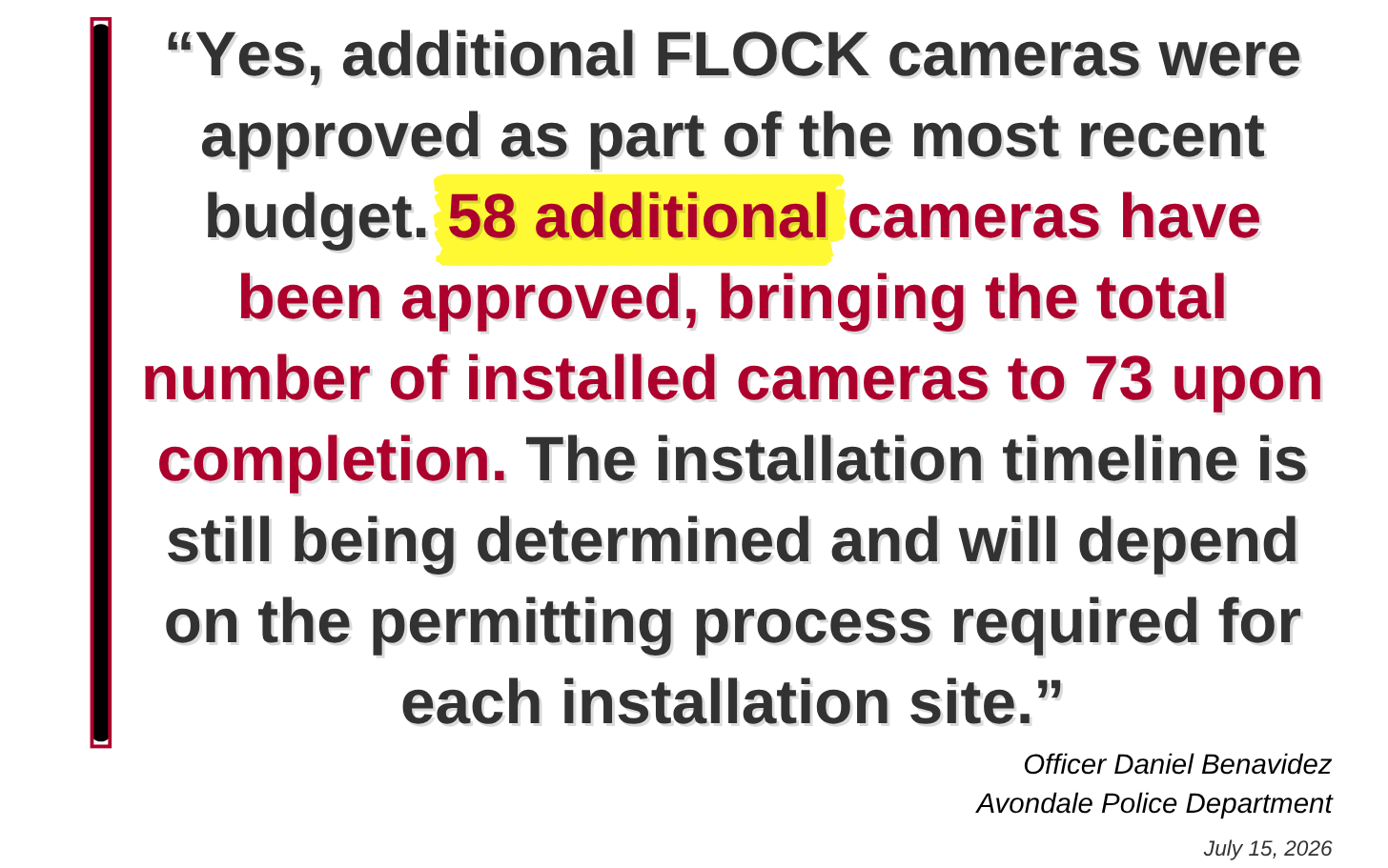
During a March 2, 2026, council presentation outlining the department’s priorities for the upcoming budget, police included the Flock expansion alongside other technology initiatives, including AI-assisted report writing software and a Drone as First Responder program.
“We’re asking to expand the Flock camera system. These are our license plate readers,” Police Chief Memo Espinoza told council. “We use these license plate readers as an investigative tool. And that’s the only reason we use ‘em for.”
From Avondale to Scottsdale, my reporting has documented how local camera systems have become part of a much larger interconnected surveillance network spanning at least 59 Arizona law enforcement and related agencies, including city police departments, county sheriff's offices, tribal and campus police, the Arizona Department of Public Safety, and the Pinal County Attorney's Office.
In this August 2025 interview with Flock Safety, Scottsdale Police said its Real-Time Crime Center had access to more than 6,000 cameras through partnerships and was connected with 12 other Real-Time Crime Centers, a regional network officials expected to grow to nearly 20 law enforcement agencies by the end of the year.
“Then we have homeowners associations that have also purchased Flock Safety license plate reader (LPR) cameras, plus cameras in churches, malls and schools, among others. So, when we need to check into a new incident scene to advise responding officers what is happening there, we have the coverage and the RTCC infrastructure to accurately advise them what is happening there and what to expect when they arrive, in real-time,” reportedly stated by SPD RTCC Supervisor Chris Henningsen.
Police1.com Report | January 16, 2024
How Public Awareness Changed the Debate
Langley is correct about one thing. Much of the public scrutiny is new.
But the cameras aren’t.
The issue was never whether these decisions were legal. It was whether the public had a meaningful chance to weigh in before they were made.
Across Arizona, the same pattern emerged. Public debate followed the decisions that brought Flock into communities, not the other way around.
That’s the context missing from Langley’s “one year ago” remark.
Langley has suggested the backlash is driven by broader concerns about the federal government. But Arizona’s public record tells a more local story.
On a wider scale across the country, citizens are showing up to city council meetings, questioning contracts, challenging grant funding, and scrutinizing budget decisions made in their own communities. A shift in Arizona I’ve been documenting for more than a year.
The question isn’t why residents are speaking up now. It’s why, in so many communities, the public conversation began only after the cameras were already there.
Jen’s Two Cents.
Earlier this year, State Senator Jake Hoffman (R-LD15) introduced a striker amendment to HB 2917 which would have required local governments to notify residents, hold public hearings, and obtain voter approval before establishing a government mass surveillance network, including automated license plate reader systems.

The proposal also included limits on data retention and restrictions on surveillance near constitutionally protected activities.
As I reported earlier this week, State Senator John Kavanagh (R-LD3) invited constituents to submit ideas for legislation they’d like to see introduced during the 2027 legislative session.
“If I think the bill is good policy, and I think I can get the bill passed, I’m more than happy to introduce legislation that constituents want. Even non-constituents. If it’s a good bill, let’s get it into the system.”
I suggested Arizona lawmakers introduce legislation banning AI-powered mass vehicle surveillance and automated license plate reader systems.
Today, State Senator John Kavanagh responded:

