

Flock Around: What Arizonans Are Finding Out
Not every camera is tracking you the same way. Here's how the most common surveillance systems in Arizona actually work.
As more and more Arizonans begin learning about Flock Safety cameras, this seems like a good time to answer some of the questions I’m seeing across social media.
If you’re new here, I’m Jen Barber, an independent journalist. For the past several years, I’ve been investigating the rollout of automated license plate reader (ALPR) systems across the state, using public records to uncover how the technology was introduced, expanded, and approved in Arizona communities.
Along the way, I’ve reviewed thousands of pages of emails, contracts, invoices, and internal government records, attended public meetings, interviewed experts, and even obtained the records my own local government maintained about my vehicle’s travel history. That reporting has given me a firsthand look at how these systems operate… and how little many communities know about them before they’re installed.
My goal isn’t to tell you what to think. It’s to explain how these systems work, document how they’re being used in Arizona, and give you the information you need to ask informed questions about the cameras in your own community.
So, let’s break it down.
The Different Types of License Plate Readers
For most Arizonans, "license plate reader" means one thing: the bright flash from a speed camera… and the expensive surprise ticket that arrives in the mail a few weeks later.
But that’s only one piece of a much bigger picture.
Today’s surveillance networks include traffic enforcement cameras, investigative license plate readers, live video cameras, and even drone-mounted systems. They don’t all do the same thing. Understanding the difference is the first step toward understanding what technology may be watching your community.
If you live in Arizona, these are the surveillance systems you're most likely to encounter… on the road, at intersections, and even from the air.
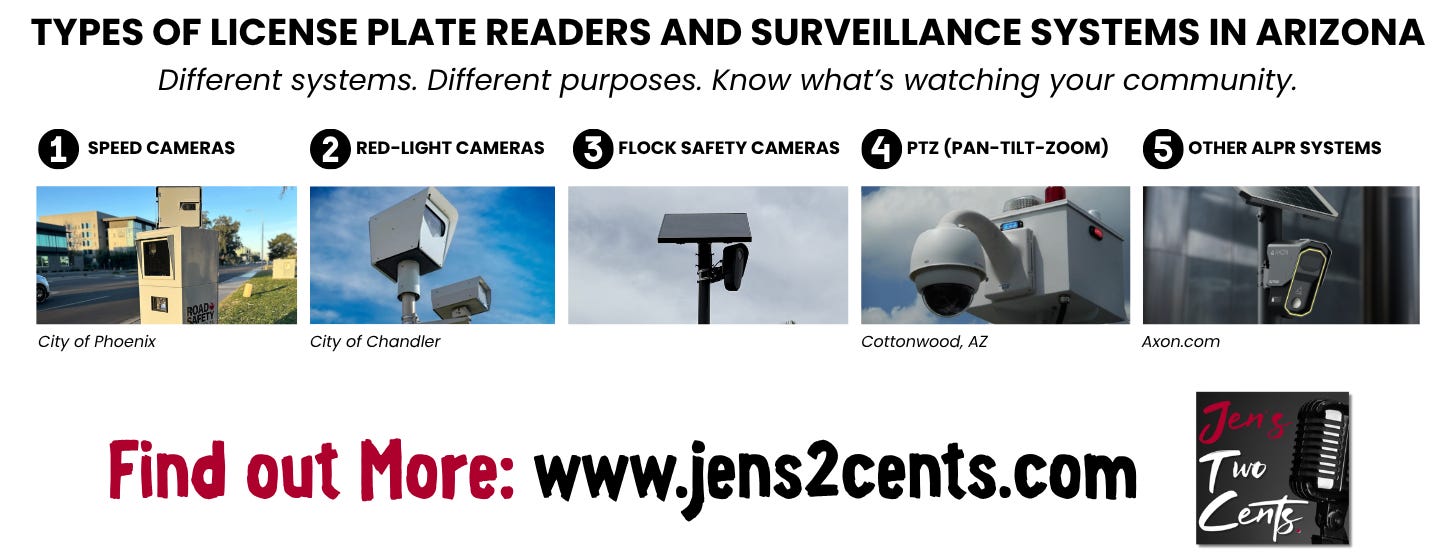
1. Speed Cameras
These cameras automatically photograph vehicles traveling above the posted speed limit. In Arizona, enforcement typically begins when a driver exceeds the speed limit by more than 11 mph. The system captures images of the vehicle and license plate, and if a violation is confirmed, a citation may be mailed to the registered owner.
2. Red-Light Cameras
Red-light cameras monitor intersections and photograph vehicles that enter an intersection after the traffic signal has turned red. Most systems capture multiple images to document the violation before a citation is issued.
3. Flock Safety Cameras
These are the cameras generating the most attention in Arizona today. Flock Safety cameras are automated license plate readers (ALPRs) designed primarily as investigative tools rather than traffic enforcement devices. They continuously scan passing vehicles, recording information such as the license plate number, time, date, location, and characteristics of the vehicle… including its make, model, color, and other identifying features. Officers can later search this information to assist criminal investigations or receive alerts for vehicles on agency hot lists.
4. PTZ (Pan-Tilt-Zoom) Cameras
PTZ cameras are not license plate readers, but they are increasingly deployed alongside ALPR systems. They provide live video that operators can remotely pan, tilt, and zoom to monitor intersections, public spaces, or incidents in real time. Some PTZ cameras can be integrated with ALPR systems so officers can view both the license plate data and live video from the same location.
5. Other ALPR Systems
Flock isn’t the only company in this space. Other manufacturers - including Axon, Motorola Solutions, Rekor, and others - also offer automated license plate reader technology. Some systems are mounted on patrol cars, while others are fixed to poles, trailers, or existing infrastructure. Many agencies also integrate ALPR data with body cameras, in-car cameras, real-time crime centers, or other investigative platforms.
And It’s Not Just Cameras on Poles...
License plate reading technology continues to evolve. Today, some systems can be mounted on patrol vehicles, trailers, portable units, and even drones. Demonstrations have shown that high-powered aerial cameras can identify license plates from significant distances under the right conditions, allowing agencies to collect information from perspectives that weren’t possible just a few years ago.
My investigations find that, depending on where you drive in Arizona, images and records associated with your vehicle may remain in government databases anywhere from two weeks to up to one year, depending on the agency, the technology being used, and that agency's retention policy.
Who Owns the Data? Can You Access It?
One of the biggest misconceptions I’ve seen on social media is about who actually owns the data collected by license plate readers… and whether you can obtain it through a public records request.
Based on the contracts I’ve reviewed from Arizona cities, government agencies generally retain ownership and control of the data generated by license plate readers they own or operate on public roadways. In many Flock Safety agreements, the contract specifies that the law enforcement agency - not Flock Safety - owns its data.
That matters because records maintained by a government agency may be subject to Arizona’s Public Records Law, unless a specific exemption applies. In other words, if a city police department owns the cameras and maintains the records, members of the public can often request those records, although agencies may lawfully redact or withhold certain information depending on the circumstances.
Private cameras are different.
If a Flock camera is installed by a private business, homeowners association, or other private property owner, those records are generally not subject to Arizona’s public records law because they are not government records. However, if a government agency obtains copies of those records as part of an investigation, different legal questions may apply depending on what records the agency possesses.
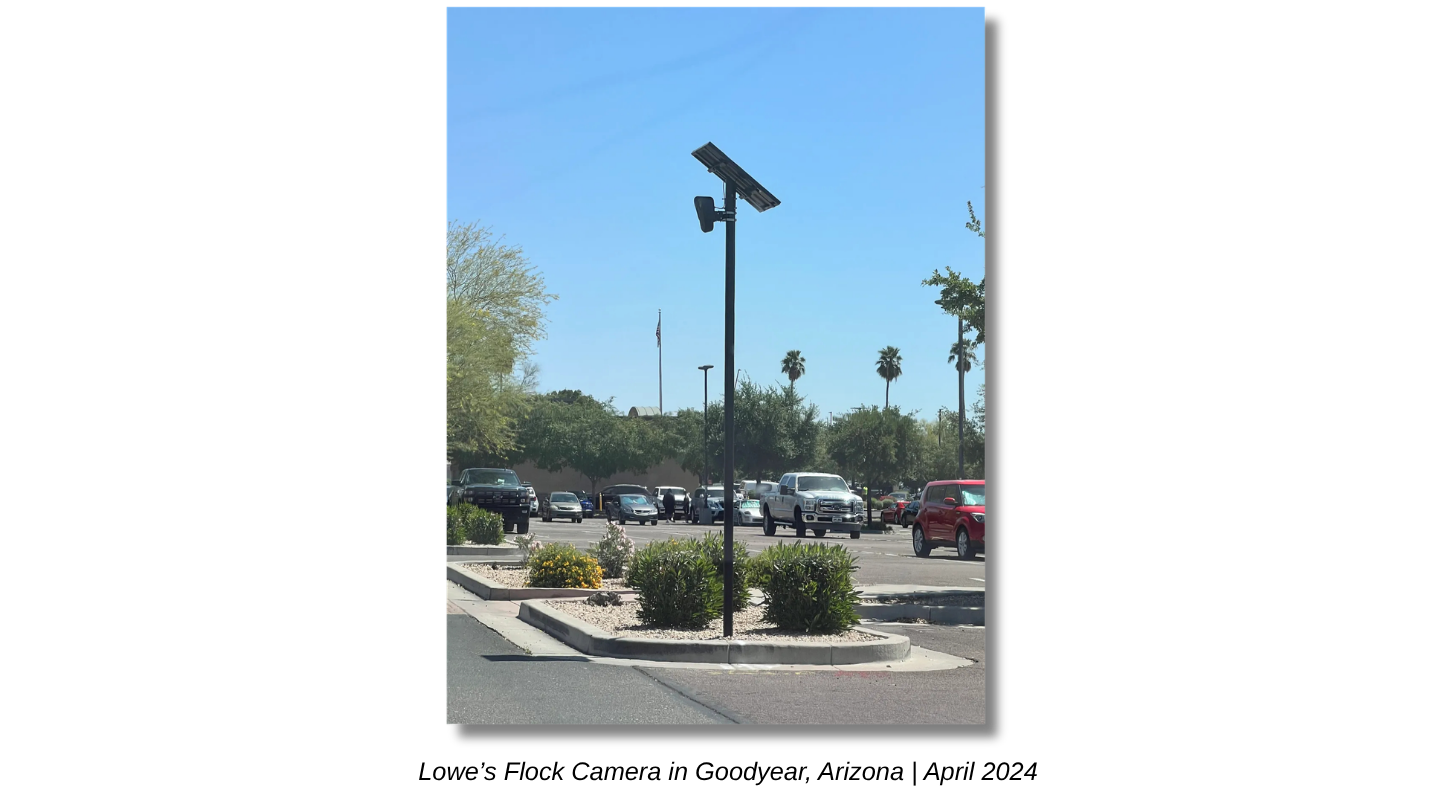
Understanding who owns the camera—and who controls the data—is one of the most important questions you can ask. It often determines what records the public can access and what remains outside the reach of public records laws.
Rule of thumb:
Government-owned camera = records may be subject to Arizona's Public Records Law.
Privately owned camera = records generally are not public unless they later become government records.
Note: Ownership and access are not the same thing. While many Flock contracts state that the law enforcement agency owns its data, the agreements may also authorize Flock to access or process certain information to operate the platform, provide customer support, monitor performance, or improve its products. Those provisions are separate from the question of who legally owns the records.
Dig Deeper
I’ve spent the past several years investigating license plate readers, surveillance technology, and public records in Arizona. If you’d like to go beyond this guide, here are a few places to start.
🎥 Featured Investigations
How I Obtained My Own Government Travel History
What my local records request revealed about where my vehicle had been—and what records were being kept.One Records Request. More Than 700 Photos.
An Arizona woman’s public records request returned more than 700 government images of her vehicle.The Flock Records Policy That Quietly Spread Across Arizona
How a single policy limiting access to Flock-related public records appeared in multiple Arizona agencies and proposed legislation.How Many Times Are Police Searching Flock?
Public records reveal the scale of Flock searches conducted by Arizona law enforcement—and beyond.Surveillance Is Shrinking: The Miniaturization of License Plate Readers
How ALPR technology has evolved from large roadside cameras to smaller, more discreet systems mounted on poles, patrol vehicles, trailers, and even drones.Beyond the License Plate
How modern cameras capture vehicle fingerprints—and how public social media posts can sometimes help connect a vehicle to its owner.Cash Cows or Public Safety?
An investigation into the business of photo radar and the fight over its future in Arizona.
Want to learn more? This guide only scratches the surface. Feel free to explore my Substack and YouTube channel, where you'll find in-depth investigations, public records, expert interviews, and city meeting coverage documenting how license plate readers and surveillance technology are being deployed across Arizona. I encourage you to review the evidence for yourself and reach your own conclusions.
Resources
If you’re looking for the best place to learn more about license plate readers and surveillance issues in Arizona, I highly recommend Live Free AZ.
The site is dedicated to helping Arizona residents understand surveillance technology, navigate public records requests, organize locally, and stay informed about developments in communities across the state. Whether you’re just starting to ask questions or are already digging into records yourself, it’s an excellent place to begin.
Know Something?
Are Flock cameras or other ALPR’s being installed in your city? Have you obtained public records or attended a Council meeting? I’d love to hear from you. If you’re willing to share documents or tips, please get in touch.
Jen’s Two Cents
Even though I’ve been following the rollout of license plate readers and surveillance legislation in Arizona for several years, what has inspired me most are the everyday residents asking tough questions about how these systems ended up in their communities.
From Sandy in Sedona, to the countless hours of public meetings in Flagstaff and Sierra Vista, to residents across Arizona filing public records requests and speaking before their local councils, the demand for transparency has grown dramatically over the past year. I’ve had the privilege of documenting many of those stories.
And the work isn’t finished.
Just last weekend, residents in Cottonwood packed a library meeting room after questions were raised about an $826,055 surveillance equipment purchase that included Flock and Axon technology. According to organizers, the item was approved as part of a consent agenda in just a few minutes, prompting renewed calls for a dedicated public discussion.
Questions are also emerging in another Arizona community, where an August 6, 2026 Town Council agenda item seeking approval of opioid settlement funds also requests authorization for unspecified police “equipment and software”—without identifying the vendor, the equipment being purchased, or its intended use in the public agenda materials.
This isn’t just an Arizona conversation.
➡️ In Pensacola, Florida, officials are now debating whether opioid settlement dollars should be used to purchase Flock Safety license plate readers after residents raised similar concerns, according to this video. The discussion has reportedly prompted council members to consider tighter controls on how those funds can be spent.
👀 Watch the short:
🚨 Worth noting: The FY2027 Arizona Nonprofit Security Grant Program once again prohibits grant funding for License Plate Reader (LPR) systems. It's the same restriction I first reported on last year in "Border Security to Mass Surveillance," and it remains in place for FY2027.

Meanwhile, in another Arizona city, my investigation has uncovered more than 550 pages of public records documenting the planning, procurement, and expansion of that city’s Flock Safety program. The records include emails, contracts, invoices, procurement documents, and internal communications discussing procurement, Council approval, and the timing of public presentations giving residents a much clearer picture of how the program developed.
One thing has become increasingly clear:
Arizonans are paying attention.
People are reading agendas. They’re filing public records requests. They’re attending City Council meetings. And they’re asking informed questions about surveillance technology before it’s installed… not after.
If similar questions are being asked in your community, I’d be happy to help tell your city’s story. Many of the answers are already available in public records, Council agendas, and documents available to anyone willing to look.